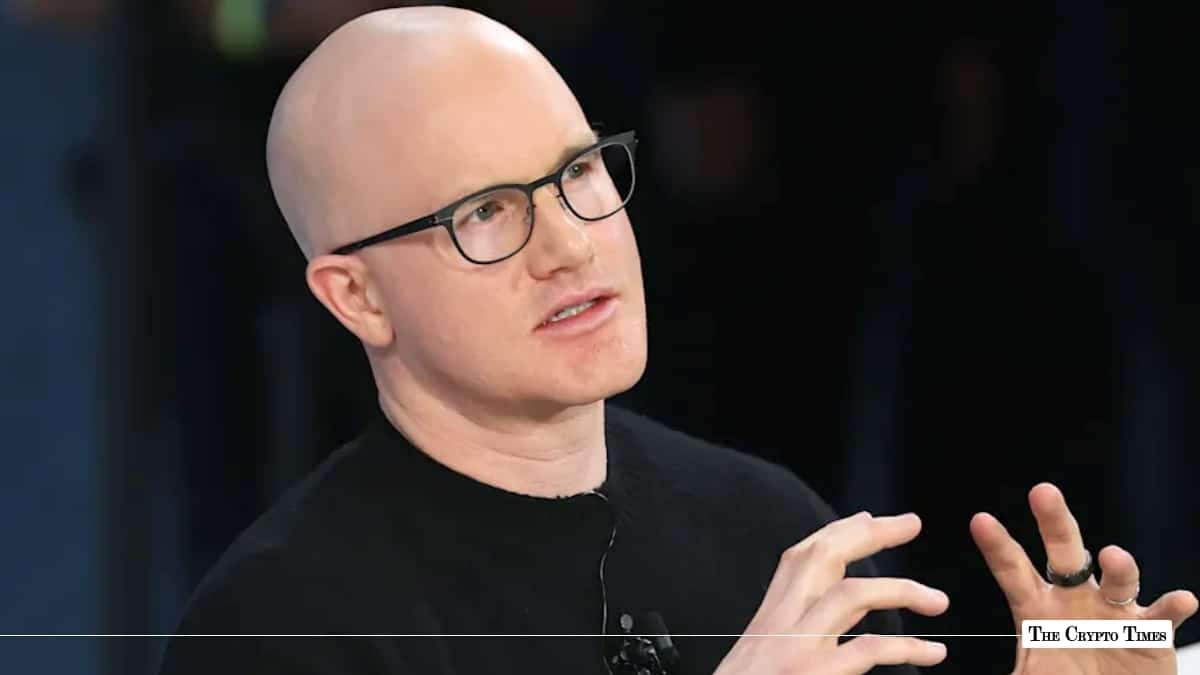
Coinbase Chief Executive Officer (CEO) Brian Armstrong said $400,000 remains a realistic long-term level for Bitcoin by 2030, repeating a range he first set out last month and scaling back a far higher target he published a year earlier.
In a CNBC Squawk Box Asia interview published September 10, 2026, Armstrong described $400,000 by 2030 as a “reasonable target.” He also said the most recent Bitcoin cycle had already found a bottom and pointed to pressure in global bond markets as a possible source of demand. The appearance followed his comments on the Digital Asset Market Clarity Act and the prospect of clearer U.S. rules for digital assets.
Armstrong first paired the $300,000 and $400,000 figures on Fox Business Network’s Varney & Co. on August 20, 2026. On that program he said: “I think over the next couple of years — if I say 2030 — I think it’s very likely we’ll see $300,000 and $400,000 Bitcoin and we’ll see how it goes.” He tied the outlook to a White House meeting with regulators and to what he called urgency around completing the Clarity Act.
How Armstrong’s 2030 targets have changed
Armstrong’s public 2030 forecasts have moved lower over the past year. On August 20, 2025, he wrote on X: “I think we’ll see $1M per bitcoin by 2030,” citing emerging U.S. regulatory clarity, a government Bitcoin reserve, and growing interest in crypto exchange-traded products. He added that the comment was not financial advice and that outcomes cannot be guaranteed.
He restated a similar $1 million figure on September 24, 2025, writing: “I think Bitcoin could reach $1M by ~2030 based on current conditions and progress. Think long-term.”
The 2026 interviews replace that $1 million level with a $300,000–$400,000 range. Armstrong has not published a detailed model showing why the figure changed. In the August Fox Business segment he linked the newer range to regulation, institutional participation, and Bitcoin’s fixed supply rather than to a new valuation formula.
What the later interviews emphasized
On Fox Business, Armstrong said Bitcoin spot trading had spent about a year in a downturn and that prior bear phases lasted roughly 370 to 380 days. He also said October through December have often been stronger months after Bitcoin halvings. Coinbase, he noted, now draws only about 12 percent of revenue from Bitcoin spot trading, with other lines including derivatives, prediction markets, stablecoin payments, and tokenized assets.
On CNBC this week he said the industry would get more regulatory definition either if the Clarity Act passes or if the Securities and Exchange Commission and Commodity Futures Trading Commission issue rules if the bill fails. He presented that outcome as separate from the price forecast but part of the same policy backdrop.
Armstrong’s comments are statements of opinion by the chief executive of a public crypto exchange. They are not guarantees of future prices. Bitcoin’s path to any 2030 level would still depend on demand, regulation, liquidity, and broader financial conditions. Armstrong has consistently described his figures as long-term views with wide uncertainty, a point he made explicit when he first published the $1 million target on X.
At the time of publishing (8:00 AM UTC), BTC was trading near $78,100, up 22% in the last month—as per CoinGecko data.
Wall Street’s 2030 range for Bitcoin price
ARK Invest has published one of the most detailed public 2030 Bitcoin models. In its valuation note, the firm set bear, base, and bull cases of about $300,000, $710,000, and $1.5 million per Bitcoin, based on assumed penetration of institutional portfolios, store-of-value demand, and other capital sources.
ARK later said the composition of demand had shifted—stablecoins took some of the emerging-market role it once assigned to Bitcoin—and it trimmed the bull case, while still treating a mid-six-figure outcome as its core 2030 framework.
Chief Executive Officer Cathie Wood has separately described a base case near $730,000 and said the firm’s conviction rose even as prices fell. Those figures sit above Armstrong’s $300,000–$400,000 range but share the same decade horizon and the same emphasis on institutions and digital gold.
Wall Street research has clustered closer to Armstrong’s band on a slightly different calendar. Bernstein analysts led by Gautam Chhugani, in an August 26, 2026 client note widely reported by MarketWatch, used a four-year cycle and miner cost framework to put a base-case peak near $300,000 by the end of 2029, with a bull case as high as $500,000 that year and a longer $1 million target for 2033.
Standard Chartered’s Geoffrey Kendrick, after cutting nearer-term targets, kept a $500,000 Bitcoin destination and moved that date to 2030, with an interim path that included $300,000 in 2028 and $400,000 in 2029. Both houses treat currency debasement, ETF holders, and scarce supply as the main drivers. Like Armstrong’s interviews, these are research opinions, not guarantees, and they have been revised when prices or adoption lagged earlier assumptions.
Also read: XMR Price Prediction for September 2026: Can Monero Clear $550?