
Key Highlights
- Bitcoin fell to about $78,500 at 15:06 UTC, reversing an earlier move to an intraday high near $79,742.
- The U.S. Treasury will buy back up to $6 billion of 10-to-20-year securities on September 10, triple the size of its previous operation in that maturity sector.
- The benchmark 10-year Treasury yield reached 4.8528%, its highest since November 2023, while the 30-year yield moved back above 5.3%.
Bitcoin (BTC) gave up its earlier Wednesday gains as U.S. Treasury yields moved higher following details of the government’s first expanded long-duration debt buyback.
Bitcoin was trading around $78,500 at 15:06 UTC on September 9, after trading near $79,600 shortly before the announcement. BTC had reached an intraday high of approximately $79,742, while its latest 24-hour low was around $77,600.
The reversal came after the U.S. Treasury said it would purchase up to $6 billion of outstanding 10-to-20-year Treasury securities during Thursday’s liquidity-support buyback. The amount is three times the $2 billion maximum used in the previous operation for the same maturity sector.
Treasury’s $6 Billion Buyback Fails to Push Yields Lower
The Treasury had already announced in August that it would at least double long-end buybacks from $2 billion to at least $4 billion per operation beginning in September.
Wednesday provided the first indication of how far above that minimum the Treasury was prepared to go. The $6 billion maximum was above the previously announced floor, but some bond-market participants had expected a still larger operation. Estimates ahead of the announcement extended as high as $8 billion to $10 billion.
Instead of falling, yields climbed after the announcement. The benchmark 10-year Treasury yield reached 4.8528%, its highest level since November 2023, while the 30-year yield moved above 5.3%.
The Treasury is buying older and relatively less-liquid securities as part of its liquidity-support program rather than conducting monetary stimulus. The September 10 operation is scheduled for 17:40 to 18:00 UTC, with settlement on September 11.
Bitcoin Reverses Earlier Treasury Buyback Trade
Bitcoin’s reaction contrasts with what happened when the larger buyback program was first announced on August 19.
At the time, long-term Treasury yields fell and Bitcoin accelerated from the mid-$60,000 range. BTC subsequently climbed above $72,000 as short positions were liquidated, extending a rally that eventually carried the cryptocurrency toward $80,000. Bitcoin’s rally after the initial Treasury buyback expansion
The relationship works in the opposite direction when yields rise. Higher Treasury yields increase the return available on government debt and can tighten financial conditions, raising the relative opportunity cost of holding non-yielding assets such as Bitcoin.
Bitcoin Breaks Below Key Intraday Averages as Selling Accelerates
Bitcoin’s reversal became more pronounced after the Treasury announcement, with the 15-minute chart showing two distinct legs lower.
BTC had recovered to around $79,600 shortly before 14:00 UTC on September 9, but the rebound failed near its earlier session highs. The price then slipped below $79,200 before briefly stabilizing around the $78,900-$79,000 area.
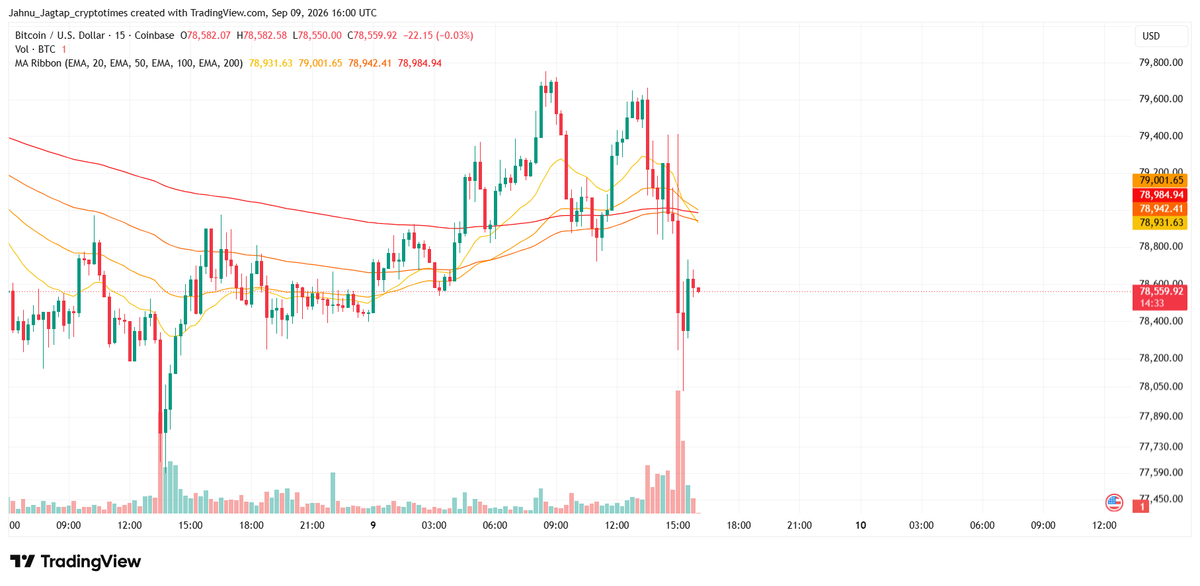
The sharper move came around 15:00 UTC, when Bitcoin broke below a cluster of closely packed exponential moving averages. At the time, the 20-period EMA stood at $78,931.63, the 50-period EMA at $79,001.65, the 100-period EMA at $78,942.41 and the 200-period EMA at $78,984.94, according to the 15-minute Coinbase chart.
Once BTC lost that roughly $78,930-$79,000 technical zone, selling accelerated. Bitcoin briefly traded below $78,000 during the initial downside wick before rebounding toward $78,600.
The breakdown was accompanied by the largest volume spike visible on the chart during the session, indicating that the move below the moving-average cluster came with a sharp increase in trading activity rather than a gradual drift lower.
By 16:00 UTC, Bitcoin was trading at $78,559.92, leaving it roughly $370 to $440 below all four plotted exponential moving averages. That kept the short-term price structure weaker even after BTC recovered from the initial selloff.
Bitcoin’s next test now comes from the Treasury’s September 10 buyback operation and fresh U.S. inflation data. The August PPI report is due September 10, followed by CPI on September 11, giving traders two more readings on inflation before the Federal Reserve’s September 15–16 policy meeting. With Treasury yields already moving higher, any further repricing in rates could remain an important driver for Bitcoin after Wednesday’s sharp reversal.
Also Read: Bitcoin Price Near $79K: On-Chain Structure Builds but Spot Demand Remains Soft