Key Highlights
- Executive Director P. Vasudevan highlighted legal uncertainty, data privacy, liquidity, interoperability, and concentration risks in tokenization.
- Vasudevan said multiple tokenization platforms must be able to work together, building on India’s successful payments interoperability.
- Higher transaction speeds and leverage could create financial stability and risk-management challenges.
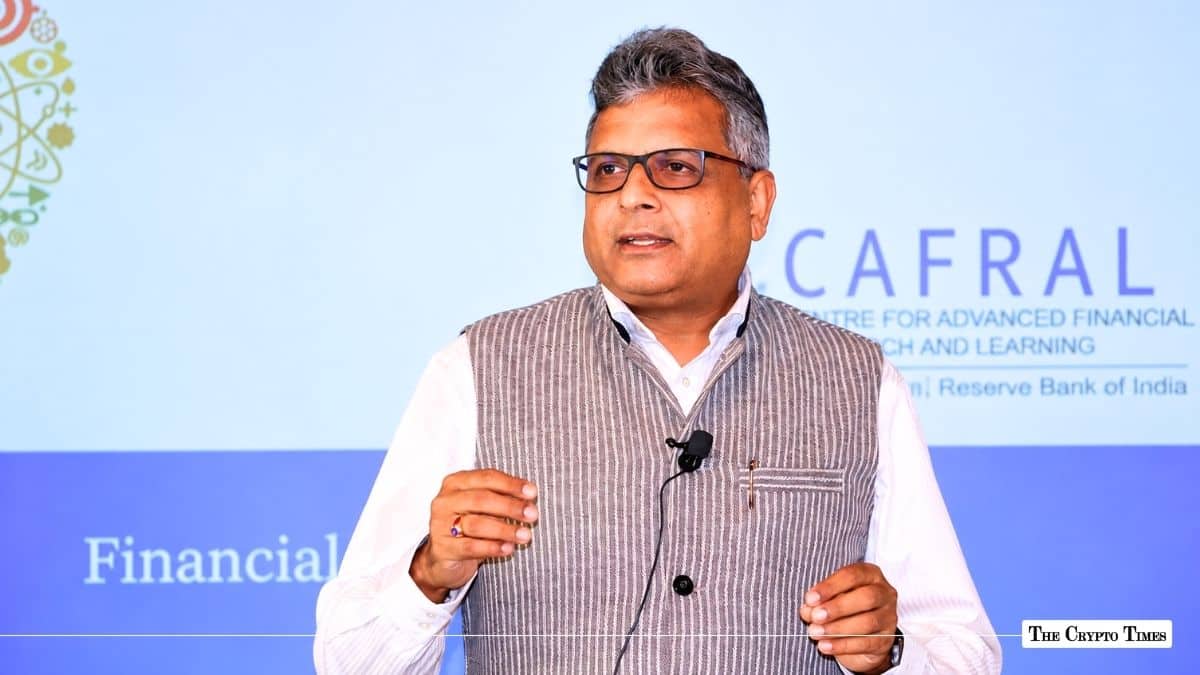
Reserve Bank of India executive director P. Vasudevan said on Wednesday that legal uncertainty, data privacy, liquidity, interoperability, and the risk of excessive concentration could pose significant challenges as India expands tokenization of financial assets.
Speaking during a fireside chat on tokenization of financial assets at the Global Fintech Fest 2026, Vasudevan listed several issues that require attention. “Initial costs are there. There are issues of legal clarity, legal certainty, data privacy, data movement, and consent management; those are some challenges. So, we need to be mindful,” he said.
Tokenization involves representing an asset’s ownership and transaction records digitally on a blockchain or distributed ledger.
Interoperability and platform risks
Vasudevan identified the need to avoid fragmented or concentrated tokenization platforms as another key challenge. “If there are two or three platforms doing similar things, how do we actually make them interoperable?” he asked. He noted that interoperability has been one of the success stories of India’s payments ecosystem and should not be lost in the move toward tokenized assets.
He also addressed the effects of faster transaction speeds and higher leverage. “If you increase the leverage, and it involves issues of risk or stability, you have to be looking at that,” Vasudevan said. “In some situations, if money moves too fast, and if you are not able to stop it somewhere, that again could be an element.”
Existing market intermediaries would need to be reimagined rather than eliminated, according to Vasudevan. Depositories, custodians, clearing corporations, and exchanges could evolve into token service providers or offer tokenization as a service.
Testing and expansion plans
The RBI has tested tokenization through its Unified Markets Interface. About 248 certificate-of-deposit transactions worth ₹17,000 crore have been processed so far, Vasudevan said. Roughly two-thirds of these occurred in the secondary market.
He stated that tokenization can cover the entire lifecycle of an asset, including issuance, trading, settlement, interest payments and servicing. The RBI is studying broader applications such as bank-deposit tokenization. Markets in Europe, the UK, the US and Asia are experimenting with similar models, he said, while noting that regulatory and financial-stability implications must be considered. Tokenization of gold is also being examined overseas.
Vasudevan said the RBI is looking to expand the number of asset classes that can be tokenized. “Tokenization is for the future,” he said, adding that its expansion requires both optimism and caution.
Separately, the Securities and Exchange Board of India’s annual report for 2025-26 listed a pilot project on the tokenization of corporate bonds using distributed ledger technology among its priorities for 2026-27.
Also Read: Consensys Splits Into Two Companies as MetaMask Goes Independent