Monero (XMR) entered mid-September 2026 near $514.89, up 2.2% in the past 24 hours on September 10 (7:00 AM UTC) with daily trading range falling between $505.66 and $517.76—as per CoinGecko data.
The privacy coin remains far above its rising moving averages: the 20-day EMA at $489.27, the 50-day at $439.60, the 100-day at $405.03 and the 200-day at $384.28—as shown in TradingView’s year-to-date (YTD) chart. That alignment keeps the medium-term trend constructive even as price cools from a brief test of the $550 area.
Live trackers show Monero’s market capitalization is near $9.6 billion, leaving XMR inside the upper ranks of large-cap crypto assets. The January 2026 peak of $797.73 remains the dominant overhead reference, meaning XMR is still about 35% below that high.
The September question is narrow: does the July–September advance resolve as a confirmed breakout, or as a stall under $550? Daily RSI has eased from overbought territory above 70 to about 61.5, which is consistent with digestion rather than a completed trend reversal.
Technical Setup and the $550 Decision Level
The daily chart shows a long base through the first half of 2026, repeated tests of the $275–$300 region, then a persistent climb that carried price through every major EMA.
Independent technician @TehLamboXcharts framed that structure in early September as a completed double bottom with a formed neckline and an expected retest. The level the account highlighted was $550. A hold after the retest, the analysis said, would make $800 more realistic; a failure would risk turning recent short positions into forced buying rather than producing an immediate collapse. An earlier August note from the same desk pointed to a $475 neckline and argued that a breakout-and-hold would put $800 “very real.”
Current price action sits inside that map. XMR reached the $550 zone, paused, and is now working a shallow pullback while still printing higher lows on the larger swing. First support is the 20-day EMA near $489. A daily close below that line would be the earliest warning that September momentum is fading. Next supports are the 50-day EMA around $440 and the $400–$405 band around the 100-day average. Those levels separate a normal pause from a deeper reset toward the summer range.
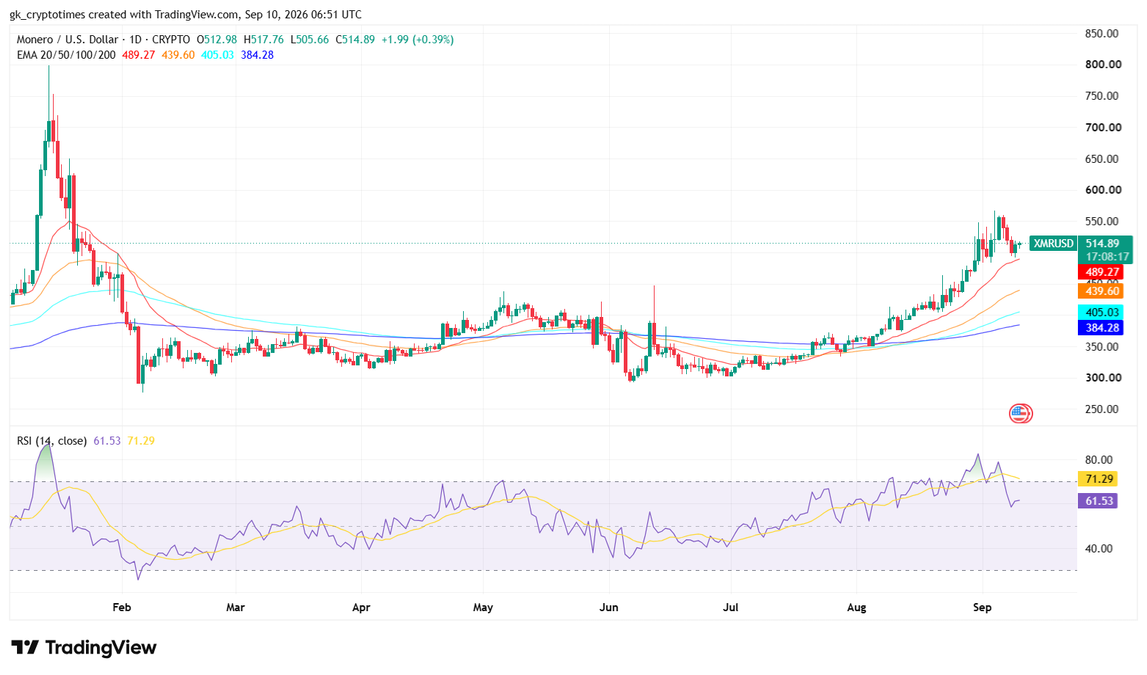
Resistance is stacked just overhead. $518–$535 is nearby supply. A decisive daily close and hold above $550 would validate the breakout case circulating among chart-focused accounts. Measured-move logic from the double-bottom structure points toward the prior high near $800, but that target depends on the neckline holding. Pattern targets fail often in crypto when Bitcoin volatility rises or sector rotation fades.
Monero’s Design, Delistings and the 2026 Contest With Zcash
Monero is a privacy-focused payments network in which concealment is the default rather than a setting. Its highly debatable comparison with Zcash is best read as two different products, not a single contest with one winner. Zcash uses zero-knowledge proofs and lets users choose shielded or transparent transactions; that optionality has helped it remain listed more widely and attract institutional attention during this year’s privacy-coin rally.
In late 2025, ZEC led the sector’s surge while Monero, Dash and other privacy assets also posted gains, with the broader privacy group outperforming much of the rest of the market. XMR still stands out for always-on privacy, but delistings have left it more dependent on remaining venues, peer-to-peer routes and holders who already have coins.
ZEC has taken a larger share of category value in 2026; Monero has advanced more slowly from a stronger default-privacy base. Which one matters more depends on whether the buyer prioritizes exchange access and optional disclosure, or mandatory privacy despite thinner regulated liquidity.
Read: Zcash vs. Monero: The 2026 Privacy Coin War Just Got Decided in One Week
Bull Case and Bear Case for the Rest of September
The bull case for XMR in September 2026 requires the $489–$505 zone to hold and price to reclaim $535, then $550, on expanding volume. If that sequence occurs, short covering and continued interest in privacy coins could open $600 first, then $680–$800 if the move extends into month-end. That path assumes the higher-low sequence from July stays intact and that RSI can reset without breaking the EMA stack. It matches the conditional $800 objective outlined by the early-September technical commentary, not a promise of a straight line higher.
The bear case begins with a loss of the 20-day EMA and a failure to recapture $518. A slide toward $440–$405 would not automatically end the larger uptrend, but it would delay any $550 breakout and pressure traders who bought the recent spike. A break of $400 would reopen the mid-year range and put the $300 support zone back in view. That outcome would look like a failed breakout rather than a new bear market by itself, yet it would invalidate the more aggressive September targets.
Neither path is certain. XMR’s daily structure remains constructive above a rising EMA stack, but the coin is digesting a sharp two-month rally and sitting under a clear $550 ceiling. For the rest of September 2026, $489 is the near-term support line and $550 is the level that decides whether the next impulse is higher. Exchange access, regulation and Bitcoin’s direction can still override the chart within days. This is market analysis, not investment advice.
Also read: XRP Price Prediction September 2026: Can XRP Break $1.50?