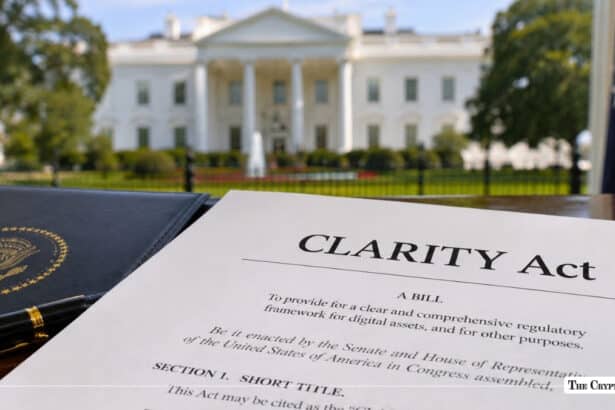
Crypto markets reversed a late-Monday bounce on Tuesday as traders marked down the odds of U.S. market-structure legislation advancing, just hours before a Senate procedural vote on the Digital Asset Market Clarity Act.
As per aggregated market data from CoinGecko, Bitcoin slipped from an overnight peak near $79,400–$79,600 into the mid-to-high $76,000s, Ethereum traded around $2,475–$2,480, and Solana hovered near $100–$101. XRP held closer to $1.40 and was relatively firmer than the large-cap pair.
Total crypto market capitalization sat near the $2.7 trillion range after giving back Monday’s lift, while equity index futures moved the other way—leaving the retreat a crypto-specific affair rather than a broad risk-off session.
All eyes on Clarity Act
The Senate is scheduled to vote at 2:15 p.m. Eastern Time on cloture on the motion to proceed to H.R. 3633. That is not a vote on final passage. It is a 60-vote test of whether debate can even begin. Republicans hold 53 seats, so several Democratic crossovers are required.
The House already passed a version of the bill 294–134 in July 2025. The Senate Banking Committee advanced its text 15–9 in May 2026.
Over the weekend, Republican sponsors released what they called a final draft incorporating more than 100 Democratic-requested changes, including ethics rules covering the president, vice president, members of Congress, judges and their spouses, a Treasury emergency brake on stablecoin rewards if community-bank deposits flee, and additional DeFi and validator language.
President Donald Trump publicly backed the revised package. Democrats then prepared a counteroffer. Banking groups and a coalition of state attorneys general kept pressing for tighter limits. Prediction-market odds that the bill becomes law in 2026 jumped toward 30–34% on Monday, then fell back to roughly 17–19% by Tuesday morning as the counteroffer news hit.
Positioning tightens as the vote clock runs down
Derivatives books show the market treating Tuesday as an event window rather than a trend day. CoinGlass data put aggregate crypto futures open interest near $135.5 billion, down about 1.1–1.2% over 24 hours, even as 24-hour futures volume jumped to about $204 billion, up roughly 45–49%. That mix—higher turnover, slightly lower open interest—points to existing positions being closed faster than new risk is added.
Bitcoin futures open interest was about $52.1 billion, down roughly 1.3% on the day. Ethereum open interest was near $32.8 billion and essentially flat. Solana and XRP open interest rose, to about $6.0 billion and $3.1 billion respectively.
Liquidations tell the same two-act story. Over the full 24-hour window, CoinGlass recorded $331 million in forced closures, up more than 70% from the prior day, with about 79,700 accounts liquidated. Shorts accounted for roughly $190 million and longs $148 million, reflecting Monday’s squeeze higher.
The largest single print was a Binance ETHUSDT order of about $9.19 million. Ethereum absorbed the biggest notional hit at around $130 million, followed by Bitcoin at about $85 million. In the most recent four hours, the tape flipped: $33.2 million liquidated, of which $30.3 million were longs as prices faded from the Monday high. The last hour was quiet at about $2.1 million.
Traders are also watching Wednesday’s Federal Reserve decision, where markets have priced a high probability of a 25 basis-point hike, and a rebound in oil toward $103 a barrel that has revived inflation-sensitivity concerns.
What a yes—or a no—would actually change
A successful cloture vote would not enact the Clarity Act. It would only open floor debate, after which amendments, a second vote, House reconciliation and a presidential signature would still stand between the industry and a statute that splits digital-asset oversight between the Securities and Exchange Commission and the Commodity Futures Trading Commission.
Failure would not invent a new regulatory regime overnight either; agencies would keep operating under existing enforcement tools. But the calendar is thin. The Senate has limited session days before the midterm recess, and analysts have treated a failed 60-vote test as a likely postponement into late 2026 or 2027 rather than a one-day shock.
Read: White House’s Patrick Witt Calls Bank ‘Deposit Flight’ Claim a Myth Ahead of Clarity Act Vote
That is why prices have tracked implied passage odds almost tick for tick. Monday’s rally priced the revised text and Trump’s ethics concession. Tuesday’s fade priced Democratic resistance, bank pushback and the recognition that enactment-this-year remains a minority outcome on prediction markets.
A surprise clearance of 60 votes is still not fully in the tape. A clean miss would confirm what the open-interest decline already hints at: leveraged books were lightening into the event, not building a directional bet that Washington would deliver market-structure certainty before the vote even started.
Also read: CLARITY Act: Democrats Send Counterproposal Hours Before Senate Cloture Vote