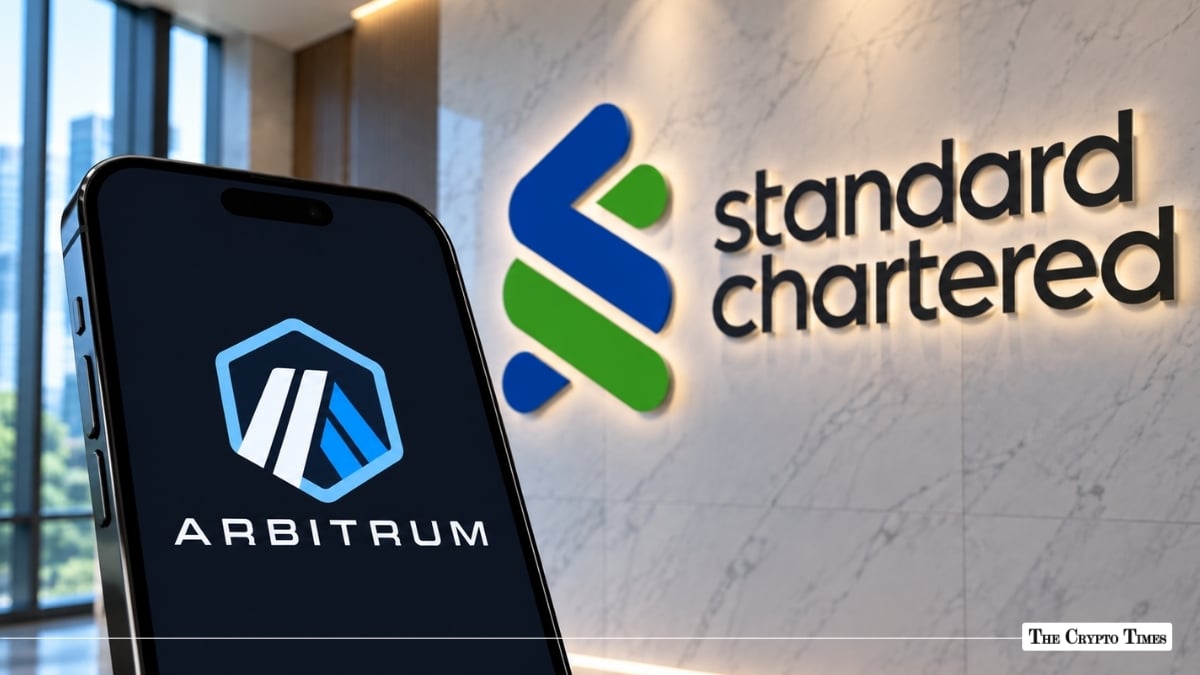
Standard Chartered sent clients a Global Research note on 15 September 2026 titled “Arbitrum – The blockchain for TradFi,” written by Geoff Kendrick, Global Head of Digital Assets Research.
Excerpts from the note were published the same morning by Brendan Ma, Head of Investment Strategy at the Arbitrum Foundation. The bank initiated coverage of the ARB token and described Arbitrum as having a “unique advantage” in supporting traditional finance firms that want to move activity on-chain.
The note is not a public prospectus. It is client research. Its forecasts are opinions, not guarantees. Standard Chartered PLC reported total assets of $993.4 billion at 30 June 2026.
Tokenized equity growth and Arbitrum’s stated role
Ma’s post said the note forecasts a 250x increase in the tokenized equity market by 2028. The same research also projects tokenised assets more broadly—stablecoins plus real-world assets—reaching $4 trillion by the end of 2028, from about $340 billion at the time of writing.
The bank’s case for Arbitrum rests on a specific business model. Unlike some other layer-2 networks, Arbitrum has a native token and an expansion programme under which other chains that use its technology stack pay a rolling fee equal to 10% of net protocol revenue. The note presents that arrangement as a way to “help TradFi operators move on-chain.”
The report names the July 2026 launch of Robinhood Chain, built on the Arbitrum stack, as the leading current example. It estimates that Arbitrum could receive about $5 million in expansion-programme fees in September at the then-current run rate, and that total monthly revenue had risen more than fivefold from levels before that launch.
Kendrick’s team also compared Arbitrum with other layer-2 networks on total value locked and total value secured. The note describes Arbitrum and Base as the two dominant layer-2 chains on those measures, while noting that Base does not yet have its own token.
Coverage initiation, price path and disclosed risks
The bank initiated coverage of ARB and published a year-end price path of $0.50 in 2026, $1.50 in 2027, $3.50 in 2028, $6.50 in 2029 and $10.00 in 2030. That $10 figure is about 70 times the $0.14 level cited in the note.
At the time of publication (12:30 PM UTC, September 15), ARB was trading at $0.1380 with a market capitalization of $916.38 million—as per CoinGecko data.
The research argues that markets currently assign Arbitrum a much lower market-cap-to-fees multiple than large layer-1 networks, even though fee-to-activity ratios look similar, and that the gap could narrow if tokenisation scales.
The note is explicit about limits. It states that the ARB token currently has no direct mechanism for accruing protocol value. It lists two main risks to the thesis: a slower-than-expected pace of asset tokenisation, and competition from other blockchains seeking the same TradFi flows.
Those caveats matter. Tokenised equities remain a small slice of on-chain assets. A large multiple from a low base is a forecast, not an observed trend. The 10% revenue share depends on other operators choosing the Arbitrum stack and generating net protocol revenue. Robinhood Chain is one data point, not a completed industry shift.
The research sits inside a wider Standard Chartered digital-assets programme that has covered Bitcoin, ether and tokenisation for several years. The Arbitrum note is the bank’s first dedicated initiation on this token. Readers should treat the price targets and the 250x equity-market figure as scenario analysis from one research desk, and weigh them against execution risk, token-value-accrual design, and competing chains.
Also read: Ethereum Q2 Revenue Jumps 112% as Active Addresses Fall 30%