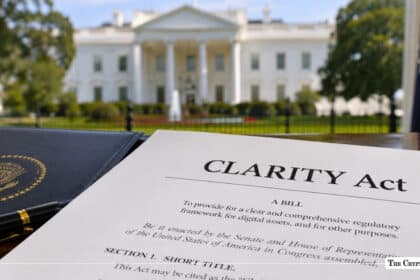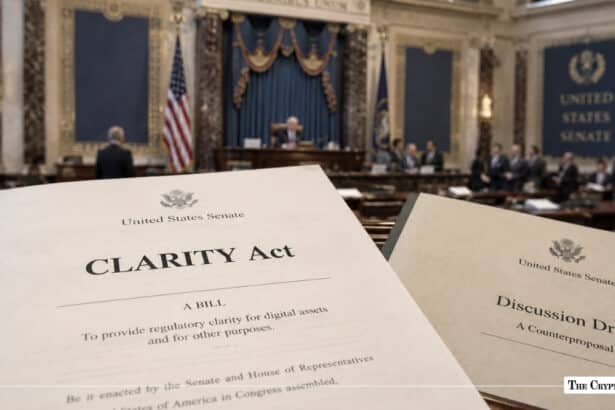
The United States Senate is scheduled to vote at 2:15 p.m. Eastern Time on Tuesday, September 15, 2026, on the motion to proceed to H.R. 3633, the Digital Asset Market Clarity Act, commonly known as the CLARITY Act. It is the first floor test for comprehensive United States crypto market-structure legislation since the House of Representatives passed the bill in July 2025.
The procedural step, called cloture, requires 60 votes in the 100-member chamber to end debate on the motion and allow the Senate to take up the bill. Cloture success would not enact the law. It would open the door to amendments, an eventual passage vote, and House concurrence on any Senate substitute.
What Is on the Floor
The CLARITY Act would divide federal oversight of digital assets between the Securities and Exchange Commission (SEC), the federal securities regulator, and the Commodity Futures Trading Commission (CFTC), the federal derivatives regulator.
Under the framework in the House-passed text, the CFTC would supervise spot trading of tokens treated as digital commodities on mature blockchains, while the SEC would keep authority over tokens that remain investment contracts. Payment stablecoins sit under a separate statute, the Guiding and Establishing National Innovation for U.S. Stablecoins Act (GENIUS Act), which President Donald Trump signed on July 18, 2025.
CLARITY is intended as the missing market-structure layer covering registration, exchange and broker standards, decentralized finance (DeFi) treatment, and ethics rules for officials who hold or sponsor crypto.
The Vote Math and the Calendar
Senate Majority Leader John Thune of South Dakota filed cloture on the motion to proceed on August 8, 2026, locking in the ripen date on the Senate’s official schedule. Republicans hold 53 seats. If the full conference votes yes, at least seven Democrats or independents are required.
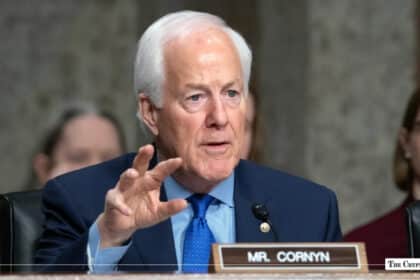
Sen. John Cornyn of Texas told Punchbowl News he is still considering how to vote. Sen. John Curtis of Utah said he will vote to proceed but is a no on final passage. Punchbowl also reported that Sen. Susan Collins of Maine is among seven Republicans who have raised community-bank concerns.
Vote-count analyses have flagged possible Republican defections, including Sen. John Cornyn of Texas on community-bank grounds, which would raise the number of Democratic crossover votes needed.
Even if cloture succeeds, the calendar is tight. The House of Representatives has canceled the weeks of September 21 and September 28 and is expected to leave Washington after September 17. The same House Financial Services Committee hearing Bessent on Tuesday is scheduled to mark up H.R. 8957, the American Reserve Modernization Act, at 10:00 a.m. ET on Wednesday. That markup is a separate bill and would not decide CLARITY. Crypto Times has laid out the arithmetic in this pre-vote count primer.
The Ethics Fight and the Overnight Counteroffer
Republican sponsors, led by Sens. Cynthia Lummis of Wyoming, John Boozman of Arkansas, and Tim Scott of South Carolina, released a substitute text late Sunday framed as their “last, best and final” offer to Democrats.
The office of Sen. Lummis said the text incorporates 126 substantive changes requested by Democratic negotiators over more than a year of talks. President Trump accepted expanded ethics language covering elected officials, judges, and spouses, and agreed to a state attorneys general enforcement role.
On Monday night, Senate Democrats sent a formal counterproposal to Republican negotiators, keeping talks alive hours before the cloture window. Sens. Mark Warner of Virginia and Adam Schiff of California have said the text still does not go far enough on the first family. Sen. Lummis said on X that “there is nothing left to give.”
A coalition of 18 state attorneys general, led by New York Attorney General Letitia James, urged a no vote over preemption language they say would limit state fraud cases, citing $11.4 billion in FBI-reported crypto losses in 2025. Crypto Times has covered the substitute release, the overnight counteroffer, and the pre-vote White House ethics meeting in detail.
Banks, the CEA Tool, and the Yield Question
Stablecoin-yield rules have been the second flashpoint. The White House Council of Economic Advisers first published its stablecoin-yield analysis in April 2026 and posted an updated FAQ on September 15, 2026, restating that an effective ban on stablecoin yield would have little effect on bank lending and that a household’s bank deposit is not destroyed when it buys a GENIUS-compliant stablecoin.
The latest CLARITY draft preserves transaction-based stablecoin rewards while giving the Secretary of the Treasury authority to restrict them if deposit flight becomes “detrimental.”
Eight banking trade groups, including the American Bankers Association and the Independent Community Bankers of America, wrote to Thune and Democratic Leader Chuck Schumer of New York on September 14 seeking tighter language. The groups said a circuit breaker that activates only after substantial deposit flight “is not a safeguard at all.” Treasury Secretary Scott Bessent has said he would use the authority if community banks were harmed, as Crypto Times reported.
Markets Around the Vote
Bitcoin was trading in a $76,800 to $77,500 band on Tuesday morning, giving back Monday’s bounce, as the United States 10-year Treasury yield printed above 5% and oil stayed elevated.
The Federal Open Market Committee (FOMC), the Federal Reserve’s rate-setting panel, delivers its rate decision on Wednesday. Treasury Secretary Scott Bessent is separately testifying before the House Financial Services Committee on Tuesday morning on the state of the international financial system. Corporate Bitcoin balance-sheet positions, led by Strategy at 845,050 BTC followed by Twenty One Capital and Japan’s Metaplanet at about 43,000 BTC each, would not be rewritten by the statute. A completed law could, over time, shape how auditors, lenders, and listing venues treat digital-asset treasuries under a statutory CFTC commodity status.
How the World Already Regulates
Cross-border platforms already face divergent rulebooks. The European Union’s Markets in Crypto-Assets Regulation (MiCA) is live. The crypto-asset service provider (CASP) grandfathering window closed on July 1, 2026.
The United Kingdom’s Financial Conduct Authority (FCA) application gateway is opening this month, with the wider perimeter set for October 2027. Hong Kong has begun licensing under its Stablecoins Ordinance.
Singapore continues to license digital payment token firms under the Payment Services Act. A United States statute would not automatically recognize those licenses. Crypto Times mapped the divergence in its MiCA cutoff coverage.
What It Means for Indian Investors
The CLARITY Act has no legal effect in India. The 30% tax on virtual digital asset income and 1% TDS under the Income-tax Act remain unchanged. India’s Standing Committee on Finance is separately scheduled to hear the Department of Economic Affairs on virtual digital assets on Wednesday, September 16, as Crypto Times reported.
What Settles Today, and What Does Not
Possible outcomes on the floor are narrow. Cloture is invoked and debate begins, cloture fails and the bill stays on the calendar without floor debate, or the vote proceeds while the Democratic counteroffer continues off the floor. Prediction markets priced 2026 enactment near 17% to 18% after the counteroffer landed, down from about 34% on Monday, a measure of trader views rather than a forecast.
A failed cloture vote would not repeal the House-passed 2025 bill. It would stall formal Senate consideration in this window and keep the dual SEC-CFTC compliance track that firms have built by default. The only number that settles today is whether 60 senators agree to begin debate. Everything after that, from amendments and House concurrence to a presidential signature and agency rulemaking, remains a later, separate sequence.
Also Read: US House Files 114-Page Crypto Tax Bill With $10 Fee Break Before Sept. 16 Vote