Crypto Times Logo Black
Google News Follow Banner
  • News
    • Market
    • Bitcoin
    • Ethereum
    • Altcoins
    • Regulations & Policies
    • DeFi News
    • Blockchain News
    • Industry
  • Exclusive
    ExclusiveShow More
    3D Liquid Network logo with a hooded hacker shadow and computer code overlays in the background
    Liquid Network Exploit Explained: Unbacked L-BTC and the $320M Peg-Out
    Clarity Act bill with a September 15 calendar and Senate chamber in the background.
    Can the Senate Pass the CLARITY Act on September 15? Here’s the Vote Math
    Simon Gerovich, CEO and President of Metaplanet
    Inside Metaplanet’s Floating Option Pool: How a 2023 Option Clause Followed Its Bitcoin Treasury Era
    Magnifying glass highlighting a red bug icon within broken code, flanked by metallic 3D logos for OpenAI and Anthropic
    OpenAI’s Astra and Anthropic’s Fable 5.1 Put Crypto Security in Focus
    Kevin Warsh, Chair of the Federal Reserve of the United States
    Bitcoin Falls Below $78K as Fed Hike Odds Jump to 56%: What Experts Say
  • Opinion
    OpinionShow More
    Jackson Hole 2026: Crypto Is No Longer Outside the Fed’s Door
    Jackson Hole 2026: Crypto Is No Longer Outside the Fed’s Door
    The Architecture of Trust Same Routes, New Risks in Global Tokenisation
    The Architecture of Trust: Same Routes, New Risks in Global Tokenisation
    The Architecture of Trust What 4,000 Years of Trade Teach Us About RWA Tokenisation
    The Architecture of Trust: What 4,000 Years of Trade Teach Us About RWA Tokenisation
    One P2P Trade, Months of Limbo Why Innocent Indian Crypto Users Keep Paying the Price
    One P2P Trade, Months of Limbo: Why Innocent Indian Crypto Users Keep Paying the Price
    CLARITY Act The Bill Exists, the Deal Does Not, Trump Has to Wait
    CLARITY Act: The Bill Exists, the Deal Does Not, Trump Has to Wait
  • Learn
    • Explained
    • How To
    • Insights
  • IndicesNew
    • India USDT Premium Index
    • India USDC Premium Index
  • Videos
  • More
    • About Us
    • Our Authors
    • Contact Us
    • Editorial Policy
    • Daily Crypto Puzzles
The Crypto TimesThe Crypto Times
  • All News
  • Market
  • Bitcoin
  • Ethereum
  • Altcoins
  • Regulations & Policies
  • Blockchain
  • DeFi
  • Industry
  • Exclusive
  • Opinion
Search
  • News
    • Market
    • Bitcoin
    • Ethereum
    • Altcoins
    • Regulations & Policies
    • Blockchain
    • DeFi
    • Industry
    • Exclusive
    • Opinion
  • Learn
    • Explained
    • How To
    • Insights
  • IndicesNew
    • India USDT Premium Index
    • India USDC Premium Index
  • Quick Links
    • About Us
    • Our Authors
    • Contact Us
    • Editorial Policy
    • AI Policy
    • Sponsored & Advertorial Policy
    • Daily Crypto Puzzles
  • Videos
  • Glossary
Follow US
© 2026 By Crypto Times. All Rights Reserved.
Market News

India’s ED Sharpens Crypto Crime Tracking Under New 18-Month Probe Plan

India’s Enforcement Directorate plans to cut economic crime investigation timelines to 18 months while expanding its focus on crypto, AI and cyber-forensics.

Written By Jalpa Bhavsar
Fact Checked by Dhara Chavda
Published 2026-09-16·Updated 1 day ago
Make The Crypto Times preferred on GoogleGoogle
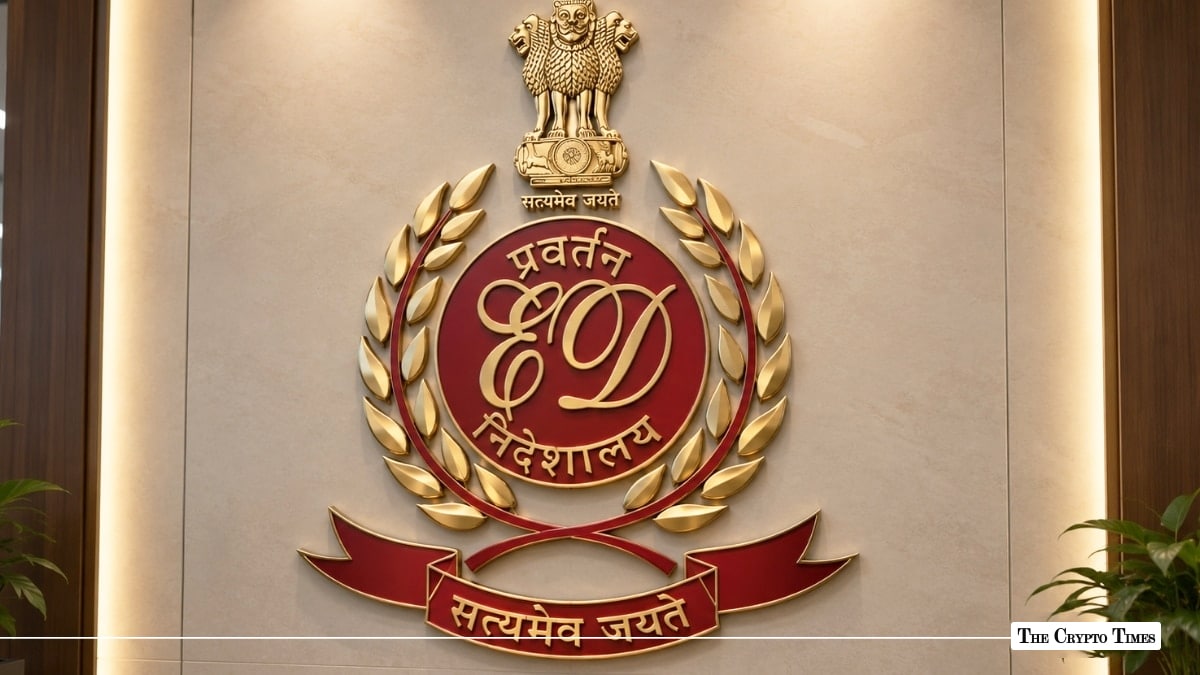
The official emblem of India's Directorate of Enforcement (ED) featuring golden laurel leaves and the State Emblem of India

India’s Enforcement Directorate is planning a major overhaul of its economic crime investigations, targeting completion of probes within about 18 months while strengthening its ability to track emerging financial crime methods involving cryptocurrencies.

AI Summary
Show
ED’s restructuring, approved now, rolls out January 1 2027, expanding staff to 3,256 and zones to 50.
Conference (Sept 13‑15 2026) outlined 18‑month probe target, faster trials, and real‑time coordination protocols.
Crypto‑crime session highlighted techniques like chain‑hopping and mixers, guiding investigations for upcoming 2027 reforms.

The developments were discussed during the ED’s 36th Quarterly Conference of Zonal Officers (QCZO), held at IIM Bangalore from September 14-15. The conference was preceded by a management and leadership workshop on September 13, bringing together ED officials, IIMB faculty and international experts.

The Directorate of Enforcement (ED) successfully conducted its 36th Quarterly Conference of Zonal Officers (QCZO) at Indian Institute of Management, Bengaluru (IIM-B) on 14-15 Sept 2026, preceded by a Management & Leadership Workshop by IIM-B faculties on 13 Sept 2026. The… pic.twitter.com/qUJuUZqjla

— ED (@dir_ed) September 15, 2026

ED Director Rahul Navin chaired the three-day programme, which also covered artificial intelligence, data analytics, deepfakes, cyber threats, international cooperation and asset recovery. 

The agency said the broader approach is to move from a “case-centred” model toward an “ecosystem-centred” approach, with greater use of technology, data and coordination among enforcement agencies.

Crypto crime investigation

A dedicated session on emerging trends in the crypto ecosystem examined how digital assets and blockchain-based services can be used to move or conceal funds.

The ED said officials discussed decentralised finance protocols and the tokenisation of real-world assets without intermediaries. The session also examined hawala networks that can convert rupee funds through domestic brokers into dollar-pegged stablecoins for cross-border transfers.

Investigators reviewed several techniques that can make blockchain transactions more difficult to trace, including chain-hopping, cross-chain bridges, mixers and tumblers, privacy coins, nested accounts and wash trading involving non-fungible tokens.

The agency also reviewed investigative responses available for tracing such transactions, alongside access to platforms that provide virtual digital asset transaction records.

Data analytics and cyber-forensics were another focus. The ED said its officers examined advanced forensic tools and field acquisition kits, as well as plans to expand its arrangement with the National Forensic Sciences University for deploying experts at regional laboratories.

The conference also highlighted the risks associated with artificial intelligence. The ED Director cautioned that even offline AI deployments could create data-leak risks and stressed that confidential case material must be handled carefully.

ED plans major expansion

The Centre has approved a significant expansion of the ED’s sanctioned workforce, increasing posts from 2,029 to 3,256.

Under the restructuring, the field structure will expand to 50 Prevention of Money Laundering Act (PMLA) zones and five dedicated Foreign Exchange Management Act (FEMA) zones in Delhi, Chandigarh, Mumbai, Kolkata and Chennai.

Functional units will also increase from 131 to 241. The restructuring is targeted for rollout from January 1, 2027, with the broader objective of reducing the investigation lifecycle from the current four to five years to about one and a half years.

The agency also plans to strengthen its use of intelligence and technology platforms. Officials reviewed NATGRID, the Interoperable Criminal Justice System, corporate and immigration databases, virtual digital asset transaction records and analytical reports from the Financial Intelligence Unit-India.

The ED is also proposing real-time coordination protocols with FIU-IND and tighter controls over the official use of sensitive databases.

Faster trials and asset recovery

Alongside faster investigations, the ED is pushing zones to identify at least 10 high-profile cases in each region where trials and convictions can potentially be completed within six to eight months.

The agency is also seeking closer information sharing with state police, CBI, Customs, DRI, NCB and SEBI. A proposed automated reporting system would integrate crime-related information with CCTNS and NATGRID, with threshold-based alerts.

For long-running cases, the conference approved a live trial-pendency dashboard and a standardized system for tracking prosecution complaints. Cases pending for more than 10 years are to be placed on a dedicated monitoring register for monthly review.

The agency also wants tighter monitoring of adjournments, witness examinations and other court proceedings to reduce delays.

Asset recovery remains another priority. The ED said restitution of attached and confiscated assets has crossed ₹73,800 crore across 76 cases.

Officials were directed to pursue restitution more actively, including during pending trials where legally permitted. Confirmed attached properties are also to be valued by government-approved valuers and geo-tagged within six months.

The agency described restitution as part of completing the “justice cycle” by returning illicit wealth to legitimate victims.

Recent crypto fraud cases

The ED’s focus on digital-asset investigations comes as Indian authorities continue to deal with several alleged crypto-related investment fraud cases.

Last month, the ED provisionally attached assets worth about ₹8.54 crore in the BTCFUND Bitcoin investment fraud case, taking total attachments in the matter to around ₹13.10 crore. The agency alleges that Hemant Ishwar Sharma lured investors through the Iceland-registered BTCFUND.IS website.

A separate case emerged in Tamil Nadu in August, involving the FQL app, which allegedly collected money by promising cryptocurrency-based returns. On August 31, the state police transferred six FIRs related to the case to the Economic Offences Wing for a detailed investigation.

In September 2026, a Bengaluru surgeon reported losing about ₹4.47 crore after being directed to a website presented as a cryptocurrency trading platform. According to the police complaint reported by The Times of India, the platform displayed purported profits of nearly ₹14 crore before additional payments were demanded for withdrawal.

These cases are separate from the ED’s broader restructuring, but they highlight the range of crypto-related investment fraud and digital-asset investigations being handled by Indian authorities.

What comes next

The ED’s new structure is scheduled to roll out from January 2027, with the agency targeting faster investigations, wider use of technology and stronger forensic capabilities.

For crypto-related cases, the conference indicates that the ED is looking beyond individual wallet transactions to a broader set of mechanisms involving DeFi, stablecoins, cross-chain transfers, mixers, privacy-focused assets and other blockchain-based services.

The roadmap also links digital investigations with faster prosecution, closer coordination between enforcement agencies and more active recovery of assets for victims.

Also Read: India’s FM Urges RBI to Scale Digital Rupee Pilots Amid Tokenisation Push

Disclaimer: The information researched and reported by The Crypto Times is for informational purposes only and is not a substitute for professional financial advice. Investing in crypto assets involves significant risk due to market volatility. Always Do Your Own Research (DYOR) and consult with a qualified Financial Advisor before making any investment decisions.

Follow The Crypto Times on Google News to Stay Updated!      Google News

Daily Crypto Puzzles
Tickerdle Tickerdle Crypto Connections Crypto Connections Crypto Crossword Crypto Crossword
TAGGED:India
Share This Article
Whatsapp Whatsapp LinkedIn Telegram Copy Link

Daily Crypto Puzzles

Tickerdle crypto game Tickerdle Crypto Connections game Crypto Connections Crypto Crossword game Crypto Crossword

Latest News

A judge's gavel next to the Ostium logo inside a New York federal courtroom.
Ostium $15M Loan Dispute Reaches NY Federal Court Today After July $23.75M Oracle Exploit
A physical Bitcoin coin standing upright on a wet street with a illuminated "ETF" sign in the background.
Spot Bitcoin ETFs See $746M Outflow During CLARITY Act and FOMC Pressure
A smartphone displaying the Polymarket logo in front of the South Korean flag.
South Korea Probes 26 Polymarket Users Over 17.6B Won Bets
US House Passes Strategic Bitcoin Reserve Bill 28-21 With 20-Year Lock
Seven Senate Democrats Vow to Revive CLARITY Act After 49-50 Cloture Defeat

Find Us on Socials

You may also like

Physical Bitcoin, Ethereum, and XRP coins resting in front of a declining market chart and the Federal Reserve building.

Crypto Market Turns Red as CLARITY Act Setback Meets Fed Rate Decision

Polymarket Predicts 89% Chance of 25bps Hike Ahead of FOMC Meeting

Polymarket Predicts 89% Chance of 25bps Hike Ahead of FOMC Meeting

Coinbase and Circle logos next to a CLARITY Act document stamped "BLOCKED" in front of the U.S. Capitol

Coinbase and Circle Lead Crypto Stock Selloff After Senate Blocks CLARITY Act

Bitcoin, ETH, XRP Prices Trade Narrowly as Markets Await FOMC Statement

Bitcoin, ETH, XRP Prices Trade Narrowly as Markets Await FOMC Statement

The Crypto Times Logo PNG

News

All News
Market News
Bitcoin News
Ethereum News
Altcoin News
Regulations & Policies
DeFi News
Blockchain News
Industry News

Sections

Exclusive
Opinions
Learn
Insights
Videos
Glossary

India Premium Indices

Stablecoins
USDT
USDC

Play

Daily Crypto Puzzles
Tickerdle
Crypto Connections
Crypto Crossword

Company

About Us
Our Authors
Editorial Policy
AI Policy
Advertorial Policy
Contact Us
Career

Follow Us

X-twitter Linkedin Telegram Youtube Instagram

© 2026 The Crypto Times | A BITROCK TECHNOLOGIES L.L.C. Company.

DMCA.com Protection Status
  • Terms and Conditions
  • Disclaimer
  • Privacy Policy
  • Cookie policy
Do Not Sell or Share My Personal Information