U.S. spot Bitcoin exchange-traded funds recorded a second straight day of net redemptions on September 16, 2026, after a Federal Reserve rate increase and a failed Senate procedural vote on digital-asset market-structure legislation a day before.
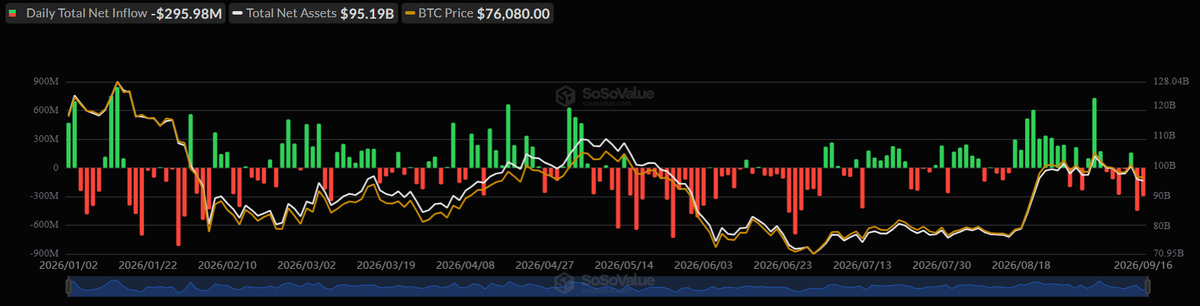
SoSoValue listed a one-day net outflow of $295.98 million across the 12 U.S. spot Bitcoin products on September 17. That followed a $450.33 million redemption day on September 15. Combined, the two sessions removed about $746 million during the market fear period. Earlier September still included large creations, including $730.8 million on September 3 and $159.9 million on September 14.
Fund flows and the CLARITY Act vote
The September 16 Farside breakdown shows selling concentrated in the largest funds. BlackRock’s IBIT recorded $144.1 million in net outflows. ARK 21Shares’ ARKB followed with $84.4 million. Fidelity’s FBTC posted $52.7 million, and Grayscale’s GBTC added $18.2 million. Morgan Stanley’s MSBT was the only product with a positive print, at $3.5 million. The remaining funds reported no net creations or redemptions.
SoSoValue placed total net assets near $95.19 billion after September 16, with cumulative net inflows since launch at about $54.59 billion and an ETF share of Bitcoin’s market capitalization near 6.21%. Those stock figures remain large relative to a single session’s flow.
The outflows overlapped a separate Washington event. On September 15, the Senate rejected cloture on the motion to proceed to H.R. 3633, the Digital Asset Market Clarity Act, by a 49–50 tally on Record Vote No. 234.
The Senate Daily Press recorded that Sen. Chris Coons did not vote and that Sens. Susan Collins, Josh Hawley, Jerry Moran, and Thom Tillis voted no, with Tillis entering a motion to reconsider. Cloture required 60 votes, so the bill did not advance to debate on the merits.
Congress.gov describes the measure as establishing a framework for digital commodities and assigning the Commodity Futures Trading Commission a central role over digital-commodity transactions while preserving aspects of Securities and Exchange Commission authority. The House had already passed its version.
A CRS overview notes that Senate text would give the CFTC exclusive jurisdiction over cash or spot sales of digital commodities, defined as fungible digital assets that can be held and transferred without an intermediary and recorded on a distributed ledger.
The vote itself does not change ETF creation and redemption mechanics. It does leave existing agency authority in place rather than enacting a new statutory split of jurisdiction.
Rate decision and what the data do and do not show
The redemptions also coincided with the Federal Open Market Committee’s September 15–16 meeting. In its FOMC statement, the Committee said it “decided to raise the target range for the federal funds rate by 1/4 percentage point to 3-3/4 to 4 percent.” It said inflation remains elevated and that the action “will support a timelier return to the Committee’s 2 percent goal.”
An implementation note set the interest rate on reserve balances at 3.90% and the primary credit rate at 4.0%, effective September 17.
Spot Bitcoin ETFs buy or sell Bitcoin when shares are created or redeemed. Net outflows therefore reduce ETF demand for the underlying asset that day. The flow tables do not identify each investor’s motive. Higher policy rates raise the return on cash and other yielding instruments. A stalled market-structure bill leaves statutory uncertainty unchanged. Both are contextual facts around the same trading window; neither, standing alone, proves a single cause for every redemption.
Daily flow numbers can still be revised after issuers finish reporting. Cumulative inflows remain positive, and the funds still hold tens of billions of dollars. September’s tape shows both large buying days and large selling days, not a one-way collapse of the product class.
Also read: Lummis Challenges Alsobrooks After CLARITY Act Vote Fails