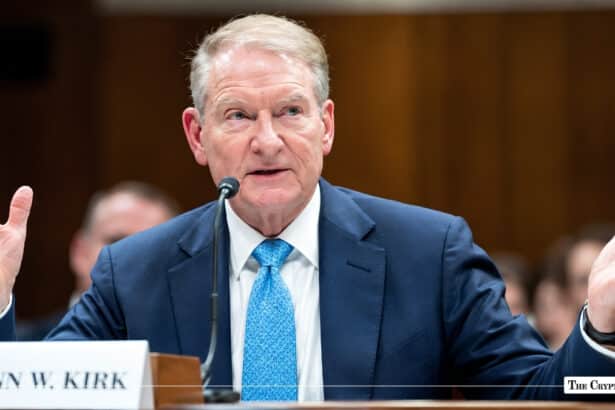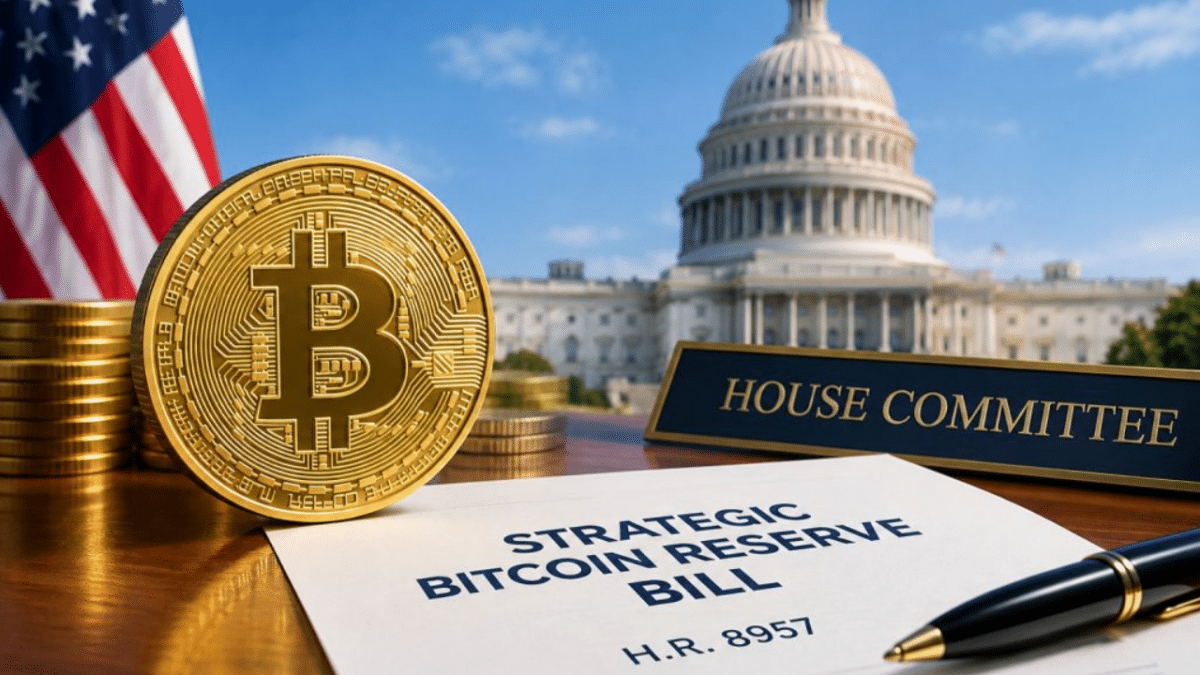
The United States House Financial Services Committee voted 28 to 21 on Wednesday, September 16, 2026, to favorably report the American Reserve Modernization Act of 2026 (ARMA) to the full House.
Filed as H.R. 8957, the measure becomes the first Strategic Bitcoin Reserve bill to clear a full House committee, and it did so only after a chairman-backed rewrite that reshaped the 20-year lockup, proof-of-reserve reporting cadence, and fork-asset handling in the base text.
What the Committee Actually Passed
Before the recorded vote, the panel adopted an amendment like a substitute offered by Representative Bryan Steil (R-Wis.), chair of the Digital Assets, Financial Technology, and Artificial Intelligence Subcommittee. An amendment like a substitute is a full replacement of a bill’s text that becomes the base language for further votes.
The substitute, catalogued in the committee record as ANS_HR8957, replaced the introduced version of the bill as the working text and was agreed to by voice vote.
Ranking Member Maxine Waters (D-Calif.) then offered Amendment No. 9, known internally as “Waters 2.” The panel rejected it on Record Vote FC-316 by a tally of 21 yeas to 28 nays. The final motion to report H.R. 8957, as amended, was adopted 28 to 21 on Record Vote FC-317.
The committee met at 10:00 a.m. Eastern Time in Room 2128 of the Rayburn House Office Building for a markup of various measures, a session that also covered several unrelated bills.
Chairman French Hill (R-Ark.) framed the day’s slate as legislation that would “expand opportunity, strengthen protections, and increase accountability for consumers” in a statement released alongside the markup.
Key Changes in the Steil Substitute
The rewrite is the substantive story of the day. Under the introduced draft of ARMA, each new deposit of bitcoin into the reserve would have started its own 20-year clock, meaning a coin seized in 2031 could remain locked until 2051. The Steil substitute pegs the 20-year clock to the date of enactment for all reserve bitcoin, so coins already held and coins added later share a single statutory start line.
The reporting cadence has also been softened. The introduced text required quarterly cryptographic attestations. The substitute cuts that back to an annual public report covering total holdings, transactions, and control of private keys, verified by an independent auditor with cryptographic-attestation experience. The Comptroller General retains oversight of the program.
Forked and airdropped assets, which are new coins created when a blockchain splits or when tokens are distributed to existing holders, received a shorter waiting period. Under the substitute, the Treasury may dispose of such assets one year after receipt, down from five in the introduced version.
After that year, the Treasury retains the chain with the higher market capitalization and may sell the minority token, with proceeds directed to the general fund unless Congress is notified of a novel utility case for the smaller chain.
The substitute also introduces a controlled off-ramp after year 20. The Treasury may recommend selling up to 10 percent of reserve bitcoin in any two-year window. That is a recommendation-based mechanism, not an automatic disposal.
Background: Executive Order 14233 and How the Reserve Was Built
The Strategic Bitcoin Reserve exists today because President Donald Trump signed Executive Order 14233 on March 6, 2025. The order directed federal agencies to retain, rather than auction, bitcoin acquired through criminal or civil forfeiture, and it established a separate Digital Asset Stockpile for non-bitcoin tokens. ARMA is designed to codify that policy in statute so a later administration cannot dissolve the reserve with another executive order.
Representative Nick Begich (R-Alaska), the bill’s sponsor, introduced H.R. 8957 on May 21, 2026, with Representative Jared Golden (D-Maine) as Democratic co-lead. In a statement issued at introduction, Begich described bitcoin as the “digital equivalent of gold” and framed the reserve as a modernization of the federal balance sheet.
Estimates of the reserve’s current balance sit between roughly 198,000 and 328,372 BTC, depending on which forfeiture wallets are attributed to United States agencies. On-chain trackers such as Arkham Intelligence and Bitcoin Treasuries disagree on the count, and the Treasury has not published a reconciled balance sheet. That transparency gap is one reason Section 7 of the substitute requires each agency to inventory its digital-asset holdings within 60 days of enactment.
The Secretary of the Treasury would then have 180 days to stand up custody infrastructure, and transfers would follow within 30 days of certification.
Known sources of the current stash include Silk Road-linked forfeitures, the Bitfinex hack recovery, and the Prince Group case. Almost none of the reserve was acquired with taxpayer cash on an open exchange.
What the Bill Does Not Do
Several social media posts and secondary reports on Wednesday claimed ARMA “extends the wash-sale rule to crypto.” The wash-sale rule prevents taxpayers from claiming a loss on a security if they repurchase a substantially identical position within 30 days. That claim is not supported by either the introduced text of H.R. 8957 or the Steil substitute.
Section 1091 of the Internal Revenue Code, which governs the wash-sale rule, is not amended anywhere in the bill. Wash-sale and constructive-sale drafts are moving on a separate track under the House Ways and Means Committee.
The bill also does not appropriate funds for open-market bitcoin purchases. Section 9 of the substitute directs the Secretaries of the Treasury and Commerce, within 180 days of enactment, to study whether additional bitcoin can be added to the reserve over a five-year horizon without expanding the national debt “nominally or economically.” Section 9(d) explicitly bars new borrowing, new taxes, and deficit spending as acquisition tools. Annual updates would be transmitted to Congress.
Section 10 preserves self-custody rights and states that nothing in the Act authorizes the federal government to confiscate or impair lawfully held bitcoin or other digital assets.
Sponsorship and Partisan Math
Congress.gov lists Begich as the sole sponsor of H.R. 8957, joined by 23 cosponsors: 22 Republicans and Golden. Golden does not sit on the Financial Services Committee, and heading into Wednesday’s markup, no Democratic committee member was on the cosponsor list.
The 28-21 committee outcome therefore tracks a party-line split more than a cross-aisle coalition vote, even though the “bipartisan” label continues to be applied because of Golden’s co-lead status.
What Happens Next
A favorable committee report sends ARMA to the House calendar. It still requires a House floor vote, Senate passage, and a presidential signature to become law. House members were scheduled to leave Washington after September 17 until after the November election, making a floor vote this month unlikely, as previewed by The Crypto Times ahead of the markup.
The timing sits alongside a separate setback for crypto legislation. The Senate failed to advance the Digital Asset Market Clarity Act (CLARITY Act), a market-structure bill that would divide oversight of digital assets between the Securities and Exchange Commission (SEC) and the Commodity Futures Trading Commission (CFTC).
On September 15, 2026, a cloture vote on the CLARITY Act fell short at 49 to 50, well below the 60-vote threshold needed to open floor debate. That result leaves the CLARITY Act stalled for the year, positioning ARMA as the primary House vehicle for federal bitcoin policy for the remainder of 2026.
Even if the House passes ARMA later this year or in 2027, the Senate path remains uncertain given current partisan alignment and the outcome of the CLARITY vote.
Market and User Implications
For bitcoin holders, the near-term consequence of a 20-year lockup, if enacted, is the removal of the federal government as a scheduled seller of forfeited coins. Auction calendars have historically injected supply that traders monitored closely. Removing that overhang does not create a standing federal bid. It simply ends an established source of supply.
Traders who use tax-loss harvesting on bitcoin, meaning the practice of selling at a loss and repurchasing to reset the cost basis, were unaffected by Wednesday’s vote. Any change to the wash-sale rule would require separate legislation.
Holders of ether (ETH), solana (SOL), XRP, or other tokens that end up in federal custody are governed by the Digital Asset Stockpile, not by the Strategic Bitcoin Reserve. Assets in the stockpile are not subject to the 20-year lock. The Treasury may sell, convert, or exchange them, with proceeds directed either to bolster the Bitcoin reserve or to reduce national debt.
For state treasuries, Section 8 of the substitute creates an optional segregated custody account inside the Federal Reserve. Participating states retain title, pay for the custody service, and accept the operational risk. The provision functions as a custody product rather than a federal guarantee.
For verification-focused users, the annual proof-of-reserve report plus independent cryptographic attestation would produce the first statutorily required public accounting of federal bitcoin holdings. An annual cadence is weaker than the quarterly cadence in the introduced draft, but it remains stronger than the current mix of executive-order language and competing blockchain-tracker estimates.
Fork Policy as a Sleeper Provision
The substitute’s fork-handling clause is small in text but consequential in signal. Following a chain split, the Treasury would keep both sides for one year, then retain the chain with the higher market capitalization and dispose of the other. That is a policy choice with market weight, as a federal wallet aligning to market capitalization would represent a late but sizeable expression of which chain the government treats as bitcoin.
Bottom Line
The committee passed a bill on Wednesday that codifies a forfeiture stash the government already holds, writes a 20-year hold into statute for that stash, orders a public accounting through agency inventories and annual reports, and directs a study of budget-neutral acquisition of additional coins.
Private wallets are left alone, tax-loss harvesting rules are left alone, and no funding line has been created for new bitcoin purchases. Committee passage is a procedural gate. It is not a law.
Also Read: Seven Senate Democrats Vow to Revive CLARITY Act After 49-50 Cloture Defeat