Shares of Coinbase Global and Circle Internet Group led a broad selloff in United States-listed crypto equities on Tuesday, September 15, 2026, after the US Senate failed to advance the Digital Asset Market Clarity Act, the crypto industry’s top policy goal for the year. Coinbase (COIN) closed 10.10% lower at $172.11, and Circle (CRCL) settled 11.41% down at $86.30, marking one of the sharpest single-session drops for the two names in 2026.
The move fully reversed Monday’s rally and pulled the broader crypto-linked stock complex, including Robinhood Markets, Strategy, Galaxy Digital and the mining group, sharply into the red.
What the Senate Actually Voted On
The vote in question was procedural, not a final passage vote. Under Senate Rule XXII, cloture on the motion to proceed to a bill requires the support of 60 senators to end debate on whether the chamber will even take up the measure. The Senate rejected that motion on H.R. 3633 by 49 yeas to 50 nays, 11 votes short of the 60-vote cloture threshold and one vote short of a simple majority. The result means the CLARITY Act failed to advance, leaving the bill stalled on the Senate calendar.
Republicans currently hold 53 seats in the 100-member chamber. All 49 yea votes were Republican. Four Republicans, Senators Susan Collins of Maine, Josh Hawley of Missouri, Jerry Moran of Kansas and Thom Tillis of North Carolina, joined every voting Democrat and both independents in opposition. Senator Chris Coons of Delaware did not vote.
Per the Senate Daily Press floor log, voting on cloture began at 2:18 PM Eastern Time, and the result was announced at 3:00 PM. Senator Tillis’s no vote was cast so that, as a member of the prevailing side, he could file a motion to reconsider, which he did at 3:01 PM. That motion preserves a procedural path for Senate Majority Leader John Thune to bring the same cloture question back without restarting the process, though it does not, by itself, create the additional votes needed to reach 60.
Coinbase and Circle Take the Sharpest Session Hits
According to session data published by Yahoo Finance, Coinbase Global closed the September 15 session at $172.11, down $19.34 or 10.10%, on volume of about 18.64 million shares against an average daily volume near 8.68 million.
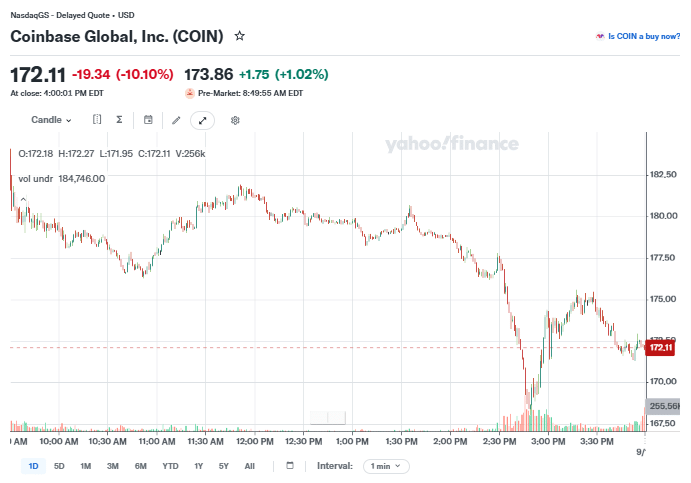
The stock traded in an intraday range of $168.07 to $184.14. In the after-hours session, COIN printed near $171.16.
Circle Internet Group, the issuer of the USD Coin (USDC) stablecoin, closed at $86.30, down $11.12 or 11.41%, on volume of about 22.40 million shares against an average daily volume near 13.81 million. Circle’s intraday range was $84.80 to $93.29. CRCL traded near $85.65 after hours.
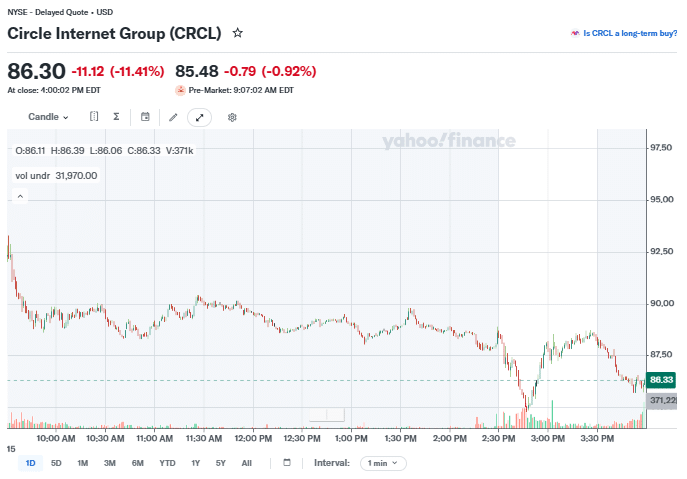
Both moves fully reversed Monday’s session, when COIN closed up 9.24% at $191.45, and CRCL closed up 7.53% at $97.42 on renewed hopes of Senate advancement following the Republican sponsors’ final substitute text, released on September 14 by Senators Cynthia Lummis of Wyoming, Tim Scott of South Carolina and John Boozman of Arkansas. Sponsors said the updated draft incorporated 126 changes requested by Democrats, including tougher ethics limits, a state attorney general enforcement role and Treasury circuit-breaker authority tied to payment-stablecoin rewards.
Broader Crypto-Linked Complex Follows Lower
Coinbase and Circle are the cleanest listed expressions of a United States market-structure statute, so both carried the largest weighted exposure to Tuesday’s outcome. Other names in the complex followed, though at smaller magnitudes.
Robinhood Markets (HOOD), whose crypto business sits inside a wider retail-brokerage book, closed at $110.45, down $3.88 or 3.39%, per Yahoo Finance, on volume of about 28.53 million shares. Strategy (MSTR), the Bitcoin treasury company formerly known as MicroStrategy, closed near $129.60, down about 5.36%, tracking Bitcoin more than the bill itself.
Elsewhere across the sector, Galaxy Digital (GLXY) fell about 8%, Bullish (BLSH) about 5%, Gemini (GEMI) about 7%, and BitMine Immersion Technologies (BMNR) about 8%. The mining group, including Riot Platforms (RIOT), MARA Holdings (MARA), CleanSpark (CLSK), Core Scientific (CORZ), IREN and Hut 8, closed in a 3% to 6% range lower.
Bitcoin and Altcoins Track the Vote
Spot cryptocurrency prices weakened into and after the 3:00 PM Eastern Time announcement. Bitcoin (BTC) traded as high as about $77,200 before the roll call, then broke on the result to session lows near $74,910 to $75,038. Late-day references clustered $75,600 to $75,900, a 24-hour decline of roughly 3% to 5%. Bitcoin traded near $75,700 early Wednesday, ahead of the Federal Reserve’s rate decision.
Ether (ETH), the native token of the Ethereum network, traded down 4.5% to 8% intraday, printing near $2,398 to $2,406 late in the session. XRP was down 9% to 13% across venues, while Solana (SOL) fell around 5%.
Ark Invest Trimmed COIN and CRCL Into Monday’s Rally
Cathie Wood’s Ark Invest, one of the most closely watched active managers in the crypto-equity complex, trimmed several positions into Monday’s advance.
The firm’s trade disclosures showed sales of 36,628 Coinbase shares, worth about $7 million at Monday’s closing price, and 142,350 Circle shares across two funds, worth about $13.8 million at Monday’s close. Additional sales touched Bullish (BLSH), BitMine Immersion Technologies (BMNR) and the ARK 21Shares Bitcoin ETF (ARKB).
Prediction Markets Reprice 2026 Enactment Odds
Prediction-market pricing on 2026 enactment fell in a straight line through the day. On Polymarket, odds of the CLARITY Act being signed into law in 2026 were quoted near 29.5% to 34% on Monday, 17% to 19% on Tuesday morning, and 6% to 7% after the result was announced. Prediction-market pricing reflects trader positioning and is not a forecast of legislative outcomes.
Fed Decision Is the Next Overlay
Attention now turns to the Federal Reserve. According to the Federal Reserve’s meeting calendar, the FOMC will release its policy statement at 2:00 PM Eastern Time on Wednesday, September 16, followed by a press conference with Chair Kevin Warsh at 2:30 PM. The September meeting is a projection-materials meeting and will include an updated Summary of Economic Projections (SEP) and the closely watched dot plot.
The current federal funds target range is 3.50% to 3.75%, held at the July 29 meeting on a 9-to-3 vote and unchanged since December 2025. Markets are pricing a 25-basis-point hike to 3.75% to 4.00%, which would be the first Federal Reserve rate increase since 2023, following August headline Consumer Price Index (CPI) at 3.4% year on year and hawkish signals from Chair Warsh at the Jackson Hole Economic Symposium. A hike is a scenario rather than an announced outcome as of publication.
The overlap of the two events means Tuesday’s crypto-equity move should not be read as attributable to the Senate result alone.
What Sponsors and CEOs Said After the Vote
Senator Lummis, one of the bill’s Republican sponsors, told reporters ahead of the vote that if cloture failed, “I think we’re done. It’s over,” and, when asked afterward whether the bill would return to the floor, said no. Senator Ruben Gallego of Arizona, the only Democrat to vote the bill out of the Banking Committee in May, said in a statement after the roll call that Republican leadership had “ended talks and forced a vote,” calling the outcome a failure to address ethics concerns.
Coinbase Chief Executive Officer Brian Armstrong posted on X that “the CLARITY Act didn’t advance in the Senate today,” adding that the industry “can’t wait on Congress anymore,” that the Securities and Exchange Commission (SEC) and the Commodity Futures Trading Commission (CFTC) “have the tools they need,” and that the Guiding and Establishing National Innovation for U.S. Stablecoins Act (GENIUS Act) “is already the law of the land for stablecoins.”
Ripple Chief Executive Officer Brad Garlinghouse posted on X that the outcome “stings,” pointing to SEC Chairman Paul Atkins and CFTC Chairman Michael Selig continuing to work on rulemaking under existing authorities.
The Policy Path Now Runs Through the Agencies
With comprehensive market-structure legislation delayed, the near-term US crypto-policy story shifts to agency rulemaking. The SEC’s Regulation Crypto Assets workstream and CFTC spot-market drafting under existing Commodity Exchange Act (CEA) authority remain the live administrative tracks through the end of 2026.
Payment stablecoins already sit under a separate statute. The GENIUS Act, signed into law by President Donald Trump on July 18, 2025, as Public Law 119-27, established the first federal framework for United States payment stablecoins, covering issuer authorisation, one-to-one reserves, disclosures and supervision, with a general effective date of the earlier of January 18, 2027 or 120 days after final implementing regulations. USDC, issued by Circle, sits within that framework.
Also Read: Bitcoin, ETH, XRP Prices Trade Narrowly as Markets Await FOMC Statement