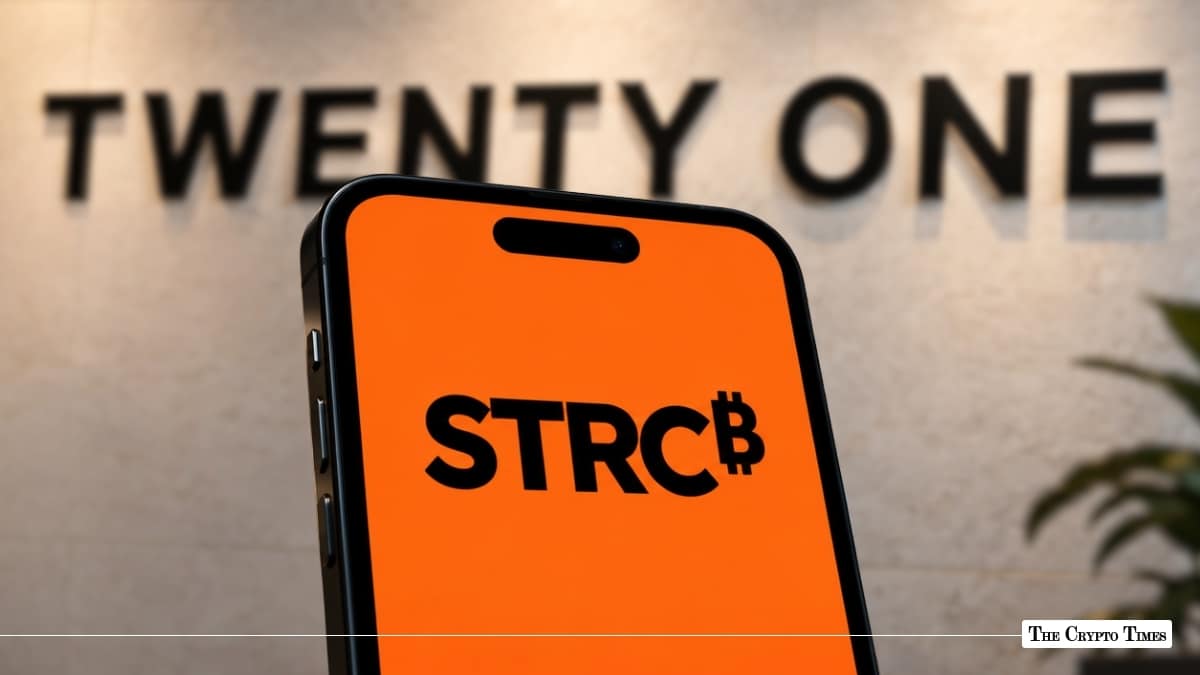
Twenty One Capital (NYSE: XXI) Chief Executive Officer Raphael Zagury said the company is considering a preferred stock instrument modeled on Strategy’s STRC to raise capital for additional Bitcoin purchases.
Speaking in a Coin Stories interview published September 15, 2026, Zagury framed the idea as a practical capital-markets option rather than a completed decision. “If it makes sense, why wouldn’t we do it,” he said.
The remarks come as Twenty One Capital, a Tether-backed public company built around a large Bitcoin treasury, continues a strategic shift under Zagury, who became CEO on July 20, 2026, after Jack Mallers stepped down to focus on Strike, a Bitcoin-focused payment firm.
What Zagury Said About a Preferred Stock Tool
In the interview with Natalie Brunell, Zagury discussed how public Bitcoin companies finance treasury growth without relying solely on common-share issuance. Strategy, formerly MicroStrategy, has used its Variable Rate Series A Perpetual Stretch Preferred Stock, known as STRC, to raise cash that is then deployed into Bitcoin. That security pays a variable cash dividend and is designed to trade near a $100 stated amount.
Zagury did not announce terms, timing, size, or a filing. He presented the concept as one tool among others if it proves accretive. Twenty One Capital’s investor materials have previously emphasized disciplined capital allocation, cash-flow businesses, and capital-markets capability as part of its next phase. An official company release in July outlined priorities that include operating businesses and more sophisticated funding structures around the Bitcoin balance sheet.
The comment is therefore exploratory. It does not constitute a securities offering or a commitment to copy Strategy’s structure in full. Preferred stock sits between debt and common equity: holders typically rank ahead of common shareholders for dividends, but terms vary widely and can include variable rates, perpetual maturity, and no conversion into common shares.
How Strategy Built STRC—and What Changed After Launch
Strategy chose STRC in July 2025 as a way to raise large amounts of capital for Bitcoin without issuing only common stock. The company closed an initial public offering of 28,011,111 shares of Variable Rate Series A Perpetual Stretch Preferred Stock at $90 a share, generating about $2.521 billion in gross proceeds. Net proceeds funded the purchase of 21,021 bitcoin.
Unlike fixed-rate preferreds already in its stack, STRC was designed as a perpetual, non-convertible income security with a $100 stated amount and a board-adjustable dividend rate, initially 9%, intended to keep the shares trading near par so Strategy could later sell more through an at-the-market program when the price held close to $100.
What followed was a shift from issuance machine to credit-management system. Strategy later raised the regular dividend to 12.00% per year, moved payments to a semi-monthly schedule, and built a dedicated USD Reserve to cover preferred dividends and interest.
After STRC slipped below par in 2026, the company said it would not issue new STRC under $100, began open-market repurchases, and used common-stock ATM proceeds—and at times bitcoin sales—to strengthen cash coverage rather than only expand the stack.
STRC remains a senior preferred claim on Strategy’s residual assets, not a direct claim on its bitcoin. The instrument still funds the treasury model, but the post-launch priority is keeping the dividend credible and the price near the $100 target.
Context for XXI’s Treasury Strategy
Twenty One Capital listed on the New York Stock Exchange through a SPAC transaction and has positioned Bitcoin as its core reserve asset. Company filings and investor communications have repeatedly stated that management measures success against Bitcoin on a risk-adjusted basis and wants operating cash flow to support further accumulation rather than depending only on equity premiums.
Zagury’s public comments since taking the role have stressed that a large Bitcoin stack is an advantage only if the firm becomes more than a treasury vehicle. A shareholder letter issued in August 2026, posted through the company’s investor relations site, argued that XXI must pair its holdings with businesses that generate cash and with capital-markets tools that do not misallocate shareholder capital.
A STRC-style preferred would, in principle, allow the company to tap income-oriented investors while directing proceeds toward Bitcoin. Whether that structure “makes sense” for XXI depends on cost of capital, dividend coverage, market demand, and how the instrument would sit alongside existing convertible notes and pledged coins. Zagury did not provide those details in the podcast.
Read: BTC Mining Electricity Use May Have Peaked — ‘The Bitcoin Standard’ Author