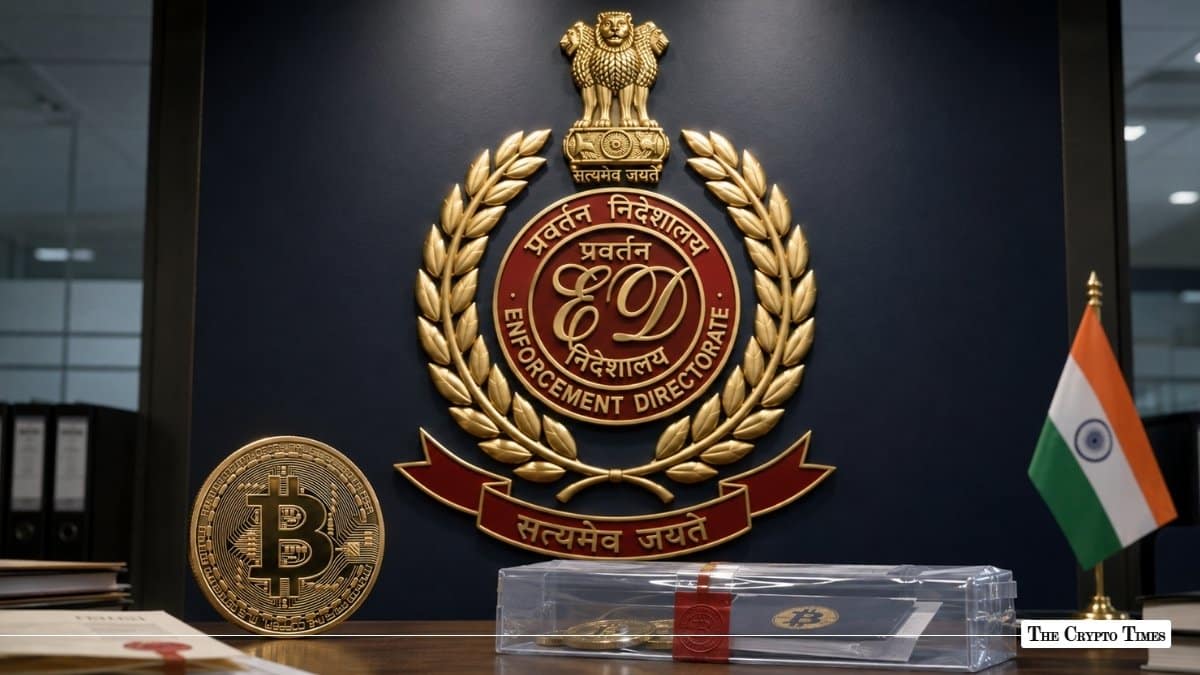
India’s Enforcement Directorate (ED) has provisionally attached assets worth approximately ₹8.54 crore (~$896,000) in connection with an alleged Bitcoin investment fraud, the agency said in a press release dated August 3, 2026. The order, issued under the Prevention of Money Laundering Act (PMLA), 2002, targets assets belonging to Hemant Ishwar Sharma, who the ED accuses of cheating members of the public by luring them into investing in Bitcoin through his Iceland-registered website, BTCFUND.IS.
With this attachment, dated July 31, the ED said total attachments in the case now stand at approximately ₹13.10 crore (~$1.37 million). The agency added that Sharma has been arrested and is currently lodged in Siddhowala Prison in Dehradun, and that further investigation is under way. The allegations described below are the ED’s; Sharma has been arrested and charged but not convicted, and is entitled to the presumption of innocence.
What the ED Alleges
According to the ED, its investigation began on the basis of a First Information Report (FIR) registered by Rajpur Police Station in Dehradun under the Indian Penal Code, 1860, accusing Sharma of cheating investors through BTCFUND.IS. A similar FIR was registered by Dineshpur Police Station in Udham Singh Nagar district, Uttarakhand, against Sharma and others in relation to the same alleged scheme.
The agency says its investigation found that Sharma fraudulently collected substantial sums from members of the public under the pretext of investing in Bitcoin through the website, which it says was under his control. According to the ED, he lured investors by promising high returns and falsely claiming that several foreign nationals were associated with the scheme, presenting it as credible and internationally backed. Investors from across India were induced to deposit funds on those representations, the agency said.
The ED alleges Sharma ran the scheme for about five years and, once he had won the public’s trust and collected substantial amounts of Bitcoin through the website, abruptly took the site down, leaving investors, in the agency’s words, betrayed and cheated. (Note: The current ED release identifies the site as the Iceland-registered BTCFUND.IS; an earlier 2024 ED action in the same case referred to the website as BTCFUND.in.)
The Alleged Proceeds and Lifestyle
The ED says its blockchain analysis identified retained proceeds of crime of approximately 856.23 BTC, which it valued at around ₹200 crore (~$21.0 million), that were allegedly laundered through crypto exchanges and used to buy real estate and vehicles and to renovate Sharma’s residence. That figure represents the agency’s assessment of proceeds; it is separate from the assets formally attached so far.
The agency further alleges that Sharma had no source of income other than the funds raised through BTCFUND.IS, yet maintained a lavish lifestyle, claiming he acquired and ran two BMW cars, a bungalow in an upscale part of Dehradun, and multiple immovable properties worth crores of rupees in and around the city.
Timeline of the Case
The August 3 announcement is the latest step in a case that has been building for more than a year. According to the ED and contemporaneous reporting, the agency had earlier issued a provisional attachment order covering movable and immovable properties worth about ₹4.56 crore (~$478,000) in December 2024. Sharma was arrested in 2026 following searches at multiple locations, and the ED filed a prosecution complaint on May 20, 2026, before the Special Court (PMLA) in Dehradun, which took cognizance of it on July 13, 2026. The newly announced ₹8.54 crore attachment brings the cumulative total to roughly ₹13.10 crore.
Under the PMLA, a provisional attachment is a step that freezes assets suspected of being proceeds of crime; it must be confirmed by an adjudicating authority within a set period and does not by itself constitute a finding of guilt, which is determined by the courts.
Why It Matters
The case is one of a growing number of Indian enforcement actions targeting crypto-linked fraud, and it reflects a pattern regulators worldwide have flagged: schemes that use the credibility of Bitcoin and claims of foreign or institutional backing to attract retail investors, then collapse. For Indian investors, it is a reminder that unregistered platforms promising outsized, guaranteed returns, particularly those that later become unreachable, remain a significant risk, and that recovering funds after such a collapse is difficult and slow even when authorities act.
The ED said its investigation into the case is continuing.
Also Read: Binance APAC Head Says India Needs Rupee Stablecoins to Cut Dollar Reliance