Robinhood Markets, Inc. (NASDAQ: HOOD) is preparing to move one of crypto’s most traded products into the mainstream US brokerage market. At its HOOD Summit 2026 event in Houston, Texas, on Tuesday, September 29, the company said eligible US customers will be able to trade crypto perpetual futures inside the Robinhood app in the coming months.
Retail traders in the United States have mostly reached this type of product through offshore exchanges operating outside federal oversight.
Perpetual futures, known as perps, are derivatives contracts that let traders bet on an asset’s price rising (going long) or falling (going short), typically with borrowed exposure known as leverage. Unlike standard futures, they never expire. A position stays open as long as the trader keeps enough collateral, called margin, in the account.
What Robinhood Is Offering
According to Robinhood’s HOOD Summit 2026 newsroom release, the first eight contracts will track Bitcoin (BTC), Ether (ETH), Solana’s native token SOL, XRP, Dogecoin (DOGE), Cardano’s native token ADA, Chainlink’s native token LINK, and HYPE, the native token of the Hyperliquid decentralized exchange.
The company set a two-tier leverage structure: up to 10x on BTC and ETH, and 3x on the other six contracts. The split tracks market depth. Bitcoin and Ethereum are the two largest and most liquid crypto assets, while the remaining tokens tend to see sharper price swings. At 10x, a 10% move against a position can wipe out the trader’s entire margin.
Robinhood said users will be able to set stop-loss and take-profit orders, see liquidation prices in real time, and get alerts when a position is at risk. A liquidation price is the level at which the platform automatically closes a leveraged position because the remaining margin can no longer cover losses.
Pricing is set at one basis point, or 0.01%, per trade through the end of 2026. A basis point is one hundredth of one percent. Robinhood has not said what it will charge from 2027.
Robinhood co-founder and Chief Executive Officer (CEO) Vlad Tenev described the product in a post on X: “Robinhood is bringing America its first true perps. No expiry, with P&L settled every 15 minutes. A new chapter for US derivatives.” Profit and loss (P&L) settlement is the process of crediting gains to and debiting losses from trader accounts. The company has not explained how the 15-minute cycle will work in practice.
Why This Matters for US Traders
For years, US regulators treated perpetual contracts as swaps, a category that keeps them largely out of reach for retail investors. That position shifted on May 29, 2026. On that day, the Commodity Futures Trading Commission (CFTC), the federal regulator of US derivatives markets, approved a Bitcoin perpetual contract called BTCPERP for listing as a futures contract on KalshiEX, LLC, a designated contract market (DCM). The agency also adopted a policy statement on the listing of perpetual contracts the same day.
The CFTC opened a second route the same day. CFTC staff issued Letter No. 26-17 to Coinbase Financial Markets, Inc., a registered futures commission merchant (FCM). The letter confirmed that certain perpetual contracts listed on its affiliated foreign exchange, Deribit FZE, may be treated as foreign futures when US customers trade them through the FCM.
US traders now have three distinct models taking shape:
- Kalshi: a domestic exchange listing its own perpetual contract.
- Coinbase: a US broker routing customers to an affiliated offshore venue.
- Robinhood: a US broker, Robinhood Derivatives, offering contracts “through” Bitstamp, its owned exchange.
Robinhood has not said which of these frameworks its product will rely on.
Tenev’s description of Robinhood’s product as America’s “first true perps” is the company’s own characterization. Kalshi’s Bitcoin perpetual received CFTC approval four months before Robinhood’s announcement.
The Open Regulatory Questions
Robinhood’s newsroom release does not name the US exchange and clearing entities behind the product, give a launch date, or define who counts as an eligible customer.
Scope is another open issue. The CFTC’s Kalshi order says its analysis applies to bitcoin and similarly structured contracts on digital commodities with deep, active, and continuous spot market trading. Robinhood’s list goes well beyond bitcoin. Neither the company nor the regulator has publicly addressed how each of the eight assets fits within that framework.
The framework itself is also being litigated. In June 2026, CME Group’s Chicago Mercantile Exchange sued the CFTC in the US District Court for the District of Columbia, challenging both the Kalshi order and the accompanying policy statement. The outcome of that case could affect how quickly US perps markets develop.
The Bitstamp Connection and European Track Record
Bitstamp, a cryptocurrency exchange founded in 2011, is Robinhood’s main infrastructure link for perps. Robinhood bought the exchange in a deal previously reported at about $200 million, which closed in 2025.
Robinhood is not new to perps. It already offers them to customers in Europe through Bitstamp. In July 2026, Bitstamp by Robinhood rolled out multi-asset perpetual futures covering commodities, exchange-traded funds (ETFs), and foreign exchange (FX) alongside crypto. The US plan is the first time Robinhood has committed to offering the same contract type inside its domestic brokerage app.
The new product is also separate from the perps access Robinhood added to its self-custody Robinhood Wallet in July 2026. That feature routed eligible users to Lighter, a decentralized exchange, with a points program tied to Lighter’s LIT token. It launched alongside the Robinhood Chain mainnet, the company’s Layer-2 blockchain.
Business Context
The perps push arrives as Robinhood seeks to deepen engagement from active traders. The company posted record revenue of $1.31 billion for Q2 2026, while its crypto earnings fell 38%. Derivatives trading, which generates fees on frequent position changes, offers a potential new revenue line if crypto spot activity stays subdued.
Perps were one of several products unveiled in Houston. The others were Robinhood Agents, in-app artificial intelligence (AI) agents built on OpenAI or Anthropic models; weekend equities trading, subject to regulatory review; and earnings-based contracts through Cboe Global Markets.
The inclusion of HYPE follows a recent episode involving the same venue. Earlier this month, two Robinhood engineers were charged with insider trading on Hyperliquid.
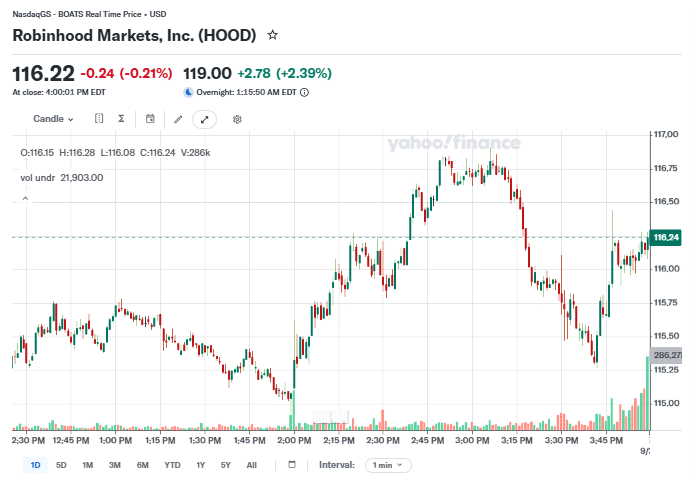
The announcement came on Tuesday evening, after the regular trading session. HOOD shares closed at $116.22 on September 29, down 0.21%, according to Yahoo Finance data. In overnight trading, the stock was quoted at $119.00, up 2.39%, as of 1:15 a.m. EDT on September 30.
What to Watch
Four things will show how significant the product becomes:
- The regulatory route Robinhood discloses for its US contracts
- The eligibility requirements it sets for retail customers
- Its fee schedule once the 0.01% introductory rate ends
- The outcome of CME’s lawsuit against the CFTC
Robinhood has said only that the contracts will arrive “in the coming months.”
Also Read: Binance Pay Expands to PayPay Merchants Across Japan