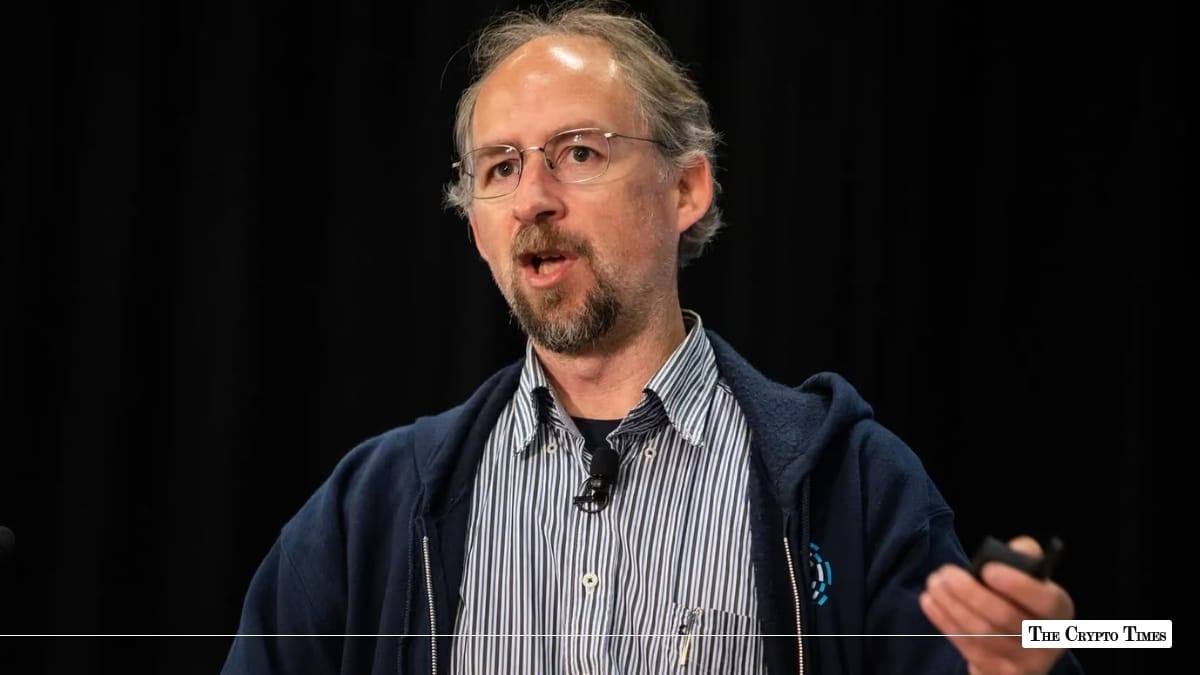
Adam Back occupies a particular place in Bitcoin’s history. His Hashcash is cited in the white paper, he co-founded one of the oldest infrastructure companies in the industry, and for years he has been named in speculation about who created Bitcoin.
This month he is in the news for three other reasons: a $320 million theft from a Blockstream-built sidechain, the collapse of a public listing for a bitcoin treasury company he was to lead, and a set of mining disputes working through US courts.
Most coverage has run them together as a single story of a business empire under strain. The documents describe something more specific. They involve different companies, different obligations, and in one case a lawsuit filed by himself.
Back is a British cryptographer. Hashcash is cited in the Bitcoin white paper. He co-founded Blockstream and has denied being Satoshi Nakamoto. The Crypto Times treated that identity claim as unproven.
What is on the record this month is narrower: a sidechain theft with coins still missing, a cancelled public listing with a cash termination fee, and mining-related court files that do not all run against him.
1. Liquid: coins still out
The Liquid Network is a federated Bitcoin sidechain Blockstream launched in 2018. LBTC is meant to be a 1:1 claim on bitcoin locked in federation custody.
On September 6 an Elements bug let attackers mint unbacked LBTC and drain bitcoin through peg-outs. About 4,000 BTC left the reserves. The Crypto Times covered the September 10 restart and the September 11 ransom refusal.
Blockstream’s later incident assessment says the attacker identified themselves on-chain, returned 3,400 BTC on September 7 (Bitcoin block 965,950), and that about 602 BTC remain outstanding. The company shipped Elements v23.3.4, said it will cover the 1:1 peg, refused a 10% bounty, and said withholding the rest is a crime, not a white-hat disclosure.
That shortfall is a Liquid/Blockstream operations problem. It is not a judgment against Back personally, and it is not the BSTR treasury vehicle.
2. BSTR: the listing is dead; the fee is not
On July 17, 2025 BSTR Holdings announced a business combination with Cantor Equity Partners I (Nasdaq: CEPO), a Cantor Fitzgerald–sponsored SPAC. The pitch was a public Bitcoin treasury starting from 30,021 BTC plus up to $1.5 billion of fiat financing. The Crypto Times reported that launch. Back was named CEO and co-founder of BSTR.
It collapsed in two stages. On July 8, 2026, the parties said they would not proceed under the original agreement, dropped the PIPE financing, and postponed the shareholder vote indefinitely while they renegotiated. On August 20, 2026, the parties signed a Termination and Release Agreement. CEPO’s current report describes the unwind.
Under that contract the Seller pays CEPO $15 million cash or may ask Blockstream Capital Partners LLC to pay. The schedule in the filing:
- $10 million on September 19, 2026
- $5 million on December 1, 2026
The Form S-4 is to be withdrawn. PIPE subscriptions and Cantor advisory mandates ended. CEPO said it will look for another target.
This newsroom has not seen a public receipt confirming that the 19 September tranche cleared. The obligation is in the SEC-filed agreement. Payment status is a separate fact.
A dead SPAC is not a Liquid hack. Blockstream Capital Partners appears in the fee clause if BSTR asks it to pay. That is not the same as Blockstream Corporation covering LBTC.
3. Mining cases: read the caption
Several mining and hosting fights are in U.S. courts. They do not all point the same way.
Blockstream Corporation, Thigmotropism LLC, and Adam Back v. Innosilicon Technology Ltd., S.D.N.Y. No. 1:25-cv-00902. Judge Colleen McMahon confirmed an arbitration award on May 26, 2026. Final judgment entered July 13, 2026: about $5.88 million to Blockstream, $19.23 million to Thigmotropism, $715,081 to Back, plus $2.34 million in arbitration costs and 8% interest. That file is Back collecting, not being sued.
River Financial and Blockstream Services Canada. River’s complaint seeks about $6.7 million after a December 2024 early-termination deal on prepaid mining hosting: a $3.5 million refund plus a $3.1 million termination fee, in $239,389.40 monthly instalments that River says stopped after March 31, 2026. Blockstream Services Canada was spun out of Blockstream Corporation around mid-2024. The defendant on that caption is the Canadian company, not automatically Blockstream Corp. or BSTR.
Other mining-hosting disputes tied to the old Blockstream Mining stack and counterparties such as Exacore have been reported around equipment, power, and deposits. Those need the docket, not a group headline. Related financing figures circulating near “$2 billion” are not a single admitted liability on one balance sheet in the public papers reviewed for this story.
Also Read: El Salvador Builds a Government-Backed Stablecoin App With Modveon on Base