
The U.S. crypto tax deadline that matters this month is not a new rule created for digital assets. It is the regular extended filing deadline for individual taxpayers who received a valid extension from the Internal Revenue Service (IRS) to file their 2025 federal return.
For those taxpayers, October 15, 2026 is the extended filing deadline. But the deadline matters more for crypto users this year because 2025 is the first tax year in which many U.S. brokers began reporting digital-asset gross proceeds on Form 1099-DA.
That creates a new reconciliation requirement: the IRS can receive third-party proceeds information, while many taxpayers may still need to calculate cost basis, holding period, income events, and wallet-level activity themselves. The IRS digital-assets guidance says brokers must report gross proceeds for certain digital-assets transactions beginning with transactions on or after January 1, 2025, while basis reporting applies to certain transactions beginning in 2026.
For a broader overview of U.S. crypto taxation and how the rules compare internationally, check The Crypto Times’ Crypto Tax Rates in 2026 guide for additional context.
This is not tax advice. Crypto users should confirm their own facts with a qualified tax professional or the IRS, especially if they used multiple exchanges, self-custody wallets, DeFi protocols, foreign platforms, or staking services.
Key Highlights
- October 15, 2026 is the extended filing deadline for taxpayers who timely filed Form 4868 before April 15, 2026 with the IRS.
- The extension gave taxpayers more time to file, not more time to pay. Any 2025 tax owed was generally still due on April 15, 2026.
- Digital-asset activity is reported on the regular federal income tax return, not through a separate “crypto tax return.”
- Form 1099-DA adds a new reporting layer for many 2025 digital-asset sales, but taxpayers may still need to supply missing basis information.
- For most 2025 transactions, brokers were not required to report cost basis, so taxpayers may still need to calculate their own basis and gain or loss.
- Missing the October 15 deadline can trigger failure-to-file penalties on top of any failure-to-pay penalties and interest.
Why October 15 Matters for Crypto Filers
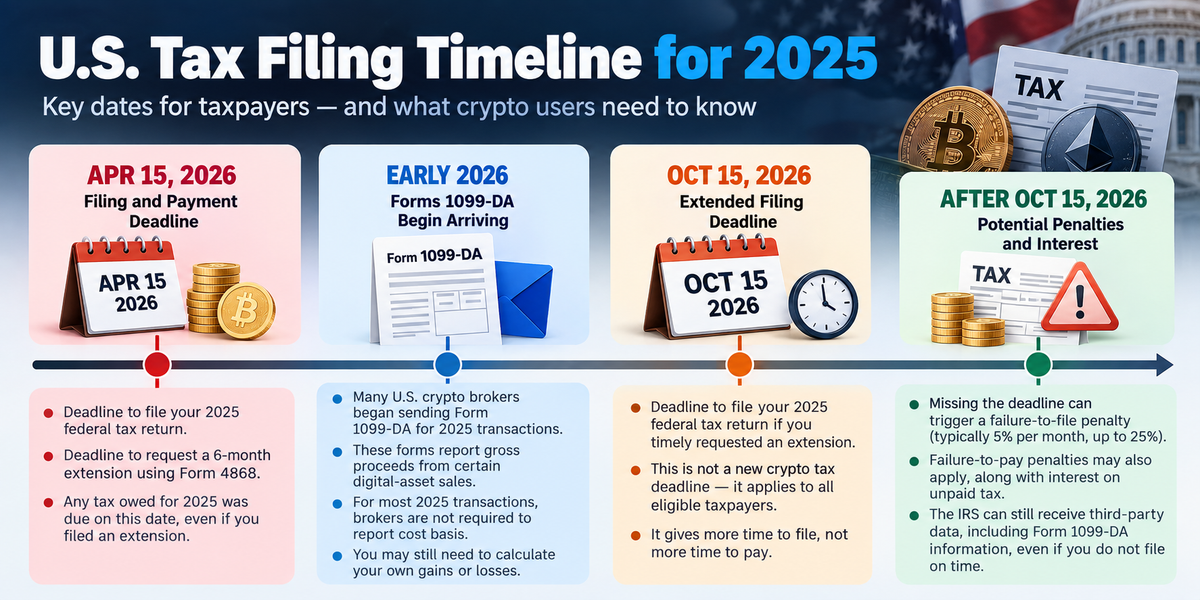
The original federal filing and payment deadline for most 2025 individual income tax returns was April 15, 2026. Taxpayers who submitted Form 4868 by that date received an automatic six-month extension to file. That extension runs out on October 15.
For crypto users, the deadline is important because the IRS digital-asset reporting system is becoming more data-driven. Taxpayers must still answer the digital-asset question on Form 1040, report capital gains and losses, include crypto income where applicable, and reconcile their own records with any forms received from brokers.
The extension does not pause interest on unpaid tax. It only gives more time to complete and file the return.
The Timeline: From April 15 to October 15
April 15, 2026: Original Filing and Payment Deadline
April 15 was the main deadline for 2025 individual returns. It was also the deadline to request an automatic extension using Form 4868.
For taxpayers who owed money, the payment was still due in April. The extension only provided additional time to file but did not extend the deadline for paying tax owed. The IRS’s Form 4868 guidance states that taxpayers should estimate their tax liability and pay any amount due when requesting the extension.
Early 2026: Forms 1099-DA Begin Reaching Crypto Users
For the 2025 tax year, brokers began reporting certain digital-asset sales using Form 1099-DA. These forms are meant to report proceeds from broker transactions involving digital assets. Their instructions state that brokers must use the form for sales they effected in 2025, but brokers are not required to report basis information for those sales.
For 2025 transactions, basis information may be voluntarily reported by a broker, but it is not generally mandatory. For certain covered digital assets sold beginning January 1, 2026, mandatory basis reporting begins under the phased-in broker-reporting rules.
Taxpayers still need to calculate gain or loss using their own exchange files, wallet history, and acquisition records.
The Crypto Times has previously covered the development of the IRS’ digital-asset reporting system, which provides background information on the reporting framework.
September 2026: Crypto Legislation Stalls, But Tax Rules Remain
The Digital Asset Market CLARITY Act failed 49-50 in the Senate in September after months of review and political and industry lobbying efforts. That political setback does not change the October 15 filing obligation.
Digital-asset tax reporting is already operating under existing IRS rules and broker-reporting regulations. Taxpayers should not assume that pending crypto legislation delays their filing responsibilities.
October 5–14, 2026: Final Reconciliation Window
This is the final practical window for taxpayers on extension to check records, confirm forms, review wallet data, and prepare missing basis information.
For active crypto users, the hardest part is often not answering whether they traded. It is matching transactions across exchanges, self-custody wallets, bridges, DeFi activity, staking rewards, and token swaps.
October 15, 2026: Extended Filing Deadline
October 15 is the last regular day to timely file most calendar-year 2025 individual returns that received the standard extension. Certain taxpayers affected by disasters or other special circumstances can have different deadlines.
A taxpayer who submits electronically should not wait until the last few hours if crypto records are complex. A rejected e-filed return may still be fixable within a short retransmission window, but that should not be treated as extra planning time.
After October 15: Late-Filing Risk Begins
Once the extended deadline passes, taxpayers who still have not filed can face failure-to-file penalties. If tax remains unpaid, failure-to-pay penalties and interest can also continue. The IRS Failure to file penalty guidance says the penalty generally applies when a return is filed late and tax is owed, subject to applicable limits, exceptions, and reasonable-cause rules.
The 1099-DA Problem: Proceeds Are Not the Same as Taxable Gain
The biggest practical issue for crypto filers this year is that Form 1099-DA may give the IRS proceeds information without giving the taxpayer a complete cost-basis answer.
That matters because taxable gain generally depends on more than the sale price. A taxpayer needs to know:
- when the digital asset was acquired
- how much was paid for it
- whether transaction fees affect the calculation
- when it was sold or exchanged
- whether the holding period was short-term or long-term
- whether the transaction was a capital event or an income event
If a broker reports proceeds but not basis, the taxpayer still has to calculate the missing side of the trade.
For example, if a taxpayer sold $20,000 worth of crypto in 2025, that number alone does not show taxable income. The gain or loss depends on what the taxpayer paid for the asset and how the transaction is characterized for tax purposes.
The IRS has advised taxpayers receiving 2025 Forms 1099-DA that most statements will not include basis and that taxpayers will need to calculate basis to determine their gain or loss.
This can become more complicated when transaction histories span centralized exchanges, self-custody wallets, and DeFi platforms. The Crypto Times’ report on Chainalysis’ estimates of $457 billion of potentially taxable crypto activity in 2025 examined some of the reporting gaps created by self-custody, DeFi, and cross-platform activity.
That is why October 15 is especially important for crypto users who asked for more time. The extra months were useful only if they were used to rebuild records.
What Counts as Digital-Asset Activity?
Taxpayers must answer the digital-asset question on Form 1040. In general, a “Yes” answer may be required if the taxpayer received digital assets as a reward, award, or payment, or sold, exchanged, or otherwise disposed of a digital asset or a financial interest in one. The IRS digital-assets guidance lists examples of transactions that require a “Yes” answer.
Common examples include:
- selling crypto for cash
- trading one crypto asset for another
- spending crypto for goods or services
- receiving crypto as payment
- receiving staking, mining, airdrop, or reward income
- disposing of NFTs or other digital assets
A taxpayer who only bought crypto with fiat currency and held it may generally be able to answer “No” to the digital-asset question, as may someone who only transferred assets between wallets they own or control. The exact answer depends on the taxpayer’s facts. The IRS lists purchases made with real currency and transfers between wallets or accounts controlled by the taxpayer among situations that can result in a “No” answer, subject to applicable exceptions.
Where Crypto Activity Is Reported
Crypto activity can appear in different parts of a tax return depending on what happened.
Capital dispositions are typically reported on Form 8949 and summarized on Schedule D. The IRS says taxpayers who sell, exchange, or otherwise dispose of digital assets held as capital assets should use Form 8949 to calculate gain or loss.
Crypto received as income may be reported differently. Mining, staking rewards, airdrops, referral rewards or payment for services may belong on Schedule 1, Schedule C, or wage reporting, depending on the circumstances.
That distinction matters. A trader selling BTC is not in the same reporting position as a freelancer paid in USDT, a miner receiving block rewards, or a business accepting crypto from customers.
Final Crypto Tax Checklist Before October 15
Crypto users filing on extension should review the following before the deadline:
- Confirm that Form 4868 was actually filed and accepted. If no valid extension exists, the return may already be late.
- Gather every 2025 Form 1099-DA and any other tax forms from exchanges, brokers or payment platforms.
- Export transaction history from all exchanges used during 2025.
- Pull wallet history for self-custody wallets, including transfers, swaps, bridge activity, and DeFi interactions.
- Rebuild cost basis where the broker did not provide it.
- Separate short-term and long-term transactions.
- Identify income events, including staking, mining, rewards, airdrops, and crypto received as payment.
- Review crypto-to-crypto trades, not just crypto-to-cash sales.
- Check whether any foreign financial accounts or other foreign assets create separate reporting obligations, such as FBAR or Form 8938. These requirements depend on the taxpayer’s specific facts and are separate from the federal income-tax return.
- Answer the Form 1040 digital-asset question accurately.
- File electronically if possible and pay any remaining balance.
- Keep copies of forms, CSV files, wallet exports and calculation reports.
What Happens If the Extended Return Is Late?
If a taxpayer misses the extended deadline and owes tax, the failure-to-file penalty can apply. The IRS generally calculates this penalty at 5% of unpaid tax for each month or part of a month that the return is late, up to 25%, subject to applicable rules and exceptions.
If both failure-to-file and failure-to-pay penalties apply in the same month, the failure-to-file penalty is generally reduced so the combined monthly penalty does not exceed the IRS limit for that month.
A separate failure-to-pay penalty can continue on unpaid balances, and interest can also accrue.
The practical lesson is simple: even if a taxpayer cannot pay the full amount immediately, filing the return on time can avoid or reduce additional penalties. Taxpayers who cannot pay in full can also explore IRS payment options.
Why This Deadline Is Different Than Prior Crypto Filing Seasons
In earlier years, many crypto users were working mainly from their own exchange statements and wallet records. The IRS still expected reporting, but third-party digital-asset information reporting was less standardized.
Form 1099-DA changes the environment; it adds a new layer of third-party reporting to the 2025 filing season. The IRS requires brokers to report gross proceeds for certain digital-asset transactions beginning with transactions in 2025, while basis reporting generally phases in for certain covered digital assets beginning in 2026.
For 2025 crypto filers: that means a broker’s proceeds information may need to be reconciled with the taxpayer’s own basis records. The 2025 Form 1099-DA instructions confirm that brokers were not required to report basis for 2025 sales, although they could voluntarily provide it.
The result is a filing process in which third-party proceeds information and taxpayer-maintained transaction records may both be necessary to determine the correct gain or loss.
Bottom Line
October 15 is not a special crypto tax holiday. It is the final filing deadline for U.S. taxpayers who individually received a valid extension in April for their 2025 federal income tax return.
For crypto users, however, the date carries extra weight this year. Form 1099-DA brings new third-party reporting of certain 2025 digital-asset sale proceeds, while most 2025 forms do not include broker-reported basis. Taxpayers therefore remain responsible for calculating basis, reporting income events, and reconciling wallet-level activity.
The safest approach is to treat the final days before October 15 as a reconciliation window, not a paperwork formality.
Crypto filers should check the extension, match 1099-DA proceeds, rebuild cost basis, include income events, answer the digital-asset question correctly, and file on time.
The deadline is about filing the return. The key compliance test is making sure the transactions and calculations behind it can be supported by the taxpayer’s records.