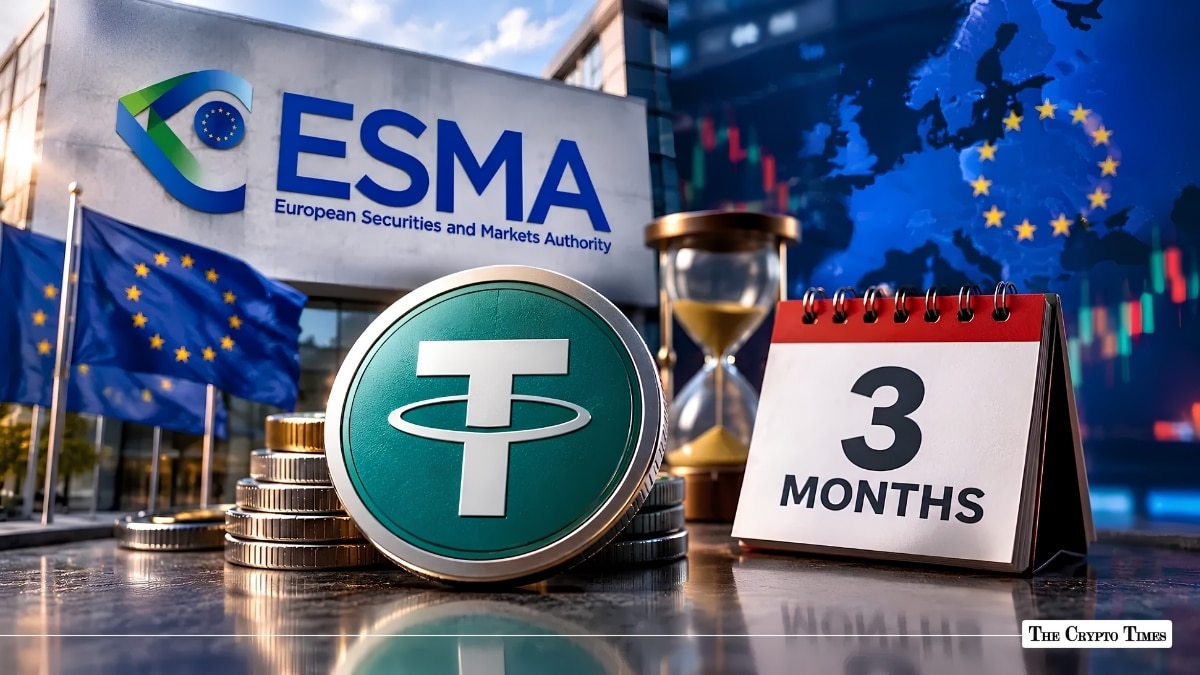
The European Union has moved from restricting Tether’s USDT to engineering its exit from regulated crypto venues. On October 8, the European Securities and Markets Authority (ESMA) told national regulators that MiCA-authorized crypto-asset service providers should stop offering services tied to stablecoins that do not comply with the bloc’s Markets in Crypto-Assets Regulation, with existing customer positions wound down within three months of the opinion’s publication, an outer limit that falls around January 8, 2027.
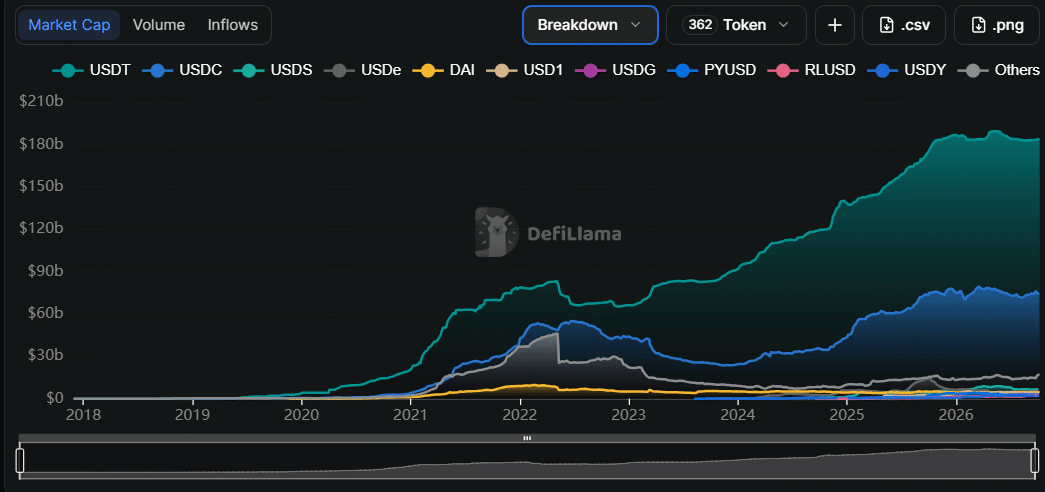
The opinion does not name USDT. It does not need to. Tether’s dollar token is the largest stablecoin by market value, about $184 billion on October 8, according to data from DefiLlama (on October 9 at 18:00 UTC), and remains outside MiCA’s authorization regime. For Europe’s crypto market, the practical consequence is a three-month operational countdown: no new buying, no promotion, no continued availability through regulated platforms, and only tightly limited exit services for existing holders.
The move is less a sudden ban than the completion of a regulatory sequence that began when MiCA’s stablecoin rules took effect in June 2024. But its scope is broader than earlier delistings. ESMA is targeting not only spot trading pairs, but the full customer journey across exchanges, brokers, custodians, transfer services, advice, and portfolio management.
What ESMA actually ordered
ESMA’s October 8 opinion is addressed to national competent authorities rather than directly to firms. It instructs them to ensure that authorized crypto-asset service providers neither maintain, introduce, nor facilitate customer access to non-MiCA-compliant asset-referenced tokens or e-money tokens.
The services covered are extensive. They include operating a trading platform, crypto-to-fiat and crypto-to-crypto exchange, order execution, placing crypto-assets, receiving and transmitting orders, investment advice, transfers, custody and administration, and portfolio management. ESMA says national authorities should assess these services individually or in combination, rather than treating any one of them as a loophole.
In practical terms, an EU-authorized platform cannot simply remove a USDT trading pair and call the job done. If a customer can still acquire USDT through another route on the platform, such as a conversion tool, an OTC desk, a broker interface, or a transfer pathway, the provider is expected to close that route as well.
ESMA also rejected the idea that risk warnings are sufficient. The regulator’s position is that warnings, additional disclosures, or client acknowledgements would not adequately address the risks created by the absence of MiCA’s issuer-level safeguards; the problem lies with the token’s lack of compliance, not with whether a customer has been informed before buying it.
The deadline applies to existing balances. National authorities should require providers to resolve remaining customer holdings “as soon as possible, and no later than three months” after the opinion’s publication, placing the outer deadline around January 8, 2027.
During that period, platforms may continue limited services needed for an orderly exit: selling, converting, withdrawing, transferring, or safekeeping affected tokens. They may not allow purchases, promotion, trading, or continued market availability.
Why USDT is the central case
USDT is not the only stablecoin affected by the guidance, but it is the most consequential. Tether’s token remains the largest stablecoin globally, with a market capitalization of roughly $184 billion, according to data from DefiLlama (on October 9 at 18:00 UTC).
MiCA classifies many stablecoins as either asset-referenced tokens or e-money tokens. Tokens offered to EU users must meet requirements covering authorization, reserves, redemption, governance, and disclosure.
However, USDT has not received MiCA authorization as an e-money token in the EU.
That does not mean USDT becomes illegal for Europeans to hold in a self-custodied wallet. The opinion concerns services provided by MiCA-authorized firms. A user can still withdraw USDT to a private wallet, transfer it elsewhere, or hold it directly. What changes is the regulated on-ramp and off-ramp: EU platforms can no longer function as convenient places to acquire or maintain USDT exposure.
The distinction matters. MiCA is not attempting to prohibit a token at the protocol level. It is restricting the distribution and servicing of that token through authorized financial infrastructure. The result is a regulatory perimeter: compliant tokens remain available through licensed venues; non-compliant tokens are pushed outside it.
A broader squeeze than the first delisting wave
This is not Europe’s first attempt to restrict USDT. ESMA first addressed the issue on January 17, 2025, when it published a statement, paired with a Q&A from the European Commission, telling crypto providers to restrict purchases of non-compliant stablecoins and move them to sell-only trading, with national regulators ensuring compliance by the end of that quarter.
The new opinion goes further in three ways.
First, it expands the scope beyond spot markets. Custody, transfers, advice, portfolio management, and order routing are all included.
Second, it targets indirect acquisition channels. A platform must assess whether a customer can still obtain a non-compliant token after a trading pair disappears.
Third, it sets a supervised wind-down period for existing balances. Earlier guidance focused on stopping new purchases; the October opinion requires national regulators to ensure existing exposure is resolved within three months.
That shift reflects a supervisory concern: partial restrictions can leave customers with continued access through adjacent products or services. ESMA wants firms to treat the token’s regulatory status as a firm-wide constraint, not a listing decision confined to a trading desk.
The market-structure impact
The immediate effect will be felt in liquidity, pricing, and venue choice.
USDT remains deeply embedded in global crypto trading. It is commonly used as a quote currency, collateral asset, settlement token, and cross-border payment rail. Removing or restricting it on EU-regulated venues does not eliminate that role globally, but it changes how European users access it.
For EU retail traders, the likely outcome is a migration toward MiCA-compliant alternatives, particularly Circle’s USDC and EURC, which are issued in the EU through Circle’s authorized French entity and can continue to be offered under the regime.
For institutions, the effect may be more operational than emotional. Funds, market makers, and corporate treasuries with EU exposure will need to review custody arrangements, trading manuals, counterparty permissions, and internal policies. A token that remains acceptable globally may no longer be acceptable in an EU-regulated account.
The deeper issue is fragmentation. Crypto markets are globally connected, but stablecoin regulation is increasingly jurisdiction-specific. A trader in Dubai, Singapore, or the United States may continue to use USDT without restriction, while an EU customer faces a shrinking set of regulated access points. That creates arbitrage, operational complexity, and potential differences in liquidity across venues.
Liquidity: The measure that matters
The central question is whether Europe can maintain deep, efficient markets without USDT.
The early evidence suggests the disruption may be contained. A July 2026 study by Nicola Borri and Kirill Shakhnov concluded that MiCA has not caused a significant global outflow from USDT; its effect has been largely confined to regulated European venues, where USDC gained ground as platforms restricted the Tether token, while aggregate market shares and trading volumes “hardly change.”
Consistent with that finding, the authors report that USDC’s share of combined USDT-USDC trading rose only modestly, from 17.70% to 18.24%, around the April 2025 restrictions on several EU platforms. The increase is meaningful but small, suggesting that substitution is possible, yet neither automatic nor dramatic at the global level.
What happens to existing USDT holders
For an EU customer holding USDT on a regulated exchange, the next three months will be defined by platform-specific instructions.
ESMA permits providers to support the liquidation, conversion, withdrawal, transfer, or safekeeping of existing holdings. But it says those services must be time-limited, risk-based, and closely supervised.
That language leaves room for different outcomes across platforms. One exchange may allow customers to withdraw USDT until January 8. Another may set an earlier internal cutoff, convert balances automatically, or restrict withdrawals to compliant stablecoins or fiat. The opinion sets the outer boundary; national regulators and firms determine the details.
Customers should therefore treat January 8 as a legal deadline, not necessarily a personal one. A platform may require action earlier, particularly if it needs to close operational systems, update contracts, or comply with directions from its home-state regulator.
The practical risk is not that USDT disappears from a user’s wallet. It is that a user may find fewer regulated ways to convert it into euros, move it into a compliant stablecoin, or use it in an EU-based trading account.
Why ESMA chose enforcement by opinion
ESMA did not issue a new regulation, publish a token blacklist, or amend MiCA. It issued an opinion clarifying how national authorities should apply existing MiCA requirements. That approach has advantages. It allows ESMA to set a common supervisory expectation quickly, without waiting for legislation. It also leaves implementation to national regulators, who know their local markets and authorized firms.
But it creates unevenness. Enforcement intensity may differ between member states. A platform authorized in one jurisdiction may face more aggressive supervision than a comparable firm elsewhere. Firms will need to document their token-assessment processes carefully, because the absence of a public blacklist does not remove their obligation to determine which tokens are compliant.
The approach also shifts the burden to compliance teams. Each provider must assess a token’s regulatory status, identify any exemption or transitional arrangement, map every customer acquisition route, and implement technical and contractual controls to prevent new exposure.
The competitive consequence
The clearest beneficiary is Circle. USDC and EURC can continue to be offered in the EU through Circle’s authorized French entity, giving the company a regulatory advantage at precisely the moment a major competitor faces a supervised exit.
But the larger consequence may be the acceleration of a two-track stablecoin market.
One track is MiCA-compliant: authorized issuers, EU-facing reserves and redemption arrangements, disclosure obligations, and access through regulated platforms. The other is global-market USDT: deep liquidity, broad exchange adoption, and continued use across much of the world, but restricted access within the EU’s authorized perimeter.
For European policymakers, that is the intended outcome. MiCA is designed to make regulated tokens more attractive by making non-compliant tokens harder to distribute through licensed infrastructure.
For Tether, the challenge is not existential. USDT’s global scale and trading role remain substantial. But Europe is becoming a more expensive market to serve indirectly. Without EU authorization, Tether loses regulated distribution, marketing, custody, and portfolio-management channels in the bloc.
The unresolved questions
Three issues will determine whether the policy achieves its stated goals.
First, will euro liquidity deepen? If EURC and other compliant euro tokens gain volume, Europe will have strengthened its local stablecoin market. If euro pairs remain shallow, traders may simply shift to offshore venues or dollar-pegged alternatives.
Second, will institutional adoption follow? MiCA-compliant tokens may win regulatory preference, but institutions also care about market depth, collateral mobility, and global acceptance. A compliant token with thin liquidity may not displace a non-compliant token with deep liquidity.
Third, will enforcement be consistent? ESMA has given national authorities a common framework, but implementation will depend on supervisory capacity and political appetite across 27 member states.
The larger signal
ESMA’s opinion is a test of whether crypto regulation can reshape market structure without simply displacing activity. The EU is not trying to make USDT vanish globally. It is trying to make MiCA compliance the price of admission to Europe’s regulated crypto economy.
If euro-denominated liquidity strengthens and compliant stablecoins absorb demand, the policy will be viewed as a successful use of supervisory pressure. If liquidity migrates offshore or users retain USDT in self-custody while euro markets stay thin, the EU will have narrowed regulated access without solving the underlying liquidity problem.
Either way, January 2027 will mark more than a deadline for USDT. It will show whether Europe can build a stablecoin market around its own rules, or merely build a border around everyone else’s.
Also Read: The Fed’s GENIUS Act Blueprint: What New Capital and Reserve Rules Mean