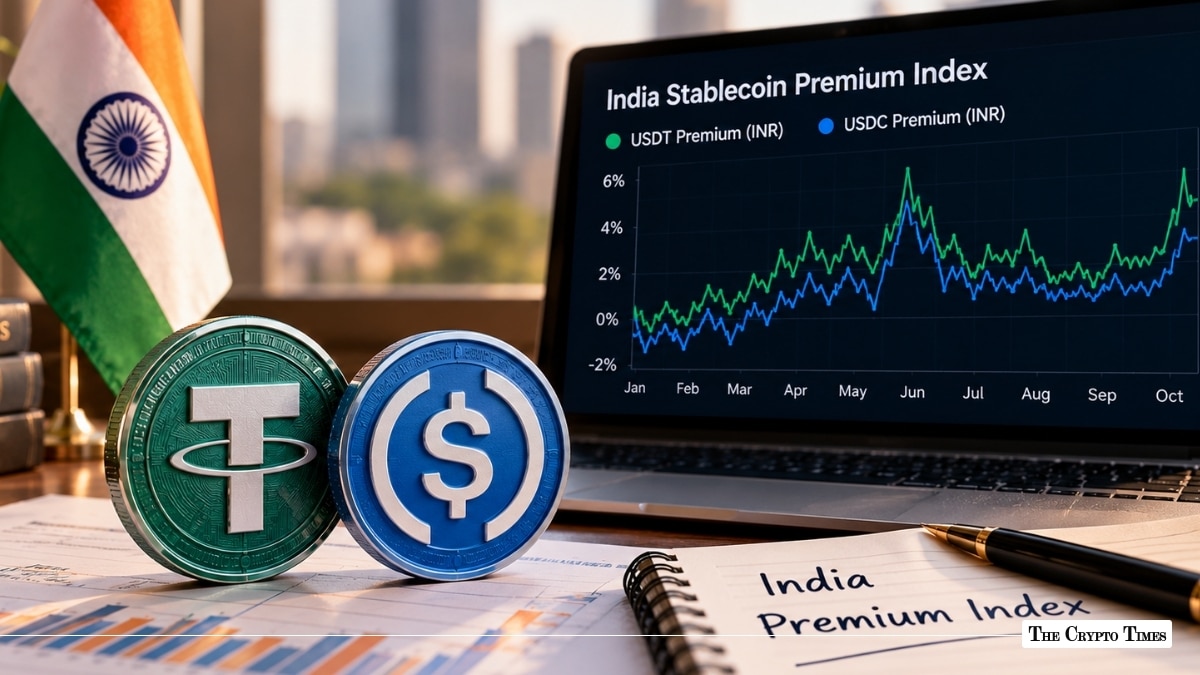
The India premium index shows how much more Indians pay for one dollar stablecoin than the USD/INR reference rate implies. At the 13 October 2026 fix, the USDT premium in India was +4.27% and the USDC premium in India was +4.51%. One trading day earlier, both read +2.74%.
That swing is why the number needs context before anyone quotes it. This guide explains the two versions of the premium, the reference rate behind them, what the figure can and cannot say, and how to cite it.
What the India premium index measures
The Crypto Times publishes two daily indices: the India USDT Premium Index (CTPI-USDT-SPOT-INR) and the India USDC Premium Index (CTPI-USDC-SPOT-INR). Both sit in the India stablecoin hub.
Every trading day between 11:30 and 12:30 IST, the index records buy and sell prices on Indian exchanges. It takes the middle price on each exchange, drops any quote that fails quality checks, and uses the median across exchanges as the day’s India price. The USDT fix is struck at 12:35 IST and the USDC fix at 12:31 IST.
In plain terms: if the reference rate says a dollar costs ₹95.7750 and one USDT costs ₹99.74 on Indian exchanges, Indians are paying more than the world dollar price. The size of that gap is the premium.
Raw vs clean premium
The index publishes the premium two ways. The index pages call the clean version peg-adjusted.
- Raw premium is what a buyer in India pays over the dollar reference. It answers the question “how much more is this costing me?”
- Clean premium divides out the coin’s own deviation from its dollar peg. It isolates the India-specific part and is the headline figure on each index page.
Here is how the two compare at the 13 October 2026 fix.
| USDT | USDC | |
|---|---|---|
| India price at the fix | ₹99.74 | ₹100.09 |
| USD/INR reference rate | ₹95.7750 | ₹95.7750 |
| Coin’s global price | $0.9987 | $1.0000 |
| Raw premium | +4.14% | +4.51% |
| Clean premium | +4.27% | +4.51% |
USDT traded at $0.9987 abroad that day, a little under one dollar. Indian buyers paid full rupee prices for a token worth slightly less, so removing that dip lifts the India-specific premium 0.13 percentage points above the raw figure. USDC traded at $1.0000, so its raw and clean premiums match.
Quote the clean premium to describe the India effect. Quote the raw premium to describe a buyer’s cost. Always say which one you are using.
Why the index uses ECB rates and not the RBI rate
Every premium needs a dollar reference. The index derives USD/INR from European Central Bank (ECB) euro reference rates by dividing EUR/INR by EUR/USD. For 12 October, the ECB published EUR/INR at 107.0860 and EUR/USD at 1.1181. That gives ₹95.7750, the rate used for the 13 October fix.
The ECB sets these rates through a daily concertation procedure between central banks, which normally takes place around 14:10 CET, and publishes them at around 16:00 CET. Its copyright terms allow free use of the data if the ECB is cited as the source and any modification is stated. Anyone can rebuild the index’s denominator from the same public file.
The RBI no longer publishes a reference rate. It stopped after 9 July 2018, when Financial Benchmarks India Private Limited (FBIL) took over the USD/INR reference rate. The Crypto Times says India’s official benchmark cannot be redistributed on the same terms as the ECB rate. For that reason, the index figures are not the official reference rate and should not be described as such.
The ECB reference is from the previous working day. A rupee move since then is not in the denominator, so small day-to-day changes in the premium can partly reflect that lag.
What the number can tell you
It shows what a dollar costs in rupees through a stablecoin, measured against the reference rate. On 13 October, ₹1,00,000 bought 1,002.61 USDT. Adjusted for USDT’s global price, that amount was worth ₹95,904, so the premium paid was ₹4,096.
It shows direction. The index page says a jump means dollars are scarce onshore and a fall means supply is catching up. Since the series began on 9 July 2026, daily USDT readings have stayed between 2.56% (8 October) and 5.29% (8 September). USDC readings have ranged from 2.74% to 5.44%.
It also prices the choice between coins. At the 13 October fix, USDT was cheaper than USDC by 0.24 percentage points, about ₹220 on ₹1,00,000.
The index page links the premium to demand outrunning supply. Under Section 115BBH, the Income Tax Department taxes income from transferring virtual digital assets (VDAs) at 30%, and Section 194S applies 1% TDS on transfers. The page lists these taxes among the frictions that limit how much new USDT flows into India.
What the number cannot tell you
- It is not a forex rate or India’s official reference rate.
- It is not a black-market dollar rate. The index page notes that India has no parallel currency market of the kind Argentina or Nigeria have had.
- It is not a quote. Each exchange adds its own spread and fees, so real trades cost a little more than the fix.
- It is not a trading signal or a fee charged by anyone.
- It is not a safety ranking. A lower premium means a cheaper dollar on the day. It says nothing about a coin’s reserves or issuer.
- It is not for contract settlement. The ECB itself says its reference rates are for information only.
- It is not a live price. The “right now” reading is indicative and is never part of the daily fix series.
The number of exchanges also matters. Five exchanges counted toward the USDT fix on 13 October, and two counted toward the USDC fix. The USDC index uses a depth-weighted median because a single thin order book could otherwise move a two-exchange fix.
How to cite the India premium index
Cite the daily fix, not the live reading. A good citation has four parts: the figure, the basis (peg-adjusted or raw), the fix date, and a link to the index page.
The lines below use the 12 October 2026 fix, when both indices read +2.74% peg-adjusted. Each index page shows the ready-made line for its latest fix, so swap in the current figure and date before you publish.
USDT
USDT premium in India: +2.74% (peg-adjusted) at the 12 Oct 2026 daily fix — The Crypto Times India USDT Premium Index (CTPI-USDT-SPOT-INR), https://www.cryptotimes.io/data/india-usdt-premium-index/
USDC
USDC premium in India: +2.74% (peg-adjusted) at the 12 Oct 2026 daily fix — The Crypto Times India USDC Premium Index (CTPI-USDC-SPOT-INR), https://www.cryptotimes.io/data/india-usdc-premium-index/
Three habits make a citation easier to verify:
- Label the figure peg-adjusted. If you quote the raw premium, label it raw.
- Keep the fix date in the same sentence as the number.
- Name the methodology version for research work: v0.5.6 for USDT and v0.3.0 for USDC.
Historical fixes are archived, and any restatement is logged, so cited figures remain traceable to the basis under which they were published. Each index page offers the full series as CSV and JSON.
Frequently asked questions
What is the India premium index?
It is a daily measure of how much more Indians pay for USDT or USDC than the USD/INR reference rate implies. The Crypto Times publishes one index for each coin.
What is the difference between clean and raw premium?
Raw premium is the total markup a buyer pays over the dollar reference. Clean premium removes the coin’s own deviation from its dollar peg and leaves the India-specific part.
Why does the index use ECB rates?
The ECB publishes its euro reference rates openly and allows reuse with attribution, so anyone can reproduce the reference rate. India’s official benchmark is not redistributable on those terms.
Is the India USDT premium the black-market dollar rate?
No. It is the price of a dollar-pegged token on Indian exchanges measured against a published reference rate.
How often does the index update?
Once per trading day. The USDT fix is struck at 12:35 IST, and the USDC fix at 12:31 IST. There is no fix on weekends or Indian market holidays.
Disclaimer:
The Crypto Times publishes news, analysis, and educational content for informational purposes only. We do not offer financial, investment, legal, or trading advice of any kind. All content on our website is intended to be neutral and fact-based. Readers should always do their own research, consult with licensed professionals, and evaluate risks independently.
The Crypto Times does not endorse or recommend any specific cryptocurrencies, tokens, projects, financial products, or investment strategies. We do not accept legal liability for any financial losses incurred as a result of reliance on information published by us.
Disclaimer:
Some elements of this content may have been enhanced with the help of our artificial intelligence (AI) assistants for purposes such as basic refinement, review, image generation, and translation to deliver high-quality news in a shorter time frame. However, all AI-assisted content is reviewed and approved by our team to ensure accuracy, fairness, and editorial integrity.