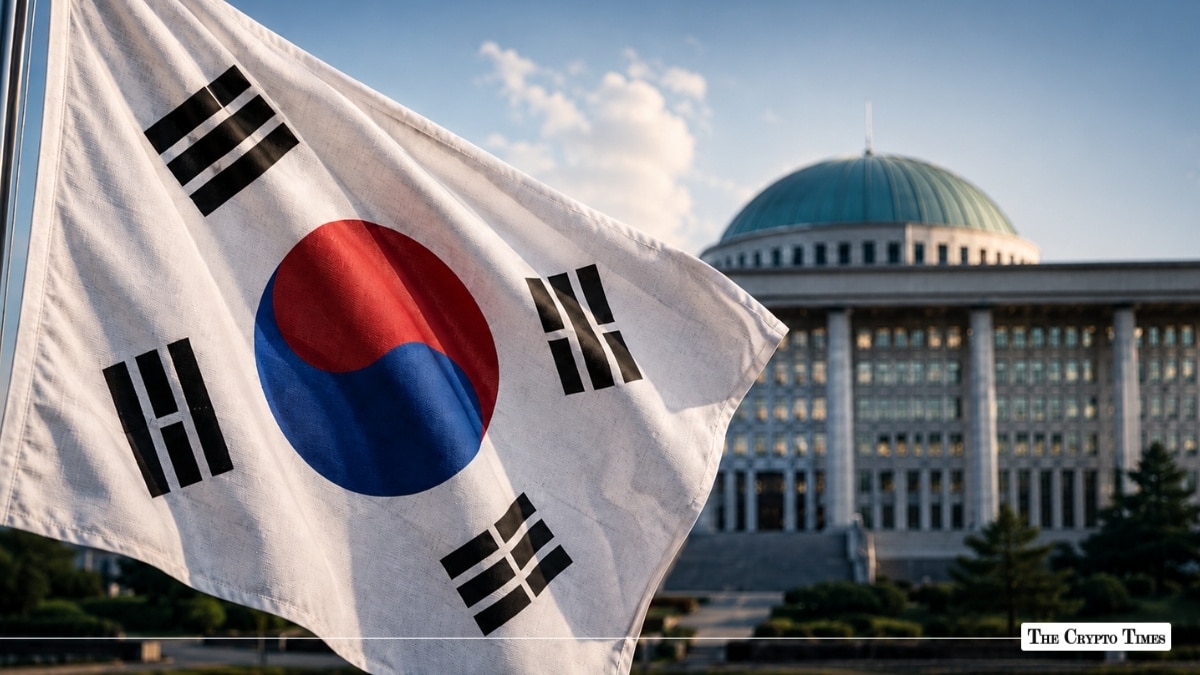
South Korea’s long-stalled effort to write comprehensive crypto legislation has found a concrete timetable. On July 20, the ruling Democratic Party of Korea held a closed-door briefing with the Financial Services Commission (FSC) at the National Assembly Members’ Office Building in Yeouido, Seoul, agreeing to accelerate the Framework Act on Digital Assets, the Phase 2 legislation that would legalize and regulate won-denominated stablecoins.
The most concrete outcome was a cadence. By committing to hold subcommittee meetings of the National Assembly’s Political Affairs Committee twice a month, the party signaled that the bill will now be pushed on a faster, more disciplined schedule, with attention turning to whether it can be submitted and debated at pace.
The First Meeting of a New Legislative Term
The July 20 session, reported by Edaily, was the first such event held since the confirmation of Political Affairs Committee Chairman Yoo Dong-soo, Secretary Park Sang-hyuk, and ruling-party members for the second half of the 22nd National Assembly. The Democratic Party was represented by lawmakers from the committee, while the authorities were led by FSC Chairman Lee Won-geon.
Park Sang-hyuk, the ruling party’s floor leader on the committee, met reporters immediately afterward. “Several lawmakers have proposed bills regarding the Framework Act on Digital Assets, and there is a great deal of interest,” he said. “Since market outlooks differ regarding the effects of the U.S. Genius Act taking effect next year, there was a general consensus that the government should quickly prepare legislatively for the Framework Act related to Korean won stablecoins, and we decided to proceed with discussions.” Dollar stablecoins, he noted, are set to be issued and distributed in earnest once the US GENIUS Act takes effect next January, a deadline that is clearly concentrating minds in Seoul.
The Twice-A-Month Plan and a September Target
Park laid out an unusually specific process. The Political Affairs Committee, he said, will “operate in accordance with the National Assembly Act during the second half of the year,” predicting it “will hold bill subcommittee meetings at least twice a month,” while stressing that party-government discussions must precede them.
The timeline hinges on the party’s internal calendar. Park noted the Democratic Party’s national convention will be held on August 17, with the selection of a new Policy Committee Chairman to follow. “As soon as the appointments for the new leadership and the Policy Committee Chairman are finalized, we will reorganize the Democratic Party’s Digital Asset Task Force and push for the bill’s introduction in September,” he said, adding: “We will make the passage of the bill in the second half of this year our top priority.”
A separate remark sharpened the September goal. At a July 15 seminar hosted by the Digital Asset Exchange Association (DAXA) and the research institute MRI, Democratic Party lawmaker Park Min-kyu said he “plans to push for the proposal of the Framework Act on Digital Assets in September.”
What Is Still Unresolved
Committee Chairman Yoo Dong-soo was candid about the obstacles. He described the Framework Act as “a bill that will determine the future competitiveness of Korea’s financial industry,” while acknowledging “there are challenges we must address, such as Korean Won stablecoins, the licensing of custodian institutions, customer asset protection, and regulatory consistency with overseas operators.” He said he had instructed the FSC to bring the government’s proposal quickly: “We cannot leave it neglected like this.”
Two specific fights stand out. The first is the one that has stalled the bill for the better part of a year: whether won stablecoins must be issued through a bank-centered consortium holding 50% plus one share, the so-called “51% rule” championed by the Bank of Korea, which has argued that allowing non-banks to issue stablecoins could cause major disruption. The second is whether to uniformly apply 15–20% equity ownership regulations to virtual asset exchanges, including Dunamu (Upbit’s operator), Bithumb, Coinone, Korbit and Gopax.
There is also a market-structure dimension that reaches into equities. Regarding single-stock leveraged ETFs for Samsung Electronics and SK Hynix, Park said lawmakers had requested the authorities “strongly monitor and assess market conditions,” and asked them to “prepare improvement measures to ensure transparency regarding the improvement of bank governance.”
From “Virtually Difficult” To A Fixed Timeline
The renewed urgency is a marked shift in tone. Just weeks earlier, the prevailing assessment inside Korea’s financial establishment was that passing the framework in 2026 was, in the words of one official cited by local media, “virtually difficult.” The bill, most expected, would slip into 2027.
The signals since have moved the other way. The government’s “2026 Economic Growth Strategy,” announced on July 14, committed to enacting the Framework Act in the second half of the year to segment the digital asset industry, establish business-conduct rules, and build a legal foundation for stablecoins. The next day, at a work-report session presided over by President Lee Jae-myung at the Blue House, FSC Chairman Lee Won-geon reported that the government would pursue the institutionalization of stablecoin issuance and strengthen anti-money-laundering rules in the second half. Ten digital-asset and stablecoin bills are already pending in the National Assembly, introduced by lawmakers from both the ruling Democratic Party and the opposition People Power Party.
Why It Matters
South Korea is one of the most active retail crypto markets in the world, and the GENIUS Act’s January start date has given Seoul a hard external deadline: without a domestic framework, a wave of dollar-denominated stablecoins could reach Korean users before a regulated won alternative exists. That competitive anxiety — the fear of ceding digital-payment rails to the dollar — is the same force driving reform across Asia, from Japan’s landmark move to legalize Bitcoin ETFs and reclassify crypto to the debates now unfolding in India.
The bank-versus-fintech question at the heart of the “51% rule” is the defining structural choice of the global stablecoin era, echoing the deposit-flight fears US community banks have raised and the ownership debates baked into Europe’s MiCA. As Kim Jong-won, chairman of the Korea Blockchain Industry Promotion Association, put it, the industry now wants direction above all: the country “must accelerate legislation by viewing stablecoins as infrastructure that needs to be nurtured under safeguards.”
What To Watch
The twice-a-month subcommittee cadence is a process commitment, not a finished law, and the hard parts remain. Watch for whether the “51% rule” survives the consolidated draft, whether the September reintroduction holds once the party finalizes its post-convention leadership, and whether the ruling party can reconcile ten competing bills into one. Korea has restarted the engine and named a month. Whether it can bridge the bank-fintech divide fast enough to legislate this year is the question the autumn will answer.
Also Read: Why the ECB Thinks Stablecoins Could Hurt Europe’s Banks