
Key Highlights
- Crypto projects have raised $1.42 billion through public token sales since January 2026.
- Ethereum leads with $334 million, followed by BNB Chain at $288 million, Base at $269 million, Solana at $241 million, and Sonic at $206 million.
- Ethereum ranked third during the comparable 2025 period but has moved into first place by capital raised in 2026.
Crypto projects have raised a total of $1.42 billion through public token sales since the start of 2026, with fundraising increasingly concentrated among a small group of blockchain ecosystems.
According to data from CryptoRank as of 15:40 UTC on August 11, the Ethereum ecosystem accounted for the largest share at $334 million. BNB Chain followed with $288 million, Base with $269 million, Solana with $241 million, and Sonic with $206 million.
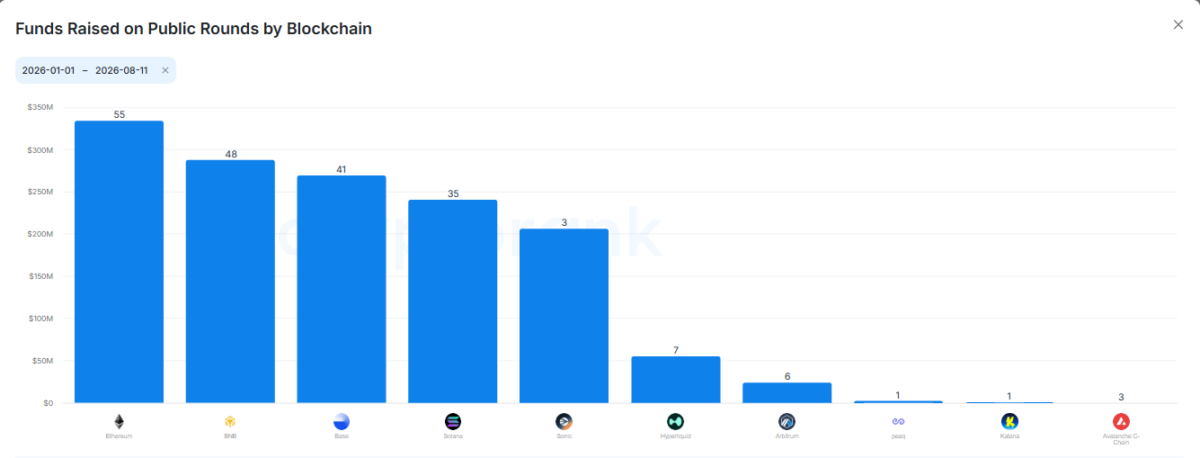
These five ecosystems together raised approximately $1.34 billion, representing 94% of all public funding recorded year-to-date. Hyperliquid ranked sixth at $55 million.
The figures cover public fundraising rounds, including initial decentralized exchange offerings (IDOs), initial exchange offerings (IEOs), and initial coin offerings (ICOs) tracked through August 11, 2026.
How 2026 compares with 2025
The distribution looked different during the comparable period of 2025.
From January 1 through August 11, 2025, Solana ranked first by total public-sale funding, followed by BNB Chain. Ethereum ranked third, with $674 million raised across 128 launched projects, according to CryptoRank data. The comparison highlights a shift in Ethereum’s relative position rather than a direct indication that activity has increased across every metric.
Ethereum has moved into first place by capital raised in the 2026 data, while the overall market has also become highly concentrated among five ecosystems. Project counts and the size of individual sales can vary significantly between periods, meaning capital raised alone does not provide a complete picture of launchpad activity.
Launchpad activity in 2026 continued to span multiple categories, including DeFi, infrastructure, GameFi, and others, with several platforms recording hundreds of sales. Gate Launchpad appeared among the higher-volume venues by number of offerings, followed by a range of specialized platforms.
Ethereum price remains under pressure
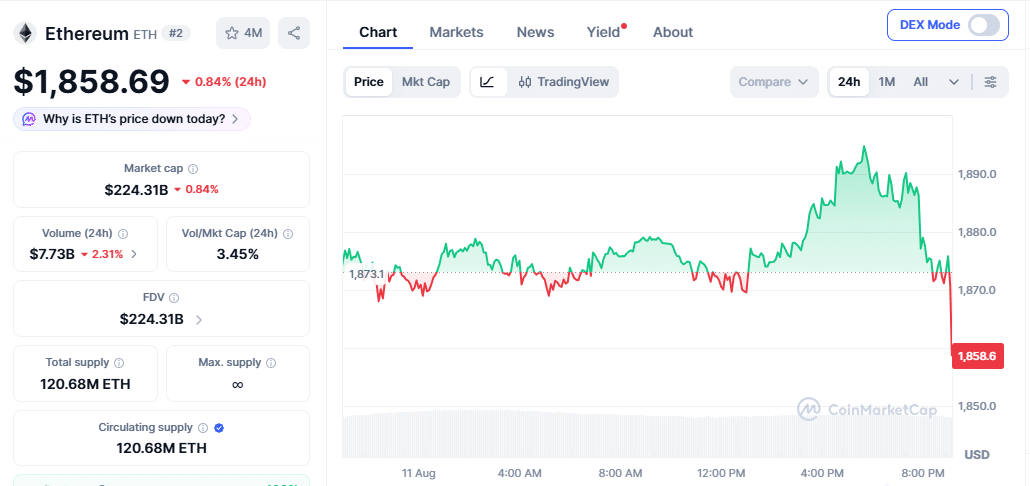
At the time of this writing (on Aug 11 at 15:40 UTC), ETH was trading near $1,858, down approximately 0.84% over the prior 24 hours, according to the data from CoinMarketCap. Market capitalization stood at roughly $224.3 billion, and 24-hour trading volume registered about $7.73 billion.
The token continued showing volatility on the day, with the intraday range showing a high near $1,895 and a low around $1,866 before settling lower. The circulating supply remained at 120.68 million ETH. The market data provides a snapshot of ETH’s price performance at the time Ethereum led public token funding. It does not establish a direct relationship between token-sale activity and ETH’s market price.
Ethereum faces debate over new proposal
Alongside the shift in public token-sale rankings, Ethereum developers and ecosystem participants are debating EIP-8361, a proposal that would alter the network’s issuance curve.
The change would gradually lower staking rewards once more than 50 percent of the total ETH supply is staked. Under the existing formula, annual yields remain near a floor of about 1.5 percent even if the entire supply becomes staked. The authors observe that the current curve lacks a built-in limit on further staking growth.
Using recent validator entry rates of roughly 1.75 million ETH per month, the proposal projects that more than 70 million ETH could be staked by January 1, 2028, exceeding 55 percent of supply.
The EIP identifies two primary concerns: security risks associated with a high concentration of staked ETH and the ongoing dilution experienced by non-staking holders from continued issuance.
The proposal has drawn differing responses from industry participants. Aave founder and CEO Stani Kulechov has argued that the change could weaken the network rather than achieve its intended objectives. Isidoros Passadis, chief of staking at Lido Finance, has said the proposal attempts to address several goals simultaneously, including increasing ETH’s monetary value, managing potential security effects from high staking participation and protecting solo stakers.
ARK Invest Director of Research Lorenzo Valente has offered a different view on related criticisms, noting that ETF issuers primarily focus on assets under management and overall take rates rather than seeking yield at the expense of inflationary effects.
Also Read: Ethereum Active Addresses Hit 989K as Network Activity Surges