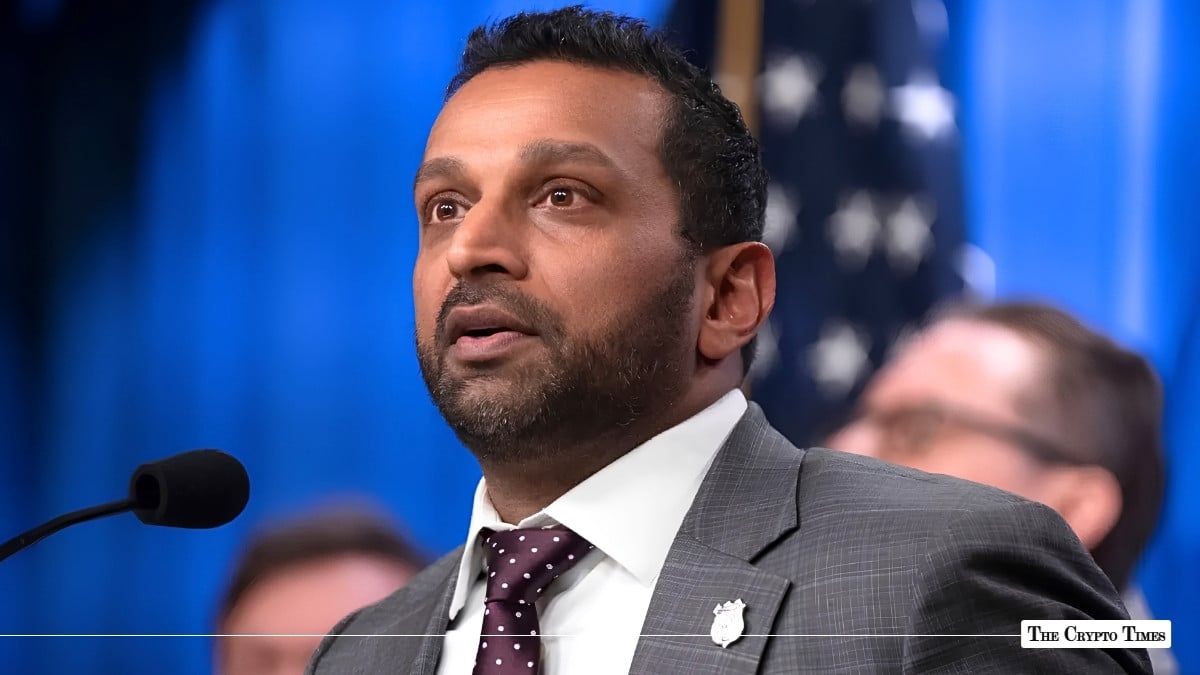
FBI Director Kash Patel’s personal financial trading patterns have triggered an intense transparency row inside Washington.
According to federal financial disclosure filings first uncovered by the nonpartisan investigative platform NOTUS, Patel purchased between $100,001 and $250,000 worth of stock in Strategy (MSTR), the Michael Saylor-led firm formerly known as MicroStrategy and the world’s largest corporate holder of Bitcoin, on November 21, 2025. He did not report the trade to federal regulators until May 26, 2026, more than six months later and well beyond the deadline set by federal ethics law.
For an executive leading an agency that aggressively targets cryptocurrency investment fraud, holding an undisclosed six-figure stake in a dominant Bitcoin proxy company creates a challenging optics problem.
What the records show
Under the Stop Trading on Congressional Knowledge (STOCK) Act, senior executive-branch officials must publicly disclose individual stock trades exceeding $1,000 within 45 days. Patel’s purchase went undisclosed for over 180 days.
In a May 26 letter to the Office of Government Ethics, he said the trade had been “inadvertently omitted” from a previously filed disclosure. Two days later, Deputy Assistant Attorney General William Taylor attributed the omission to a miscommunication, and an FBI official told NOTUS the late reporting was “not realized and unintentional.” First-time STOCK Act violators are subject to a $200 fine; the Department of Justice, which would issue or waive it, has not fined Patel.
Patel’s explanation and the FBI’s defense
The bureau has framed the episode as a paperwork error rather than misconduct. Once the mistake was discovered, the FBI said, Patel amended his prior disclosure and the corrected filing was reviewed and approved by a DOJ ethics official. Taylor, in his letter, maintained that Patel’s stake in Strategy does not create a conflict of interest with his oversight of the FBI and that the director remains in compliance with applicable ethics laws.
Not everyone is persuaded. Dylan Hedtler-Gaudette of the nonpartisan Project on Government Oversight told NOTUS the disclosure was “absolutely” late under the letter of the law — “That’s violating the law, no other way to put it,” he said — and reiterated a call, shared by many watchdog groups, to prohibit federal officials from trading individual stocks altogether.
Why a Strategy stake raises eyebrows in crypto
For a crypto audience, the identity of the stock is the point. Strategy is not an ordinary equity; it is the pioneer of the corporate Bitcoin-treasury model, holding more than 760,000 BTC and functioning, in effect, as a leveraged proxy for Bitcoin’s price. Owning MSTR is one of the most direct ways to make a Bitcoin bet through a regulated brokerage account. The company is run by Michael Saylor, a prominent crypto advocate described as an ally of President Donald Trump and a friend of Eric Trump.
That matters because the FBI, under Patel, is deeply involved in cryptocurrency enforcement, and Patel has made a point of publicizing it. In a June 19 post on X, he vowed that crypto fraudsters’ days were numbered, writing that “this FBI will find you, and we will bring you to justice.” Just weeks before his MSTR purchase last October, he had trumpeted a landmark case on X, touting roughly $15 billion in Bitcoin seized in the takedown of a global criminal network. The optics of the country’s top crypto-crime enforcer quietly holding a Bitcoin-linked stock are, at minimum, complicated.
The conflict-of-interest question
The concern goes beyond symbolism. Strategy has done millions of dollars in business with the Justice Department, of which the FBI is a part, as well as agencies including Health and Human Services, Defense, and State, over the past decade.
Critics argue that a sitting FBI director holding stock in a federal contractor, and disclosing it only after a prolonged delay, is precisely the scenario ethics rules are meant to guard against. The DOJ’s position is that no conflict exists; the watchdog view is that the appearance of one, combined with a clear reporting breach, is damaging regardless of intent. No finding of wrongdoing beyond the late filing has been made.
Part of a broader pattern
Patel is not an outlier in two respects.
First, crypto exposure has become common at the top of the current administration: Vice President JD Vance recently disclosed up to $500,000 in Bitcoin, and President Trump and his sons reported more than $1 billion in crypto-related income last year.
Second, late STOCK Act filings are widespread, NOTUS notes that more than 30 members of Congress filed disclosures late over the past year, which is exactly why reform advocates argue the current honor-system-with-a-$200-fine framework is toothless.
Why it matters
Strip away the politics and the case is a clean illustration of two trends converging. Digital assets have moved so thoroughly into the mainstream that even the FBI director’s brokerage account now carries Bitcoin exposure, if indirectly. And the disclosure regime meant to keep such holdings transparent is straining under officials who trade actively and report late. Whether Patel’s lapse was a genuine oversight or something more, it hands fresh ammunition to those pushing to ban individual-stock trading by senior officials; and it underscores how deeply crypto has embedded itself in the machinery of American government, right up to the desk of the person charged with policing its criminal underside.
Also Read: Strategy Holds 4% of Bitcoin Supply as MSTR, STRC Hit Lows