
The latest uptick in Bitcoin price pushed it back above $60K psychological support, with the cryptocurrency briefly testing lows near $57,700–$58,000 in recent sessions. The bounce sent the asset briefly touching $61,000 during early morning on July 2, 2026 .
Despite the short-term positive momentum, the broader seven-day picture remains relatively flat to mildly negative, with price action consolidating in a tight range. This stability occurs against a backdrop of significant institutional selling through spot Bitcoin ETFs and notably compressed volatility across derivatives markets—two key metrics that are painting a nuanced picture of caution mixed with potential opportunity for traders.
Bitcoin Price Action: Holding the Line at $60K
The current price recovery reflects renewed buying interest after recent downside pressure. Over the past 24 hours, Bitcoin has climbed steadily, supported by broader crypto market sentiment and technical rebounds from oversold conditions. Trading volume remains robust, with 24-hour figures hovering around $38–39 billion across major exchanges.
On the weekly timeframe, however, BTC has shown limited net movement. Market data indicate a slight decline of 2% over the past seven days, keeping the asset well below its monthly highs above $70,000. The 52-week range spans roughly $57,700 to $126,200, underscoring how far the market has corrected from peak euphoria.
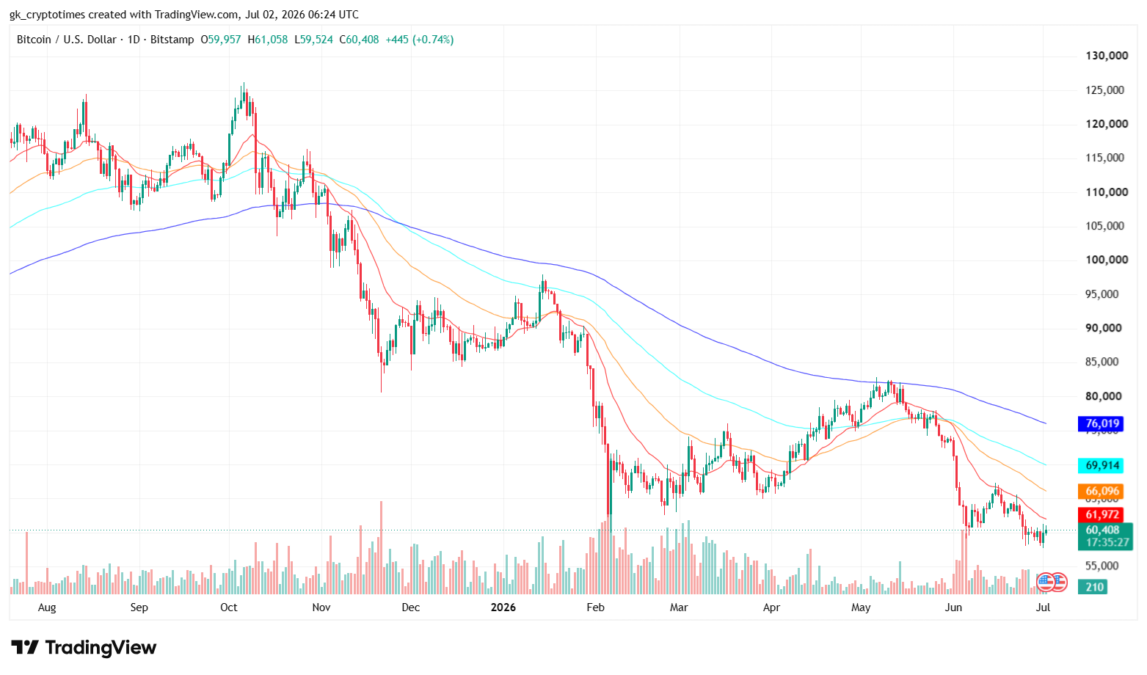
The $60,000 zone has acted as both support and resistance in recent weeks. A sustained break above $61,000–$62,000 could open the door to further upside toward $65,000, while failure to hold could lead to retests of the $57,000–$58,000 area. Macro factors, including interest rate expectations ahead of the Federal Reserve’s late-July meeting and a strong U.S. dollar, continue to influence risk appetite across global markets and digital assets.
The relatively contained price swings today contrast with the more dramatic moves seen earlier in 2026, suggesting a maturing market that is digesting previous gains and losses.
Spot Bitcoin ETF Outflows Signal Institutional Caution
One of the most striking market metrics in recent weeks has been the persistent net outflows from U.S. spot Bitcoin ETFs. Data shows over $4.5 billion exodus from ETFs throughout June 2026, with daily outflows reaching hundreds of millions of dollars and weekly figures often exceeding $1 billion.
Read: Bitcoin Reclaims $60K, Is this Reversal or Dead Cat Bounce?
These outflows represent a reversal from the strong institutional inflows that followed the ETF launches in early 2024. While some analysts view the selling as cyclical, driven by profit-taking, rotation into AI and tech stocks, or macro uncertainty, others see it as a key source of spot selling pressure that has weighed on price discovery.
The mechanical link between ETF flows and Bitcoin price remains evident: large net outflows often coincide with or precede periods of consolidation or downside. On July 1, for example, total net outflows were reported around $296 million, contributing to the cautious tone even as spot prices stabilized.
Despite the headline outflows, some market participants interpret the data as a potential capitulation signal. Historically, heavy ETF selling has occasionally marked local bottoms, especially when accompanied by other oversold conditions. With total outflows in the billions over multiple weeks, the market appears to be absorbing institutional supply without a full-blown breakdown below $58,000— a sign of underlying resilience from retail and other holders.
Compressed Volatility Reflects Cautious Market Sentiment
Another critical market metric showing dramatic change is Bitcoin’s volatility profile. Both realized and implied volatility have compressed significantly in recent sessions, with short-dated (7-day) implied volatility trading near year-to-date lows around 33% in several readings.
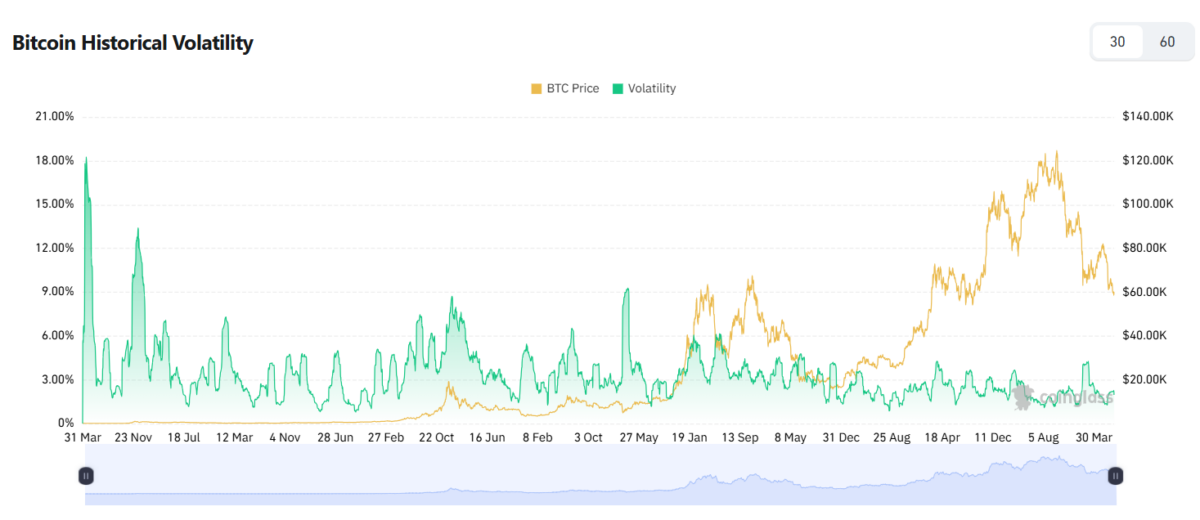
Realized volatility, which measures actual price fluctuations, has also trended lower, returning to subdued levels reminiscent of previous “summer lulls.” This compression indicates reduced conviction and thinner trading ranges, with fewer large swings compared to earlier periods of heightened geopolitical or macro tension.
Low volatility environments can be double-edged. On one hand, they suggest market participants are pricing in calmer conditions ahead, potentially setting the stage for a low-risk entry or continuation of the range-bound action. On the other hand, compressed volatility often precedes explosive moves once a catalyst emerges—whether positive (e.g., favorable Fed commentary or renewed ETF inflows) or negative (further macro deterioration).
Derivatives markets reflect this caution through relatively balanced long/short ratios and moderate funding rates, with limited aggressive leverage building up at current levels. Options skew has normalized in some tenors, showing less extreme demand for downside protection than during recent selloffs.
For traders, the low-volatility regime favors range-bound strategies or careful position sizing, while longer-term investors may view it as an opportunity to accumulate amid institutional distribution. The combination of steady price action near $60,500, ongoing ETF outflows, and suppressed volatility creates a classic “wait-and-see” environment.
Outlook: Balancing Risks and Opportunities
Bitcoin’s ability to hold above $60,000 despite billions in ETF redemptions and a broader risk-off tilt in traditional markets highlights the asset’s evolving maturity. The market is no longer solely driven by retail speculation; institutional flows via ETFs now play a central role in price discovery.
Looking ahead, key catalysts include upcoming economic data, potential shifts in monetary policy, and any signs of ETF flow stabilization. A reversal in outflows could quickly reignite bullish momentum, while continued pressure might test lower supports.
In the near term, expect range-bound trading with heightened sensitivity to news flow. The compressed volatility suggests the next meaningful move could be sharp once conviction returns, whether that leads to a breakout above $62,000 or a deeper correction remains to be seen.
Also read: American Bitcoin (ABTC) Drops 8% Despite Reverse Stock Split Announcement