
The launch of U.S. spot Bitcoin ETFs in January 2024 marked a watershed moment for cryptocurrency adoption. These products quickly amassed tens of billions in inflows, legitimizing Bitcoin as an institutional asset class and channeling regulated capital into the ecosystem. By mid-2026, cumulative net inflows had surpassed $51 billion, with ETFs collectively holding hundreds of thousands of BTC.
Yet June 2026 delivered a stark reversal. U.S. spot Bitcoin ETFs recorded approximately $4.5 billion in net outflows; the worst monthly performance since their inception. This figure eclipsed the previous record outflow month and coincided with Bitcoin’s price weakness, raising questions about short-term institutional sentiment while highlighting the maturing dynamics of this market.
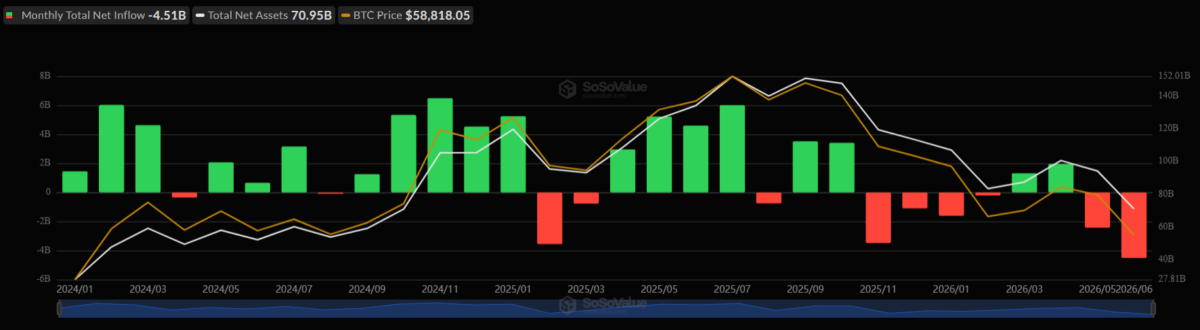
Record-Breaking Outflows Shake the ETF Landscape
June’s redemptions did not emerge in isolation. They capped a bruising period that included a record 13 consecutive trading days of outflows from mid-May through early June, totaling roughly $4.4 billion (or about 51,000–59,000 BTC depending on pricing).
Daily flows turned sharply negative in the latter half of the month. Coinglass data shows multiple sessions with thousands of BTC redeemed, including a peak single-day outflow exceeding 11,330 BTC on June 25. By month-end, total assets under management across spot Bitcoin ETFs stood around $81–82 billion, down significantly from earlier 2026 peaks above $100 billion.
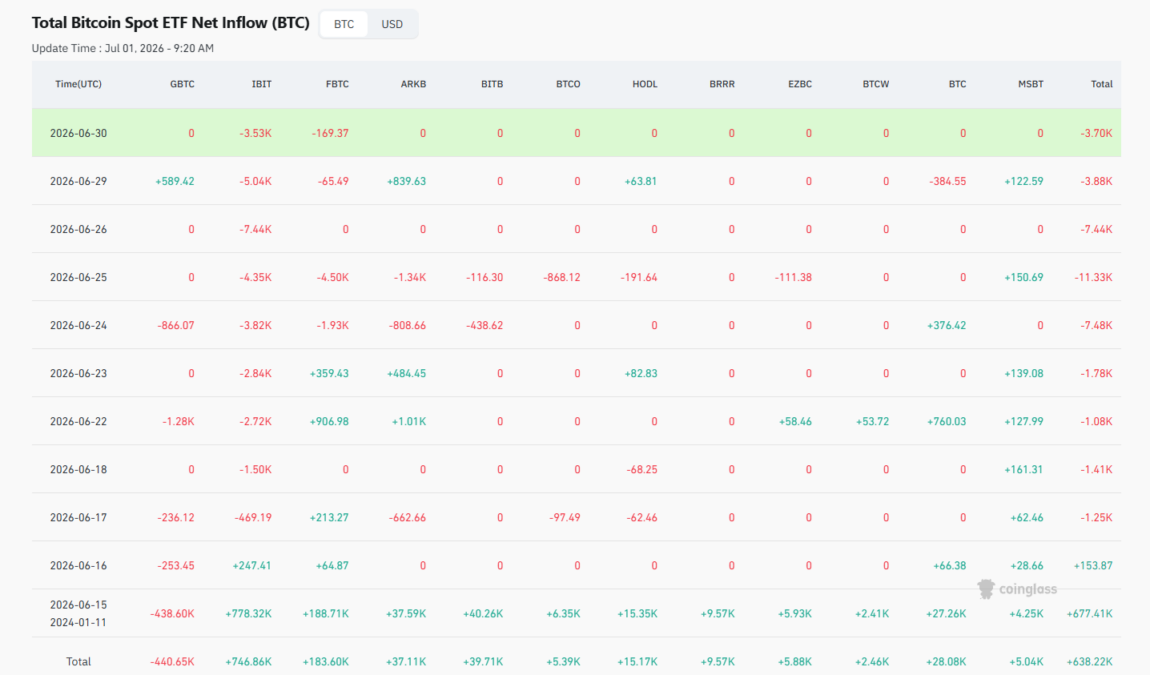
BlackRock’s iShares Bitcoin Trust (IBIT), the dominant player with the largest AUM, bore much of the brunt. During the 13-day streak alone, IBIT accounted for roughly $3.3 billion in outflows, about 75% of the total. Fidelity’s FBTC and Grayscale’s higher-fee GBTC also saw notable redemptions.
Despite the monthly hit, the long-term picture remains robust. Cumulative inflows since launch hover near $51.6 billion, with ETFs still holding over 638,000 BTC collectively. This underscores that June represented a sharp but contained pullback rather than a wholesale abandonment of the asset class.
Macro Headwinds and Investor Behavior Fuel the Sell-Off
This June exodus followed several converging factors. Bitcoin’s price corrected sharply during the period, declining approximately 21% from mid-May levels, as broader risk-off sentiment took hold. Strong U.S. jobs data tempered expectations for near-term interest rate cuts, while geopolitical tensions and a rotation toward AI-related equities pulled capital away from crypto.
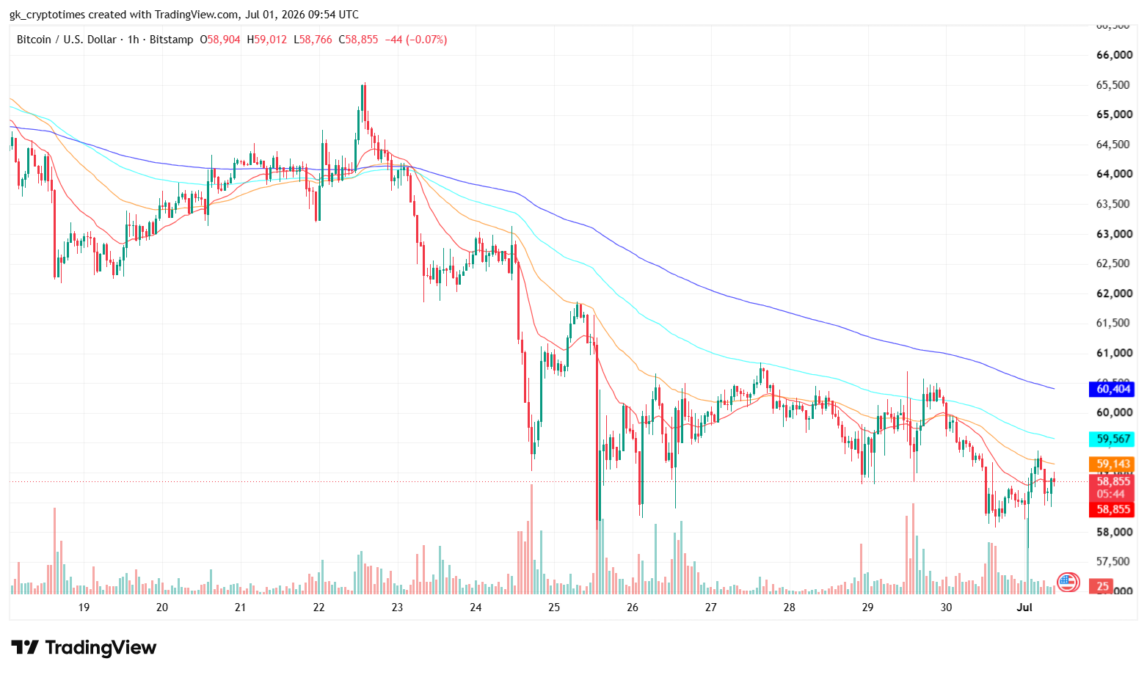
Another significant reason behind the downfall in Bitcoin’s price was massive profit-taking. Many institutional positions established at lower prices earlier in the cycle were ripe for harvesting gains. Grayscale’s GBTC, carrying a notably higher expense ratio than competitors like IBIT or FBTC (1.5% vs. ~0.20–0.25%), experienced accelerated outflows as cost-conscious investors rotated into cheaper alternatives or exited entirely.
Fund-level data reveals nuances. While aggregate flows were negative, certain days saw selective inflows into products like ARKB or FBTC, suggesting not all capital was fleeing indiscriminately. The heaviest pressure concentrated on the largest and most liquid vehicles, typical during periods of market stress when institutions prioritize ease of exit.
This dynamic mirrors historical patterns in traditional markets: ETFs amplify both inflows during bull runs and outflows during corrections, acting as a transparent barometer of institutional conviction. The speed and scale of June’s moves highlight how these products have become deeply integrated into Bitcoin’s marginal supply-demand balance.
Resilience Amid Redemptions: Cumulative Gains and the Road Ahead
Analysts are largely framing June’s outflows as cyclical rather than structural. The character of the selling—concentrated in higher-fee vehicles and coinciding with profit realization—suggests a healthy repositioning rather than a loss of long-term faith. Cumulative net buying by institutions through ETFs remains overwhelmingly positive, and holdings have proven relatively sticky since earlier 2026 lows.
Looking forward, several catalysts could reverse the trend. A shift toward more accommodative monetary policy, resolution of geopolitical uncertainties, or renewed risk appetite could reignite inflows. Historical precedents show that periods of heavy outflows often precede stabilization or renewed accumulation once selling exhausts itself.
For Bitcoin itself, the ETF channel has fundamentally altered market structure. These products provide continuous, regulated exposure that attracts capital previously sidelined by custody or regulatory hurdles. Even with June’s redemptions, the infrastructure supporting institutional participation remains intact and continues to mature.
Altcoin ETFs: Ethereum Leads Outflows While XRP, HYPE Attract Capital
Altcoin spot ETFs experienced mixed flows in June 2026 while Bitcoin ETFs suffered record outflows. Ethereum products posted the heaviest redemptions, with $528.99 million in net outflows for the full month according to SoSoValue data.
Solana ETFs saw a modest net outflow of $786.58K over the month. In contrast, XRP ETFs delivered strong positive performance with $59.46 million in net inflows, while newer or narrative-driven products like HYPE attracted a robust $161.05 million and BNB ETFs added $1.45 million.
This divergence within the altcoin ETF category highlights selective institutional rotation rather than a blanket exit from crypto exposure. While major assets like Ethereum faced sustained pressure amid broader market weakness, investors rotated capital toward XRP, HYPE, and select alternatives, demonstrating that June’s outflows were more about repositioning within the sector than a full retreat from digital asset ETFs.
Broader Implications for Crypto Markets
The June 2026 episode serves as a reminder that Bitcoin ETFs, while transformative, are not immune to traditional market forces. They democratize access but also transmit volatility more efficiently across the ecosystem.
For retail and institutional participants alike, the takeaway is one of nuance. The structural bull case for Bitcoin, driven by scarcity, adoption, and now deep institutional plumbing, remains compelling over multi-year horizons. Short-term flow data offers valuable signals but should be weighed against cumulative positioning and on-chain fundamentals.
As the market digests June’s record redemptions, attention will turn to whether this marks a temporary digestion phase or the beginning of a more prolonged consolidation. History favors the former in maturing asset classes, but only time, and fresh capital flows, will confirm the trajectory.
Also read: Bitcoin on 200-Week MA Signals Deeper Bear Phase as AI Capital Rotation Continues