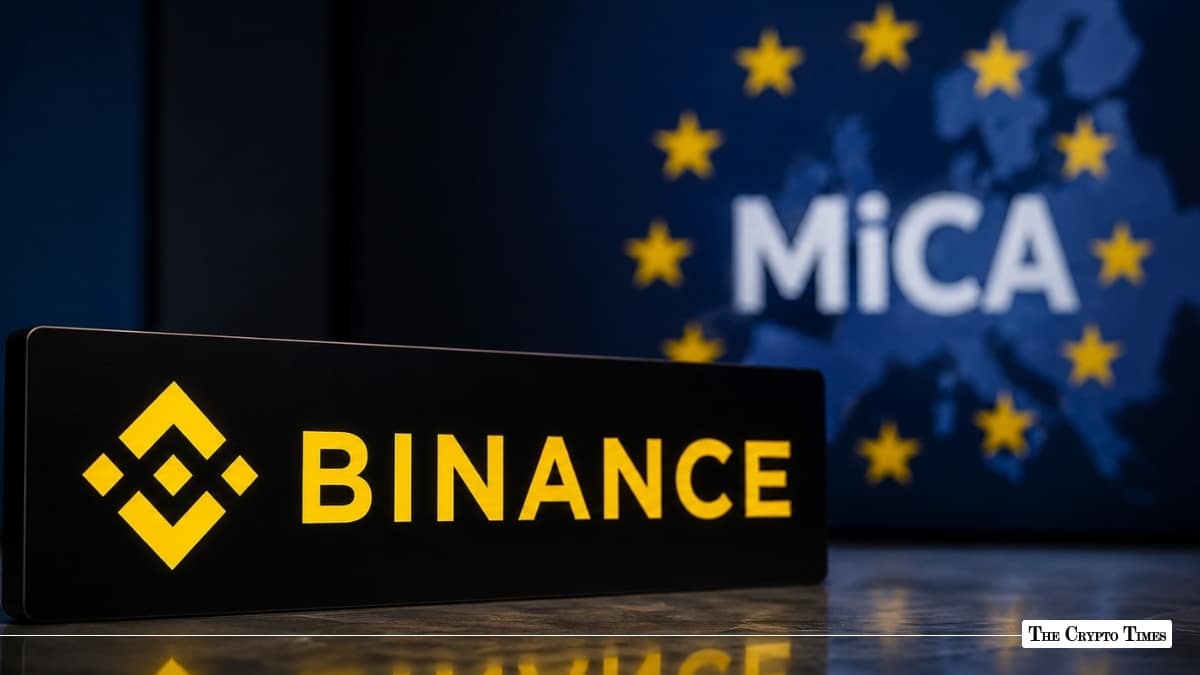
Days after halting services across the European Union for lack of a MiCA license, Binance has mounted a public defense, arguing that the bloc’s crypto rulebook should be measured by how many firms it brings inside the regulated market — not by who it shuts out.
The argument: Regulation, or regulated players?
The case was laid out by Gillian Lynch, Binance’s Head of Europe and the UK, in a recent interview with Coindesk. Her central question reframed the exchange’s exclusion as a test of the regime itself: “Is the success of MiCA that we have regulation, or is the success that the players are regulated?”
Lynch, who spent nearly two decades in traditional banking before moving into crypto, argued that keeping the largest global exchange outside the regulated perimeter does not serve Europe. Excluding a firm of Binance’s scale, she said, strips liquidity and infrastructure from the market, and regulation should work to strengthen and include compliant participants rather than wall them off.
She endorsed MiCA’s structure of national regulators granting licenses but suggested the EU’s markets watchdog, ESMA, should take a larger supervisory role over the biggest firms.
It is, plainly, an argument that serves Binance’s interests — the company being the most prominent name excluded so far. And it invites an obvious counterpoint: MiCA was designed precisely to set a compliance bar, and a regime that keeps out firms it judges non-compliant could be seen as working exactly as intended, not failing.
But the framing is also a substantive position in a real debate about whether Europe’s approach consolidates the market around a licensed few at the cost of competition and liquidity—a question MiCA’s first days of full enforcement have already sharpened.
Rejecting the financial-crime reports
Lynch’s defense was also, pointedly, a rebuttal. It followed reporting by the Wall Street Journal that ESMA had privately advised national regulators to disapprove Binance’s MiCA applications, citing financial-crime compliance concerns—reporting that reframed the exchange’s EU failure as a matter of substance rather than paperwork.
Binance rejected that account firmly. Lynch said the reporting “mischaracterizes how these accounts were identified, reviewed and acted upon” and offered what she called the fuller picture the headlines omitted: as soon as Binance uncovered the complex account patterns in question, she said, it offboarded all the accounts involved and reported them to law enforcement. She dismissed as “categorically false” any suggestion that Binance had ignored sanctions concerns or retaliated against its own compliance staff.
The exchange’s posture toward that reporting has been combative before. Binance sued the Wall Street Journal earlier this year over separate coverage of Iran-linked accounts and a U.S. investigation—an adversarial history that colors the current exchange and one reason the two sides’ accounts are unlikely to be reconciled quietly. For readers, the salient point is that the allegations remain contested: they are the outlet’s reporting, and Binance denies them.
Two accounts of how Greece collapsed
Beneath the dispute lies a factual gap that neither side’s narrative closes. By Binance’s telling, its Greek license bid was on track until it wasn’t. Lynch said the exchange was told in April that its application was “complete” and expected authorization in early June and watched as regulatory board meetings were repeatedly postponed before it ultimately withdrew the bid.
“We were deemed to have a complete application,” she said. “Nothing was missing, nothing material was outstanding.” As the executive who led the process, she added, she was made aware of no issue—”I was told the complete opposite.”
That directly contradicts the reported picture of regulators being quietly counseled to reject the application over financial-crime concerns. Binance points to its compliance investment as evidence of good faith: more than $300 million a year and over 1,500 compliance staff globally, plus months of work with Greece’s Hellenic Capital Market Commission.
Whether the application was clean and stalled by delay or flagged and quietly steered toward rejection is the unresolved core of the story—and the two versions cannot both be complete.
Not leaving Europe
For all the friction, Binance was emphatic about its intentions. “We’re not leaving Europe,” Lynch said. “This is an obstacle in our way at the moment… we will be back in the market.” The exchange has said it plans to pursue authorization through another member state, with France its likely next venue, and frames its absence as temporary rather than terminal.
The stakes extend beyond one company. MiCA’s full enforcement has triggered a broad contraction, with industry executives estimating that a large majority of Europe’s roughly 3,000 pre-MiCA firms may not survive the transition and millions of users across non-compliant platforms facing migration.
Binance’s exit is the most visible case, and its argument that a rulebook should be judged by who it welcomes in, not who it locks out, is likely to echo as more firms fall on the wrong side of the line. Whether European regulators, who have consolidated licensing into a handful of hubs, see that exclusion as a flaw or a feature is the question Binance is now, from the outside, pressing them to answer.