
In the world of cryptocurrency, very few companies attract as much scrutiny as Strategy Inc., the largest corporate holder of Bitcoin. On July 3, 2026, X lit up with rumors that the firm had quietly sold 491 BTC on July 1.
The claim, which remains unconfirmed by the company or any official filing, triggered intense debate across crypto communities already sensitive to shifts in major Bitcoin treasury strategies.
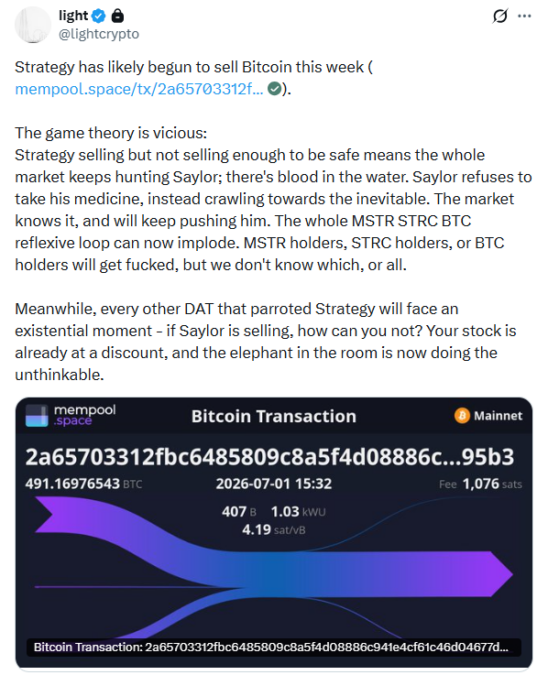
The rumor gained significant traction after prominent crypto trader and on-chain analyst Light (@lightcrypto), who had been largely silent for about a year, posted detailed on-chain analysis pointing to a 491 BTC movement from a wallet associated with Strategy on the evening of July 1.
In his post, Light cited on-chain transactions and described that Strategy is suspected to have sold 491 Bitcoin on the evening of July 1. He noted the move is currently unconfirmed and observed that Bitcoin’s price showed no immediate fluctuation.
Unconfirmed Reports Fuel Conspiracy Theories
The post served as the primary source igniting the speculation across platforms. The precise figure fueled immediate questions: why such a specific number, and why now?
Observers quickly noted that Strategy has historically been extremely transparent with its Bitcoin activity through regular SEC filings and weekly purchase updates. The absence of any immediate company statement or 8-K filing only amplified the discussion.
Strategy has built its reputation as Bitcoin’s biggest corporate champion. Under Saylor’s leadership, the company transformed from a business intelligence software firm into a de facto Bitcoin ETF.
As of June 22, 2026, Strategy reported holdings of 847,363 BTC, acquired at an average cost of roughly $75,651 per coin. That massive treasury, valued in the tens of billions depending on market prices, represents nearly 4% of Bitcoin’s total supply. The firm’s weekly purchase announcements have become ritualistic market events, often boosting sentiment when Bitcoin dips.
This context makes the rumored sale particularly jarring. Strategy’s long-standing “never sell” mantra helped fuel its meteoric rise in investor favor. Yet the company has shown some flexibility in recent months. In late May 2026, it executed its first Bitcoin sale since December 2022, offloading just 32 BTC for about $2.5 million to help fund preferred stock dividends. That small transaction caused MSTR shares to drop sharply in pre-market trading, highlighting how sensitive markets remain to any hint of reduced accumulation.
Market Reaction and Broader Implications
Company filings and statements reveal a more nuanced capital allocation approach. Strategy has raised billions through equity offerings, convertible notes, and its innovative STRC preferred stock product.
In recent updates, executives indicated they could sell up to $1.25 billion in Bitcoin if needed to maintain liquidity, cover dividends, or support share buybacks without excessive dilution. Saylor himself has emphasized maximizing “Bitcoin per share” over simple HODLing, framing the strategy as dynamic rather than dogmatic.
Despite the flexibility, net activity remains overwhelmingly bullish. After the May sale, Strategy quickly resumed buying. Early June purchases included 1,550 BTC for over $100 million, and later weekly additions pushed holdings higher. As of late June, the firm continued reporting modest weekly buys of hundreds of BTC.
A true 491 BTC outright sale to the open market would represent Strategy’s largest disposal in years — yet still only about 0.058% of its stack. For context, the company has acquired tens of thousands of BTC in single weeks during aggressive accumulation phases.
Market reaction to the rumor proved muted on price charts. Bitcoin held relatively steady in the hours following the speculation, with many traders noting the move appeared “priced in” or simply unverified noise.
MSTR stock showed limited immediate volatility, reflecting broader fatigue around headline-driven swings. Some on-chain analysts and observers, including comments referencing Arkham Intelligence analysts, questioned whether the specific address and transaction patterns fully matched Strategy’s known custody setups, adding a layer of skepticism to the claim.
Skeptics highlight the absence of an official SEC 8-K filing. Strategy routinely discloses material Bitcoin transactions within days. No such disclosure appeared by July 3, leading many to treat the story as unconfirmed speculation common in crypto social media.
Broader Outlook
The episode underscores evolving perceptions of corporate Bitcoin strategies. Once viewed as pure long-term stores of value, treasuries like Strategy’s now face pressure to generate yield, maintain liquidity, and deliver shareholder returns through dividends and buybacks.
Saylor has defended the approach in recent interviews, stressing that Bitcoin remains the core asset while the company builds a sophisticated financial engine around it. Supporters argue this maturity strengthens the thesis: a company willing to sell tiny fractions to fund growth can ultimately acquire far more BTC over time.
Critics, however, warn of risks. If Strategy begins routinely trimming holdings to service preferred stock obligations, it could erode the scarcity narrative that underpins much of its premium valuation. MSTR has historically traded at a significant premium to its Bitcoin net asset value. Any sustained selling pressure, even small, might compress that premium and test investor confidence.
As of this writing, Strategy has not commented publicly on the July 1 movement referenced in the on-chain analysis. Market participants await the next weekly update or regulatory filing, expected early next week. In the interim, the rumor serves as a reminder of Bitcoin’s sensitivity to actions by its largest holders. With over 847,000 BTC under management, even modest shifts by Strategy can dominate headlines and move sentiment.
Whether the 491 BTC tale proves a false alarm, an internal reshuffle, or the start of a new chapter in corporate Bitcoin management, it highlights the intense scrutiny facing Saylor and his empire. Crypto investors will be watching closely: in a market built on narrative as much as code, perception often moves faster than on-chain reality.
This is a developing story and more information will be added as the event unfolds.
Also read: At What Price Will Bitcoin Close 2026? Polymarket Shows Strong Contrarian Skepticism