
Bitcoin entered July with a striking comeback, surging well above $61,000 after digesting a harsh June sell-off that led its price to dip below multi-month lows below $59,000. The asset has spent much of this year consolidating after an earlier peak near $98,000 in January.
Against this backdrop, the most popular prediction market platform is offering a notably restrained view of where the cryptocurrency could stand by year-end. Polymarket’s flagship market on 2026 price action shows traders assigning limited odds to a decisive breakout above six figures before the calendar turns.
The Odds Traders Are Placing on Key Levels
Current pricing in the market shows a clear gradient. Contracts for Bitcoin reaching $100,000 or higher carry relatively low probabilities. The $100,000 upside outcome trades around 11 cents on the dollar, implying roughly an 11% chance it will be hit before year-end. Higher thresholds see even thinner odds: $110,000 around 7%, $120,000 near 6%, and $150,000 in the low single digits.
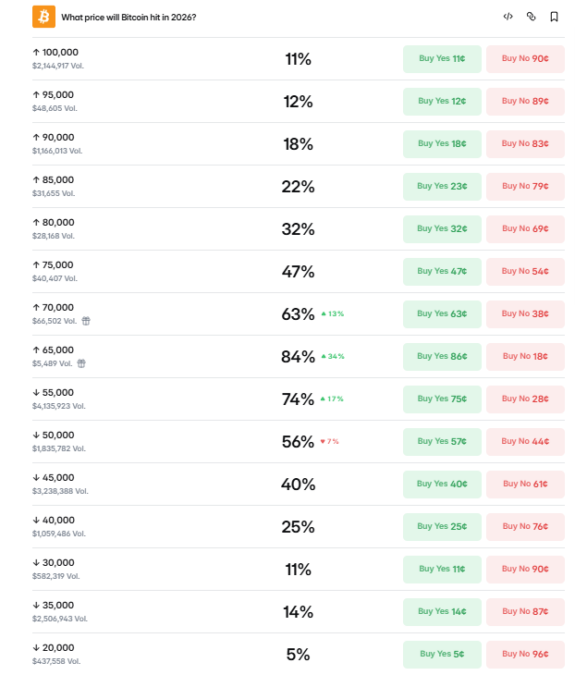
Closer levels attract more conviction. The contract for a high of $90,000 sits near 18%, while $85,000 is around 22% and $80,000 near 32%. The $75,000 and $70,000 thresholds carry probabilities of roughly 47% and 63%, respectively. The $65,000 level trades with strong conviction above 80%.
On the downside, contracts betting on a drop below $55,000 imply around a 74% chance, while a move under $50,000 sits near 56%. Deeper lows carry lower but still meaningful probabilities. These figures suggest traders see meaningful risk of further weakness alongside limited upside conviction in the remaining months.
Volumes on the more actively traded contracts, particularly around the $100,000 mark and several downside levels, exceed $1 million each in many cases, underscoring where real capital is concentrated.
Price Action and Market Context in Mid-2026
Bitcoin entered 2026 coming off a strong finish to the prior year but quickly faced headwinds. After touching highs near $98,000 early in the year, the price corrected sharply, with lows dipping toward $60,000 in the first half. Factors behind this stiff downfall include geopolitical tensions, institutional inflows, and broader macroeconomic uncertainty.
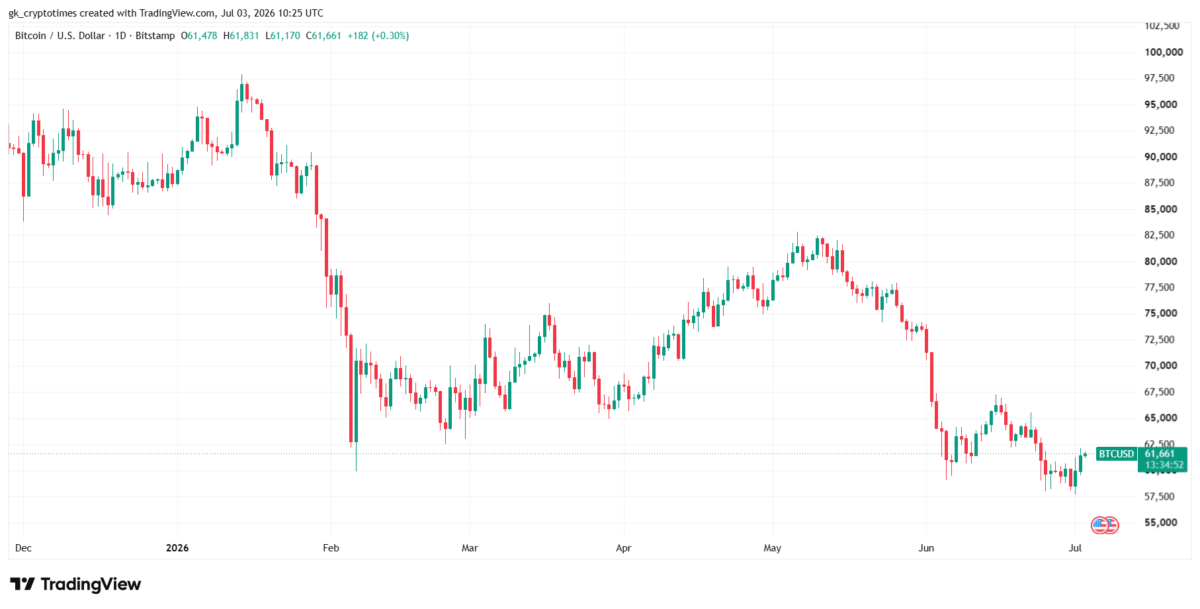
By July, the asset had stabilized in a relatively narrow band but remained more than 50% below its 2025 peak. Short-term technical levels, such as the $60,000 psychological floor, have drawn attention from traders watching for either a defense or a deeper breakdown.
At the time of publishing, BTC was trading near $61,660—up nearly 2% in the past 24 hours.
Historical patterns show Bitcoin has experienced similar mid-cycle consolidations, yet the current environment features higher institutional participation through ETFs than in previous cycles. This price history sets the stage for the forward-looking bets now visible on prediction platforms.
How Polymarket’s Annual Price Market Works
The “What price will Bitcoin hit in 2026?” market functions as a series of binary contracts tied to specific price thresholds. Traders buy or sell shares in outcomes such as whether Bitcoin will reach or exceed a given level at any point before the end of the year.
Resolution relies exclusively on Binance BTC/USDT one-minute candle data. For an upside threshold like $100,000, the contract pays out if any single one-minute high meets or exceeds that price between late November 2025 and December 31, 2026. Downside contracts resolve on lows.
The market opened in February 2026 and has already generated roughly $46 million in cumulative trading volume, indicating substantial interest from participants willing to back their views with capital.
Because each threshold trades independently, the odds do not represent a single consensus price target. Instead, they reflect the market’s collective assessment of the probability that Bitcoin will touch each level at least once during the resolution window. Liquidity varies across contracts, with heavier volume often concentrated around nearer-term and more plausible outcomes.
What These Markets Suggest for the Rest of the Year
With roughly six months remaining until the resolution deadline, the Polymarket data points to a base case centered on consolidation rather than a parabolic advance. A move back above $80,000 or $90,000 would align with moderate-probability outcomes and could shift sentiment if accompanied by improving fundamentals.
However, the low odds attached to $100,000 suggest traders currently see the path there as narrow, requiring either strong catalysts or a rapid change in risk appetite.
Downside risks remain priced in as well. A test of the mid-$50,000s or lower would resolve several active contracts and could reflect renewed macro pressure or profit-taking. Historical precedent shows Bitcoin can remain range-bound for extended periods before resolving directionally, particularly in the middle of a post-halving cycle.
Market participants will continue to watch ETF flows, regulatory developments, and broader equity and bond market signals. Any material shift in those areas could quickly move the Polymarket odds as traders reposition. The platform’s real-time nature means the probabilities described here will evolve with new information and price action.
For observers, these contracts serve as one data point among many. They capture what a self-selected group of capital-backed traders collectively believes is most likely over the next several months. Whether that view proves prescient will depend on events that have yet to unfold.
Also read: Bitcoin Climbs 6% While MSTR Surged Over 23% — Is Michael Saylor’s Plan Finally Paying Off?