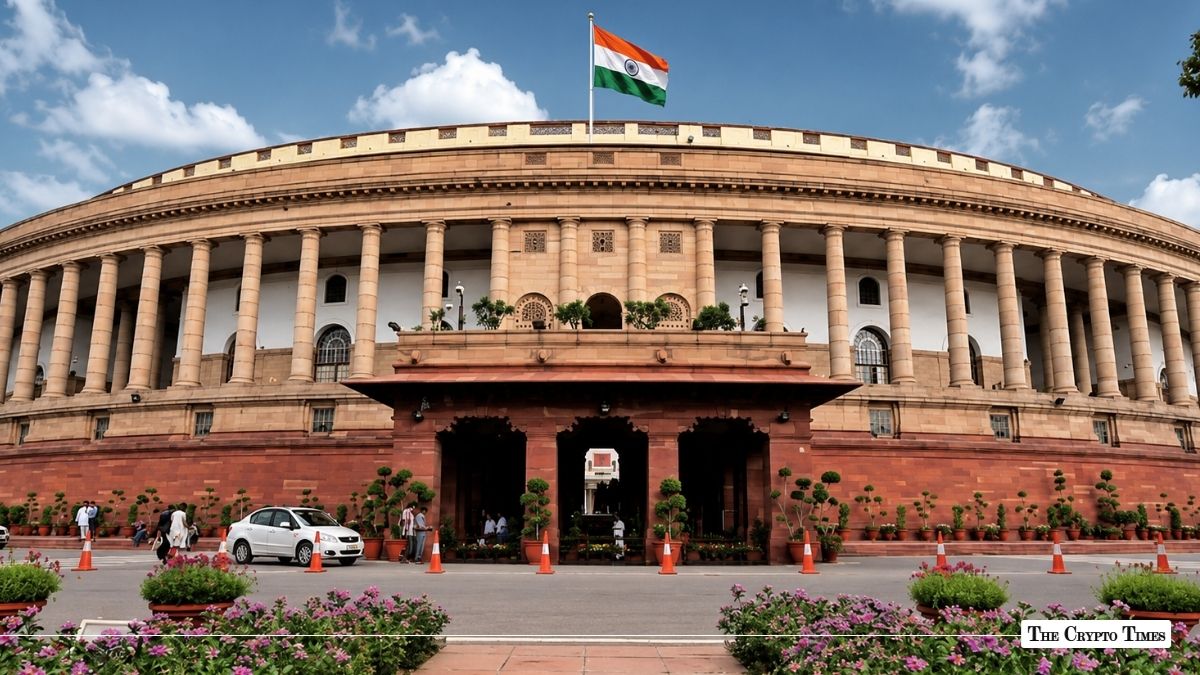
India’s Parliamentary Standing Committee on Finance is preparing to table its long-awaited report on cryptocurrency, “A Study on Virtual Digital Assets (VDAs) and Way Forward,” during the upcoming Monsoon Session — the culmination of a study that could finally signal whether the world’s largest crypto market moves toward regulation or continues in limbo.
From years of hearings to a report
The report closes a methodical, months-long process. Chaired by BJP MP Bhartruhari Mahtab, the committee took up the VDA study as a formal subject during the 2024-25 period and has since held a sustained series of sittings, hearing from domestic and global exchanges including Binance, WazirX, ZebPay, CoinDCX, CoinSwitch, and Coinbase, alongside government arms including the Financial Intelligence Unit, the Central Board of Direct Taxes, the Revenue Department, and the Ministry of Corporate Affairs.
Its 7th sitting on May 20 revealed that thousands of crores are leaving the country through crypto, a finding that has hung over the deliberations ever since.
The most consequential session came at the start of July, when the Reserve Bank of India appeared before the panel directly for the first time on the subject. One step remains before the recommendations are locked: the committee is scheduled to hear the Department of Economic Affairs on July 15, a final round of evidence before it moves to finalizing its report.
With the bulk of testimony now gathered, the report headed to Parliament will attempt to reconcile a set of positions that remain sharply divided on a question India has left unresolved for the better part of a decade—and, in doing so, to indicate whether the country leans toward the RBI’s isolation approach or an EU-style framework of licensing and oversight.
The RBI’s hard line
The central bank used its appearance to hold the line it has maintained since it first warned the public about virtual currencies in December 2013. In its deposition, delivered by Deputy Governor Rohit Jain and Executive Director P. Vasudevan, the RBI rejected any move to grant crypto legal status, telling lawmakers it does not favor treating VDAs as currency and declining, for the moment, to say whether they might be treated as securities.
Rather than a conventional rulebook, the RBI advocated a containment strategy: ring-fencing the formal financial system by barring banks and regulated entities from dealing in crypto and privately issued stablecoins and blocking the use of such assets in payments and settlements. It argued that conventional regulation would legitimize speculative products and give retail investors a false sense of safety, while the central bank repeated its long-standing concerns about parts of the ecosystem being linked to money laundering and terror financing. Notably, it kept prohibition on the table as a recognized policy option without ruling it out—and, in a line, committee members recounted to Business Standard and told the panel that “not having a policy is also a policy.” Confirming the stance afterward, Mahtab said flatly that the RBI had not recommended legal status.
Crucially, the containment the RBI proposes is targeted rather than blanket. The central bank drew a clear line between private cryptocurrencies and tokenized government securities, signaling that its restrictions are aimed at speculation, not at blockchain technology itself — it wants room for tokenized sovereign instruments to keep developing on regulated infrastructure even as it walls off private crypto. It is opposition to an asset class, in other words, not to the underlying technology.
The posture nonetheless revives a fight the central bank lost once before. Its 2018 banking ban on crypto firms was struck down by the Supreme Court in 2020, in the IAMAI case; this time, the RBI is effectively asking Parliament to write the separation between banking and crypto into law rather than impose it by circular. It is the same institutional instinct that has repeatedly stalled India’s crypto discussion paper, shelved several times over amid the central bank’s objections.
The case for a framework
The RBI’s is not the only voice, and the report will have to weigh it against several that pull the other way. In the same set of hearings, the Institute of Chartered Accountants of India backed a comprehensive VDA law spanning issuance, trading, and custody, arguing that digital assets present strategic opportunities when paired with India’s strengths in digital infrastructure and fintech and that blockchain-based systems and stablecoins could make cross-border payments faster and cheaper.
Mahtab noted that the ICAI has been auditing VDAs under the existing income-tax framework but flagged “certain constraints,” adding that “India should find a way out.” The Securities and Exchange Board of India, for its part, has signaled openness to regulating tokens classified as securities, feeding into a proposed multi-regulator model that would split oversight between SEBI, the RBI, and the Finance Ministry.
The committee itself has pushed back on the containment logic, and the data explains why. Members questioned how India can ignore capital flight while jurisdictions like the UAE, Hong Kong, Indonesia, and Japan build regulatory regimes—the global drift being toward licensing rather than isolation.
India ranks first in global grassroots crypto adoption for the third consecutive year, with an estimated 119 million users, and an OECD report pegged the country’s annual crypto transaction value at roughly $340 billion, equal to about 9% of GDP. Yet by exchanges’ own figures presented to Parliament, close to 90% of Indian trading volume has migrated offshore, beyond the reach of the tax authorities the current regime was built to serve—the precise capital flight the government says it wants to prevent.
What it means for Indian investors
For India’s crypto users, the immediate takeaway is that nothing has changed yet, and the report itself will not change it directly. It is a study with recommendations, not legislation, and the government retains the final call on whether and how to act.
The tax regime remains exactly as punitive as before: a flat 30% on gains under Section 115BBH, a 1% TDS on transfers under Section 194S, no loss offsets, and an 18% GST on platform fees, a framework that can push the effective burden past 42% for top earners and that Budget 2026 left untouched.
It is also worth reading the RBI’s containment proposal precisely. Even in the central bank’s own framing, trading remains legal for individuals; the target is banks, regulated entities, and stablecoin-based payment rails, not personal ownership. Prohibition stays a stated option, but the near-term thrust is ring-fencing the formal financial system, not confiscating holdings.
What the report can do is set the direction of travel — whether India inches toward the regulated framework its industry has long sought, hardens the current tax-but-don’t-recognize limbo, or leans into the RBI’s harder separation.
That direction now matters more than ever. India sits atop global adoption while withholding the legal clarity that would keep activity and tax revenue onshore. The report headed for the Monsoon Session is the closest the country has come to resolving that contradiction—and with the RBI’s voice the loudest in the room, whether it points toward a framework or a firmer wall is the question millions of Indian investors will be watching Parliament answer.