Key Highlights
- Major County Sheriffs of America said it is now neutral on H.R. 3633 after further review and talks over Section 604.
- The group wants state and local law enforcement included in the Treasury study under Section 309 and related advisory bodies.
- The letter warns that digital assets are increasingly used in fraud, ransomware, trafficking, child exploitation, organized retail theft, and terrorism financing.
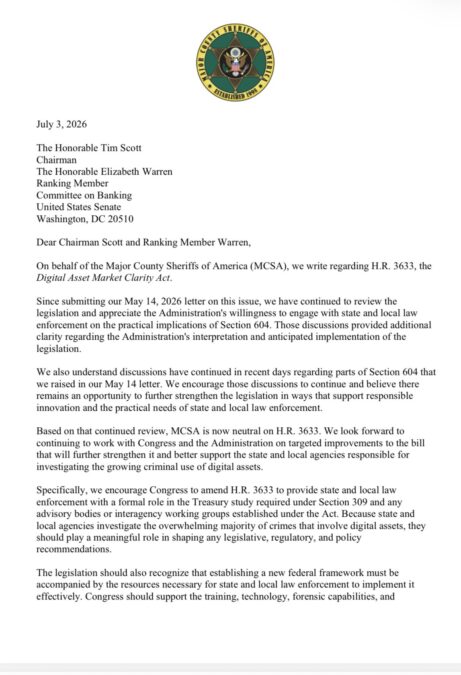
Major County Sheriffs of America (MCSA) has shifted to a neutral position on H.R. 3633, the Digital Asset Market Clarity Act, after earlier raising concerns over the bill’s law-enforcement implications.
In a July 3 letter to Senate Banking Committee Chairman Tim Scott and Ranking Member Elizabeth Warren, MCSA said continued discussions with the administration and state and local law enforcement had provided “additional clarity” on the interpretation and expected implementation of Section 604.
The move is significant because H.R. 3633 remains one of the most important crypto market-structure bills before Congress. The bill is designed to create a regulatory system for digital commodities involving the Securities and Exchange Commission and the Commodity Futures Trading Commission, while also barring Federal Reserve banks from offering certain direct-to-consumer products and prohibiting the use of a central bank digital currency for monetary policy.
Sheriffs Move From Concern to Neutrality
MCSA said it had continued reviewing the legislation since its May 14 letter and now believes there is room to strengthen the bill while supporting responsible innovation.
“Based on that continued review, MCSA is now neutral on H.R. 3633,” the group wrote.
However, the organization did not give the bill a full endorsement. Instead, it urged Congress and the administration to keep working on targeted changes that would better support agencies investigating the criminal use of digital assets.
The Senate Banking Committee advanced the CLARITY Act in May by a 15-9 vote, sending it toward the Senate floor after months of negotiations. Chairman Scott’s office said the bill would create clearer rules for digital assets and bring the sector into a safer and more transparent system.
Section 604 Remains the Main Pressure Point
The letter centers on Section 604, a provision that has drawn attention from law enforcement groups because of its treatment of non-custodial software developers and distributed ledger services.
The Fraternal Order of Police earlier opposed Section 604, saying it could limit prosecutors’ ability to pursue financial-crime cases involving cryptocurrency. The National Sheriffs’ Association also warned in a May letter that Section 604 could exempt mixers, tumblers and decentralized finance activity from some rules governing money-transmitting businesses.
Supporters of the provision argue that Section 604 preserves criminal authority against those who knowingly facilitate the movement of illicit funds, while limiting liability for non-custodial developers who do not control customer funds. TRM Labs said the provision preserves the criminal carve-out under 18 U.S.C. § 1960(b)(1)(C), which has been used in mixer-related prosecutions.
MCSA Wants State and Local Police at the Table
MCSA asked Congress to amend H.R. 3633 to give state and local law enforcement a formal role in the Treasury study required under Section 309 and in any advisory bodies or interagency working groups created under the bill.
The group argued that state and local agencies investigate most crimes involving digital assets and should have a direct voice in shaping future legislative, regulatory and policy recommendations.
The letter also said a new federal framework must come with resources for state and local agencies. MCSA specifically called for support for training, technology, forensic capabilities and investigative resources.
Crypto Crime Concerns Drive the Request
MCSA said criminal organizations increasingly use digital assets to facilitate and conceal crimes, including narcotics trafficking, fraud, ransomware, child exploitation, organized retail theft and terrorism financing.
The group said local investigators need the tools and partnerships required to identify offenders, trace illicit proceeds, recover assets and protect victims.
That framing gives lawmakers a possible path to reduce law-enforcement opposition without weakening the broader market-structure bill: keep developer protections, but add a stronger state and local role in implementation, Treasury studies and crime-fighting resources.
What’s Next
The letter gives Senate negotiators some breathing room, but it also keeps pressure on Congress to address enforcement concerns before H.R. 3633 reaches a final vote.
For the crypto industry, MCSA’s neutral position removes one source of outright resistance. For lawmakers, the message is narrower: the sheriffs are not trying to block the bill, but they want a seat at the table before the U.S. rewrites its digital-asset rulebook.
Also Read: CLARITY Act Stalls: Why Senate’s August Recess Puts US Crypto Rules at Risk