
Ethereum was trading at $2,407.72 as of 12:15 PM UTC on September 3, 2026 after hitting multi-month high near $2,527 during its late August rally, according to aggregated market data from CoinGecko.
The second-largest cryptocurrency is currently up by 28.4% but down roughly 3.6% over the past 7 days. With a market capitalization of $293.85 billion and a circulating supply of 122.015 million ETH, the asset is still down by nearly 51% from its all time high of $4,946—as marked by CoinGecko data.
ETH’s current tape is quieter than August’s squeeze off the mid-$1,800s. What has not quieted is the argument over what that tape is worth. Bank research, a family-office essay published the same morning, and a late-August trader map all attach different numbers to the same chart.
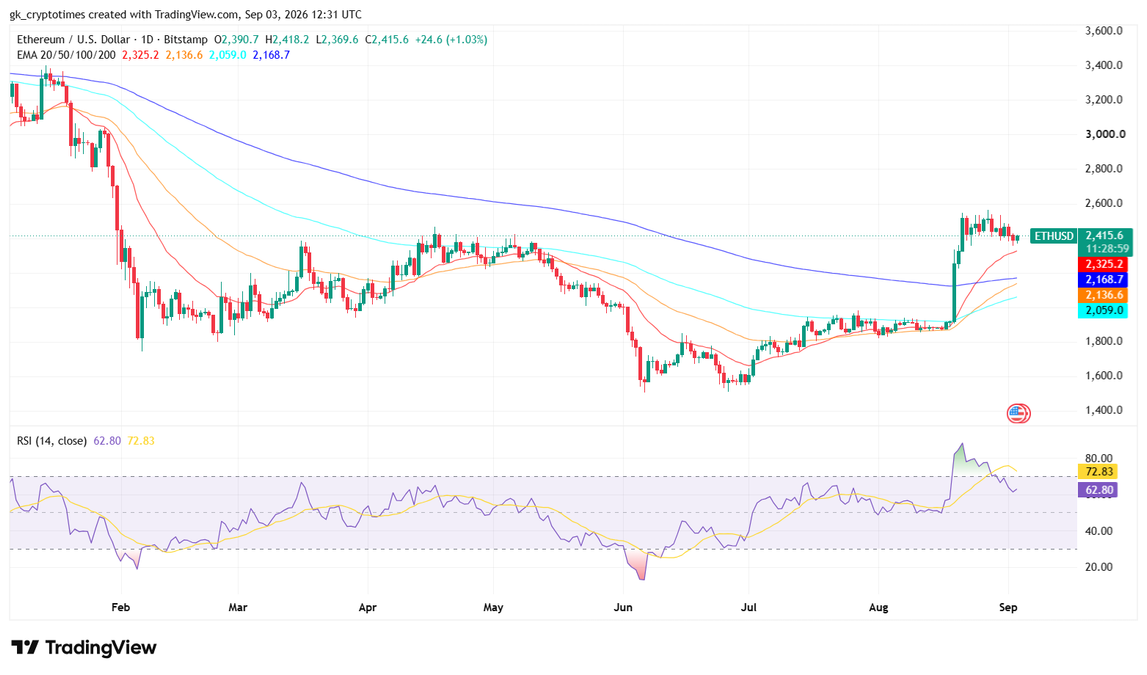
Price action after the August rebound
The immediate market is a consolidation, not a trend. Ethereum recovered sharply in the second half of August, then failed to hold the upper end of this week’s band. Intraday support on 3 September has so far held above $2,372, per TradingView data.
Trader Michaël van de Poppe framed the August bounce as incomplete. In an August 29 post, he wrote that a “true breakout” would open another leg toward $3,200, “perhaps even $3,500,” and then stall, adding that holders should not exit early.
Separately, his early-September comments flagged a possible sweep toward the low $2,300s or $2,200 as a zone to add, with $3,000 as a subsequent objective. Those are tactical levels, not a year-end model. They sit close to where the market already is and do not require a new ETH/BTC regime.
The protocol calendar is also visible but not priced as a date-certain event. Ethereum’s next named hard fork, Glamsterdam, is described by the Ethereum Foundation as expected on mainnet in Q4 2026, with a date not yet confirmed and a Sepolia fork listed for September 28, 2026. Headliners include enshrined proposer-builder separation and block-level access lists, changes aimed at raising Layer-1 capacity. That is infrastructure, not a catalyst with a printed multiplier.
Forecasts from banks, traders and treasuries
In a podcast with Milk Road, Standard Chartered’s global head of digital assets research, Geoffrey Kendrick has restated an end-2026 target of $4,000 and an end-2030 target of $40,000. Intermediate steps he has associated with that path include about $10,000 in 2027 and $18,000 in 2028.
Earlier in 2026 the bank had carried a higher near-term case of $7,500—as reported by The Crypto Times at the time—for year-end 2026 and later cut it. Kendrick’s stated rationale is a split between token price and network use: transaction counts and total value locked measured in ETH terms have stayed near highs while the dollar price and the ETH/BTC ratio lagged. In a private note to clients, he has compared that split to Amazon’s share price in 2001, when internal metrics improved as the stock fell, and wrote that “ETH will catch up to the internal metrics, it is just a matter of time.”
The same work assumes stablecoins and tokenized real-world assets keep scaling on Ethereum and that ETH/BTC can migrate back toward 0.08 by 2030. Those are research assumptions, not observed outcomes.
Arthur Hayes, BitMEX co-founder and chief investment officer of Maelstrom, published a different number on 3 September 2026. In the essay Atención on his Substack he kept a structural Bitcoin long without a price target and labeled shorter-dated, more speculative year-end 2026 marks of $10,000 for ETH. Though he did not attach a valuation model to the target print. From the current ETH price levels, that target implies roughly a fourfold move in four months.
Tom Lee of Fundstrat, who also chairs Bitmine Immersion Technologies, has not issued a single September 3 target. In late August he described $6,000 as “very conservative” if Bitcoin reaches $150,000 and ETH/BTC only recovers to 0.04. He has separately said ether “could easily be over $10,000” over one to two years. Longer ratio work he has used publicly maps a $250,000 Bitcoin assumption to about $12,000 ETH at the eight-year average ratio and about $22,000 at the 2021 peak ratio near 0.087. Those figures move with Bitcoin; they are not independent ETH forecasts.
Bitmine’s accumulation is a flow fact sitting beside Lee’s comments, not proof of his targets. Corporate treasury buying has been large enough to matter at the margin of float, but it does not close the gap between $2,408 and $10,000.
The gap the market still has to resolve
Three stories are running at once. The first is mean-reversion in the pair: ETH/BTC at 0.03091 is less than half the 2021 peak—as noted in TradingView data. A return toward 0.04 with bitcoin unchanged would not get ETH to Lee’s $6,000; that number needs a much higher Bitcoin print. A return toward 0.08 by 2030, as Standard Chartered sketches, would re-rate ether versus Bitcoin even if its own path is only moderately higher.
The second story is liquidity. Hayes treats crypto as a high-beta claim on dollar creation and uses EUR/JPY as the tell. If that pair does not fall, his year-end $10,000 mark has no stated fallback. If it does fall and crypto receives the first wave of easier dollar conditions, ETH’s 30-day gain of about 29%—as mentioned earlier—would look like an early chapter rather than the whole move.
The third is usage versus value capture. Kendrick’s Amazon analogy only works if Layer-1 ether, not only Layer-2 venues and stablecoin issuers, keeps a claim on growth in settlement, tokenization, and DeFi. Glamsterdam is the Foundation’s next attempt to raise mainnet capacity. It does not, by itself, decide whether that capacity is paid for in ETH.
As of 12:15 UTC on September 3, 2026, the observable market is narrower than the commentary. CoinGecko shows ether in a $2,372–$2,416 day range, a $2,357–$2,532 week, a $293.85 billion cap, and a 51% drawdown from the 2025 high. Van de Poppe’s map lives inside a few hundred dollars worth of spots.
Standard Chartered’s $4,000 year-end figure is about 66% above the last print. Hayes’s $10,000 is a separate regime. None of those outcomes is in the price. The next test is whether $2,370 remains a floor, or whether the August rebound was only the first half of a range.
Also read: Standard Chartered Launches Institutional Bitcoin & Ether Spot Trading in UAE