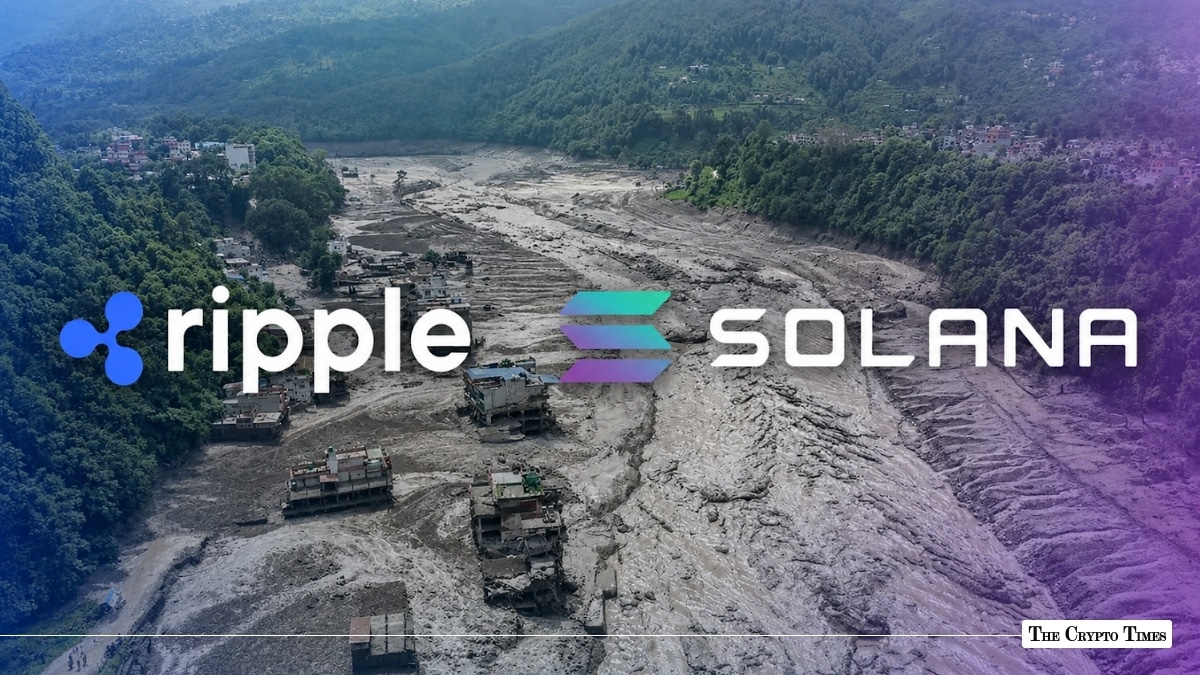
A catastrophic glacier collapse and resulting floods in northern Nepal on August 26 have prompted several crypto companies and onchain donors to launch or support relief efforts, ranging from corporate grants to a Solana fundraising auction and a crypto donation route linked to Nepal’s official disaster relief fund.
As of September 3, at least 1,252 people have died in Nepal and more than 4,200 remain missing, according to Reuters. Authorities estimate about 7,500 homes were completely destroyed, while roughly 20,000 may need to be rebuilt in safer locations.
The U.S. Geological Survey said a seismic event detected on August 26 was initially classified as an earthquake but was later linked to a glacial collapse and debris flow. The disaster sent debris and floodwater through the Lende Khola and Trishuli river systems, devastating communities and infrastructure downstream.
Ripple Directs $300,000 to Relief Groups
Ripple announced on August 29 that it would donate $300,000 to World Central Kitchen and Mercy Corps to support emergency response efforts in Nepal and Tibet, including meal distribution, clean water, and sanitation support.
Ripple described the contribution as humanitarian funding for the two organizations, rather than an XRP or RLUSD transfer directly to Nepal’s government.
World Central Kitchen said restaurant partners were already serving meals in Nepal’s Rasuwa and Nuwakot districts on the day of the disaster, with its relief team moving in to expand operations. Mercy Corps said its teams had reached affected areas and were distributing food and hygiene supplies while assessing needs in hard-hit communities.
That makes Ripple’s contribution the most conventional part of the crypto industry’s response, with corporate funding routed through established humanitarian organizations already operating on the ground.
Solana Turns Its Profile Picture Into a Relief Auction
The Solana Foundation took a different approach.
Working with NFT marketplace Mallow, it divided Solana’s official X profile picture into nine advertising zones and auctioned them to bidders. Winning brands receive placement on the profile image and pinned post for one week.
Bids were placed in USDC, with unsuccessful bids automatically returned. Solana said after the auction closed that the nine winning bids had raised $166,946.50 for Nepal flood relief.
The campaign’s published terms say 100% of the auction proceeds are earmarked for relief. Mallow is to receive the proceeds, convert them to USDC on Ethereum and transfer the funds to Engage Nepal, a U.S.-based 501(c)(3), for onward donation to the Government of Nepal’s Prime Minister Disaster Relief Fund.
Following the auction, Solana reported $166,946.50 raised, while the campaign organizer said the funds had been delivered. The reported fundraising figure should therefore be distinguished from any independently verified government receipt of the funds.
Crypto Builds an Onchain Bridge to Nepal’s Official Fund
That gap is what Nepal Relief, a crypto donation initiative working through Engage Nepal, is attempting to bridge.
The project publishes a public relief wallet accepting USDC on Ethereum and Polygon. Nepal Relief says donations are collected and accounted for onchain by Engage Nepal before being donated to the Prime Minister Disaster Relief Fund. It lists Polygon’s Open Money Stack as providing routing, bridging and conversion infrastructure, with additional support from Coinme.
Engage Nepal is led by former U.S. Ambassador to Nepal Scott DeLisi and works with nonprofit partners in the country. Nepal’s government has not listed a cryptocurrency wallet among the payment methods on its official disaster-relief donation portal. Its official appeal instead lists bank transfers, card-payment gateways, remittance services and cross-border payment options including UPI and Alipay+.
Crypto can therefore operate at the collection layer, but the last mile still depends on organizations capable of converting digital assets and delivering the proceeds through recognized relief channels.
Onchain Transparency Only Covers Part of the Journey
The response illustrates both the appeal and the limits of crypto philanthropy.
Stablecoins can let donors transfer dollar-denominated value without taking the same direct price exposure associated with volatile assets such as Bitcoin, Ether, or Solana. Public blockchain addresses can also provide a visible transaction trail showing when funds arrive at a designated wallet.
But a transaction hash cannot show whether a family received food, whether sanitation supplies reached an evacuation center or how money is ultimately allocated after conversion to fiat. Blockchain transparency can document the digital portion of the journey; it does not replace humanitarian logistics, financial controls or trusted organizations on the ground.
That distinction is particularly important after Nepal’s Prime Minister’s Office warned people against donating through unauthorized QR codes and personal accounts created in the name of flood relief.
An India Today investigation found more than 20 suspicious social-media fundraising accounts, including newly created or renamed profiles using personal payment codes to solicit donations after the disaster.
For crypto donors, the same principle applies: a wallet address is not trustworthy simply because its transactions are public.
A Real Crypto Use Case — With a Narrow Claim
Ripple’s grant, Solana’s auction and the Engage Nepal donation route do not amount to a crypto-led relief operation. Nepal’s government, domestic institutions, foreign governments and humanitarian organizations are carrying the much larger response.
What these efforts illustrate is narrower but tangible: companies, builders, and individual donors can use crypto rails to raise dollar-denominated funds, make parts of the transaction trail publicly auditable, and connect international contributions with established relief channels.
The next test is delivery. For the Solana campaign and other onchain fundraising efforts, the strongest evidence will be a documented path from public crypto wallets through intermediary organizations and into the intended official relief channels.
For disaster fundraising, onchain records can document the movement of funds, but the effectiveness of the response ultimately depends on how those funds are converted, distributed and delivered.
Also Read: 21 Firms Including BofA, Citi, Goldman Sachs Plan USD Stablecoin