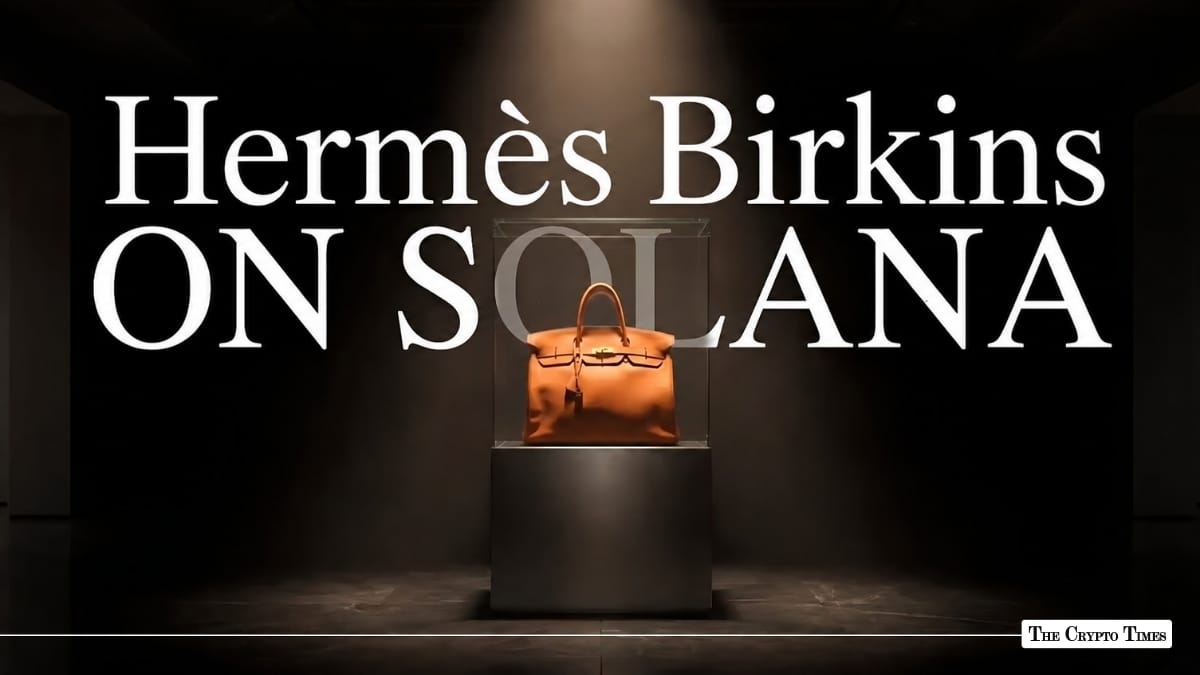
Beezie, a marketplace that brings physical collectibles onto public blockchains, has announced a partnership with The Luxury Closet, described as the Middle East’s largest luxury resale platform, to place authenticated designer handbags, watches, jewellery and accessories on Solana.
Each item will be represented by a digital twin, a blockchain token that maps one-to-one to a real object held in secure storage, and holders will be able to buy, trade, vault, redeem or swap the item back into the marketplace for up to 92% of its fair market value.
The two companies confirmed the tie-up in a joint press release issued from Boston dated on September 3, 2026, saying the offering will launch later this year with blind shopping bags containing one authenticated item each, before scaling to an always-on luxury experience featuring thousands of authenticated items across multiple price points.
The set of celebration items named in the release includes an Hermès Birkin 40, a black Chanel handbag, his-and-hers Dior and Louis Vuitton duffels, a Batman Rolex GMT-Master II watch and an 18-karat yellow gold Van Cleef & Arpels Alhambra necklace with a mother-of-pearl pendant.
What Beezie and The Luxury Closet said
According to the release, every designer bag, accessory, piece of jewellery and watch will be sourced and vetted by The Luxury Closet’s in-house authentication team before it is listed. Each authenticated item will then be tokenized on Solana and held in secure vault storage until it is redeemed or shipped directly to the collector.
“Luxury has always had the characteristics of a collectible: scarcity, cultural value and a secondary market. What’s been missing is the infrastructure that lets people interact with those assets as easily as they do digital ones,” said Andrea Miele, Founder and Chief Executive Officer (CEO) of Beezie, in the statement.
Kunal Kapoor, CEO of The Luxury Closet, said in the same release that the firm would apply the same rigour in sourcing and authentication to onchain ownership that it applies on its own site. Beezie added that the format is intended to bring the “energy and immediacy” of its trading-card activation to a new category of goods.
Neither company published a full inventory count, a redemption fee schedule or a specific go-live date beyond “late 2026”. Hermès, whose Birkin anchors the announcement, is not named as a party to the deal, and the pieces being placed onchain are pre-owned stock passing through The Luxury Closet’s authentication process rather than primary-market inventory from any luxury house.
Who The Luxury Closet is
According to The Luxury Closet’s About page, the firm was founded in 2012 in Dubai by Kunal Kapoor with a three-member team, and its first sale was a single Hermès Birkin.
The company today calls itself the largest luxury resale marketplace in the Middle East, with a clientele across 80 countries and offices in Dubai, India, and Kuwait, alongside a flagship retail store in Dubai. Every item on the platform is authenticated in-house by a specialist team that includes gemologists and leather experts.
Where Beezie fits in
Beezie is a Boston-based marketplace that tokenizes physical collectibles, holds them in Brink’s vaults, and lets holders trade them onchain. The company’s flagship product is the Claw Machine, an arcade-style pull mechanic where collectors pay $30 to $500 per pull for curated inventory that includes graded Pokémon cards, sealed products, sneakers, and memorabilia, with published odds and physical redemption available worldwide.
The platform first launched on Flow and later expanded to Base, the Ethereum layer-2 network built by Coinbase, before adding Solana. On May 12, 2026, Beezie announced its Solana expansion after reporting over 540,000 claw pulls and more than $100 million in cumulative Base volume, with luxury flagged as an upcoming vertical at the time.
On July 27, 2026, digital-asset investment manager Psalion led a $4 million round in the company through its Psalion VC Fund III, citing more than $170 million in gross merchandise value (GMV) across the platform since launch. Thursday’s release adds that Beezie has now crossed more than 1 million pulls across its flagship Claw machines.
Why Solana
Solana is a high-throughput layer-1 blockchain designed for low-fee consumer applications, and it has become one of the leading venues for tokenized real-world assets (RWA), meaning onchain claims that represent off-chain items such as United States Treasuries, private credit, or physical goods.
According to a July 31, 2026 update from the Solana Foundation, the network hosted approximately $3.7 billion in non-stablecoin RWA value across more than 313,000 holders, with tokenized Treasuries and equities driving most of the total. The Crypto Times reported in May that the foundation’s own leadership put institutional RWA growth on the network at roughly 1,000% since early 2025.
Against that base, luxury handbags are a small line item. Their appearance is more relevant as a test of whether high-ticket physical objects can settle and transfer on the same rails already used for tokenized funds.
Luxury and blockchain have met before
Luxury groups themselves have used blockchain infrastructure for several years, though mostly for authentication rather than open trading. On April 20, 2021, Prada Group, LVMH, and Cartier, part of Richemont, unveiled the Aura Blockchain Consortium, a private permissioned network that gives luxury products a digital identity for authenticity and traceability. OTB Group joined later that year. Aura functions as a brand-controlled certificate system, not a public marketplace for the goods themselves.
Beezie’s model is different. It is a third-party resale channel operating on a public blockchain, where an authenticated pre-owned bag is represented as a transferable token that can change hands without the physical item leaving the vault.
The Birkin context
Hermès does not sell the Birkin as an open-shelf product in most boutiques. Access typically depends on a client’s prior purchase history at the brand and on local store allocation. The secondary market has long served as an alternative route to the bag.
The high-water mark for that market came on July 10, 2025, when Sotheby’s Paris sold Jane Birkin’s original 1984 prototype for €8.6 million, roughly $10.1 million with fees, the highest price ever paid for a handbag at auction. Standard pre-owned Birkins in classic leather commonly resell in a five-figure range on established resale platforms.
What is still unknown
The joint statement does not publish redemption fees, insurance terms or specific launch pricing. It also does not say whether items withdrawn from the vault can be relisted, or how know-your-customer (KYC) and anti-money-laundering (AML) checks will apply given the high-ticket price points involved. Beezie’s card product already uses identity verification, according to third-party reviews of its onboarding flow.
Until listings go live, the most accurate summary remains the closing frame of the 12-second video Beezie posted on X on Thursday: “coming soon”.
Also Read: Ripple Pledges $300K, Solana Raises $167K for Nepal Flood Relief