Nasdaq-listed Farmmi, Inc. (FAMI) climbed as much as 350%, according to onchain analytics firm Nansen, during the Wednesday, September 2, 2026 session. The stock traded as high as $0.50, or about 321% above its prior close of $0.1187, after a memecoin named JINQIAN, or “money mushroom,” began trading on Robinhood Chain against an unofficial onchain token that borrowed Farmmi’s stock ticker.
The Chinese agricultural micro-cap opened near $0.118, printed an intraday high of $0.50 within a day range of roughly $0.105 to $0.50, and later faded to a band of about $0.15 to $0.18.
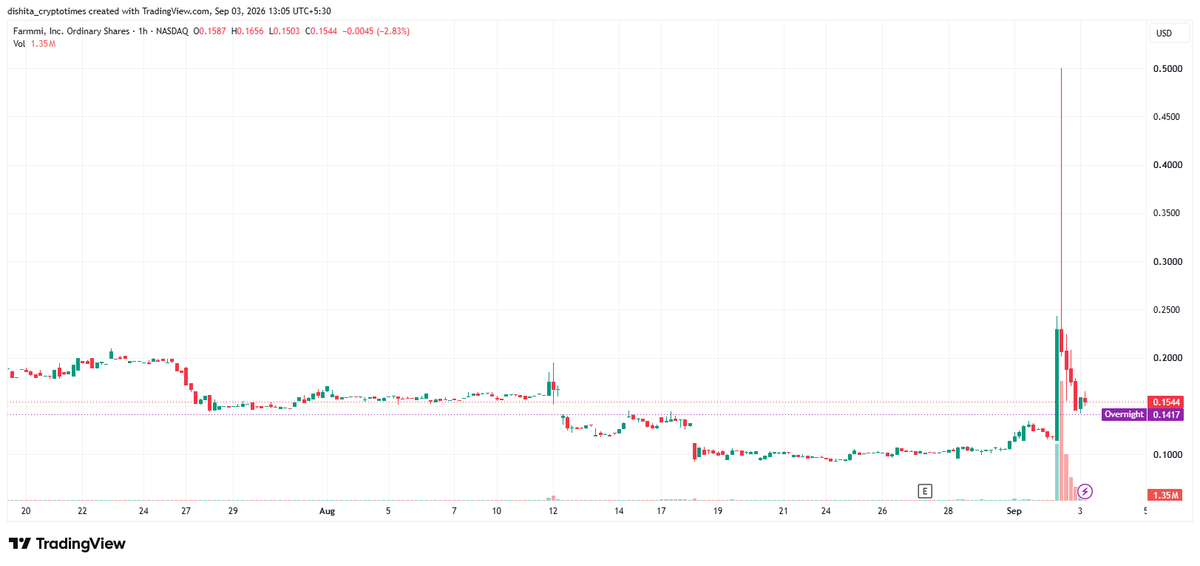
The September 2 session turnover ran in the range of 833 million to 873 million shares depending on the data provider, against a recent daily average measured in the low to mid single-digit millions on some screens and closer to 18 million on others, for a company with only about 37.43 million Class A ordinary shares outstanding. No earnings release, contract, or filed corporate catalyst appeared during the session.
Nansen Says JINQIAN Attention Spilled Into the Nasdaq Stock
Onchain analytics firm Nansen posted a four-part thread on X starting at 03:19:01 GMT on Thursday, September 3, 2026, that framed the rally as an attention transfer from the crypto market to the cash market. In its first note at 03:19:01 GMT, Nansen said the meme helped send the real stock up as much as 350%.
The firm’s second post at 03:19:05 GMT laid out the onchain mechanics of the token that JINQIAN was paired against. The onchain token was not an official Robinhood Crypto stock token, the kind typically issued as tokenized claims on listed names such as Nvidia (NVDA) and Micron Technology (MU).
The FAMI token was independently deployed. Its entire supply of roughly 37 million units was minted in a single transaction to just two wallets, a figure that sits next to Farmmi’s listed share count of about 37.43 million and made the token look like a one-to-one wrap of the shares, though Nansen said it was not redeemable for Farmmi equity.
Deployer address 0xd28…b7B0d retained 38% of that supply, and the same party controls a contract that reprices the token’s liquidity pools. About 14 million tokens moved out after launch, while two wallets still controlled roughly $5.8 million of supply at the time of the thread.
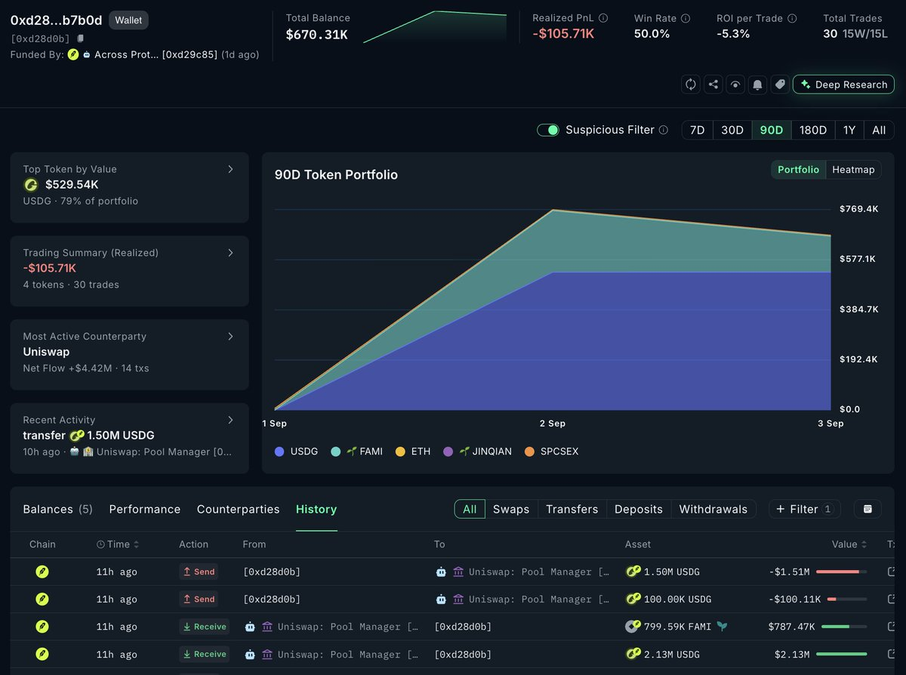
In its third post at 03:19:08 GMT, Nansen drew the operational line: there is no mint-and-redeem link between the onchain FAMI token and Farmmi’s Nasdaq shares. Buying the token does not force anyone to buy or deliver real equity.
The final post at 03:19:11 GMT warned that onchain attention can hit offchain markets fast, and advised traders to verify controller wallets, supply movement, and whether trading activity is backed by any underlying asset before touching listings on the Robinhood Chain.
Where the JINQIAN Name Actually Comes From
The token borrowed its name from Farmmi’s own regulatory filings, not from any crypto project the company had endorsed.
In its Form 20-F, the annual report used by foreign private issuers registered with the United States Securities and Exchange Commission (SEC), for the fiscal year ended September 30, 2025 and filed on February 10, 2026, the company wrote in its Shiitake product section that “Depending on the species, our Shiitake products include different varieties such as floral mushroom and Jinqian (“money”) mushroom,” per the annual report on SEC EDGAR. JINQIAN is the pinyin transliteration of the Chinese word meaning “money.” Traders treated that single parenthetical as a ready-made ticker joke.
Who Farmmi Actually Is
Farmmi, Inc. is a Cayman Islands holding company incorporated on July 28, 2015, with principal executive offices in Lishui, Zhejiang Province, People’s Republic of China (PRC). It operates business processes for selling dried edible fungi and other agricultural products and has more recently added United States (US) warehousing and logistics operations. Class A ordinary shares trade on the Nasdaq Capital Market under the ticker FAMI.
Founders Yefang Zhang and Zhengyu Wang started the edible fungi business in November 1994, and Zhang serves as chairwoman and chief executive. Market data providers list the company as having about 15 employees.
For fiscal 2025, Farmmi reported revenue of approximately $28.0 million, a 56.4% decline from $64.1 million in fiscal 2024, and a net loss of about $53.4 million. Shiitake sales came in at about $10.7 million, Mu Er sales at about $9.2 million, and logistics contributed roughly $7.3 million, or 26.2% of revenue. Roughly 96.3% of product sales were made in China.
The interim update filed on August 27, 2026, covering the six months ended March 31, 2026, showed revenue of about $6.39 million, down 60.4% from $16.1 million year on year, a net loss of about $37.6 million, and cash and restricted cash of roughly $249,252.
The filing raised substantial doubt about the company’s ability to continue as a going concern after large allowances on supplier advances and impairments on investments. On August 4, 2026, Farmmi separately announced a framework agreement for an acquisition in Brazil, an item unrelated to Wednesday’s trading action.
Fragile Listing Backdrop
The stock was already on a compliance countdown when the memecoin trade hit. On August 12, 2026, Farmmi disclosed in a Form 6-K, the interim reporting form used by foreign private issuers, that it had received a letter from The Nasdaq Stock Market LLC on August 11, 2026, notifying the company that it was not in compliance with the minimum bid price requirement under Nasdaq Listing Rule 5550(a)(2), because Class A shares had closed below $1.00 for 30 consecutive business days.
Under Nasdaq Listing Rule 5810(c)(3)(A), the company has a 180-calendar-day compliance window until February 8, 2027, and can regain compliance only if the closing bid price reaches at least $1.00 for a minimum of 10 consecutive business days, according to the company’s press release accompanying the disclosure.
A reverse stock split, if used, must be completed no later than 10 business days before that deadline. An additional 180-calendar-day grace period is possible only if other continued listing tests are met. Farmmi has been in this position before, having regained minimum bid compliance in April 2025 after earlier deficiency notices. Wednesday’s $0.50 intraday high did not clear the $1.00 threshold, and the stock closed the session far below the requirement.
How the Onchain to Offchain Loop Worked
Robinhood Chain has drawn attention in recent months for a pattern of memecoins paired against tokenized stocks rather than against stablecoins, Bitcoin (BTC), or Ether (ETH). On officially issued Robinhood stock tokens paired with large-cap names, that structure can create a transmission path from meme demand to tokenized-stock demand to authorized minting activity that touches the cash market. Farmmi did not have that path.
The FAMI token that JINQIAN traded against was not an officially issued Robinhood stock token, per Nansen’s second post. Its supply of roughly 37 million units, mimicking Farmmi’s listed share count of about 37.43 million, its single-transaction minting to two wallets, and its issuer-controlled pool-repricing contract placed it in the memecoin category rather than the regulated tokenized-equity category.
The stock rally was therefore driven by attention and mistaken mapping between the onchain ticker and the listed share, not by any redemption obligation between the two. Pairing the same memecoin-and-tokenized-equity theater with a nano-cap listing, rather than the deep large-cap names typically used on Robinhood Chain, is what allowed onchain screenshots to move the cash market.
Implied Valuation Detached From the Underlying
At its peak, the JINQIAN memecoin’s implied fully diluted valuation reached about $63 million on DexScreener, several times larger than Farmmi’s actual public market capitalization before the spike, which sat at a few million dollars on about 37.43 million shares outstanding.
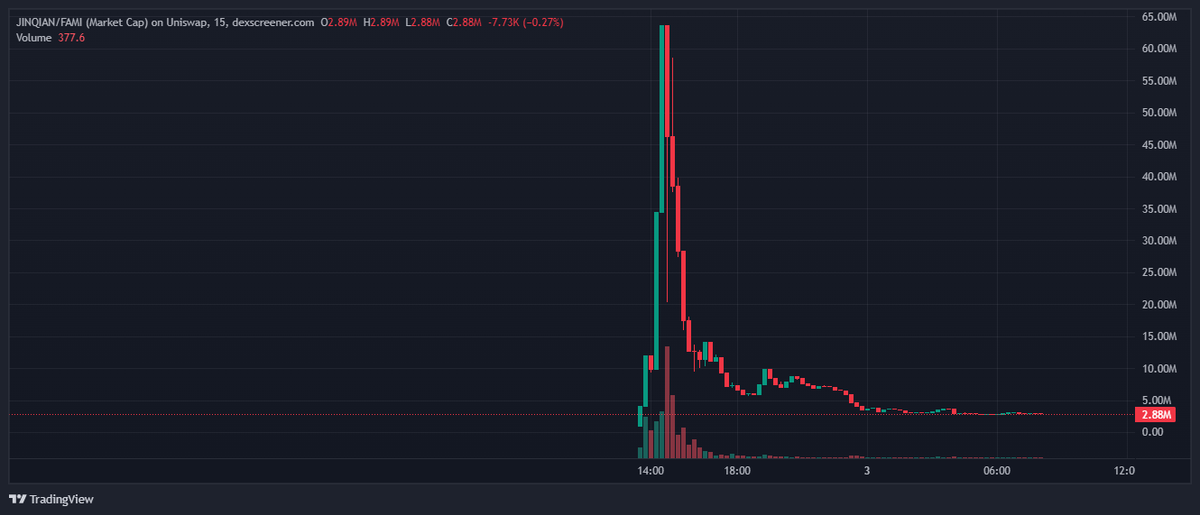
That gap illustrated how detached the token’s onchain price discovery was from the operating business it was named after.
Social Color That Primed the Trade
On Monday, August 31, 2026, at 17:17:24 GMT, an X account operating under the handle RuneCrypto posted that it had acquired 37.4% of an unnamed Nasdaq company for $1.8 million, described a $4.8 million market capitalization at $0.12 a share, claimed 92.3% short interest, and said it would tokenize the equity on Robinhood Chain and pair a memecoin against it.
Community notes on that post said no Nasdaq name matched those exact figures. No Farmmi Schedule 13D, the SEC form required from any person acquiring beneficial ownership of more than 5% of a class of equity securities, confirming that purchase appears in the public record.
The 38% deployer allocation on the unofficial FAMI token later echoed the earlier 37.4% claim, which is one reason the narrative attached itself to Farmmi. That thread should be treated as market color, not verified corporate control, since Farmmi has not said it sold any block to that account and Nansen did not identify the deployer as a disclosed Farmmi shareholder.
Separately, on Wednesday, September 2, 2026 at 14:43:25 GMT, an account operating under the handle 0xSammy described the sequence as “onchain meme, then tokenized stock demand, then viral screenshots, then offchain penny-stock buyers,” and noted that Farmmi still needed 10 closes above $1.00 for the meme rally to translate into listing compliance.
What Traders Should Note
Farmmi has issued no statement addressing the JINQIAN memecoin, the unofficial onchain FAMI token, or the September 2 price action in its public filings, and no Schedule 13D has appeared confirming any related large-block purchase. The company’s most recent listing-related filing remains the August 12, 2026 notice on the minimum bid deficiency.
Also Read: TradeXYZ Q2 Volume Jumps 79% to $202B as Equities Surge