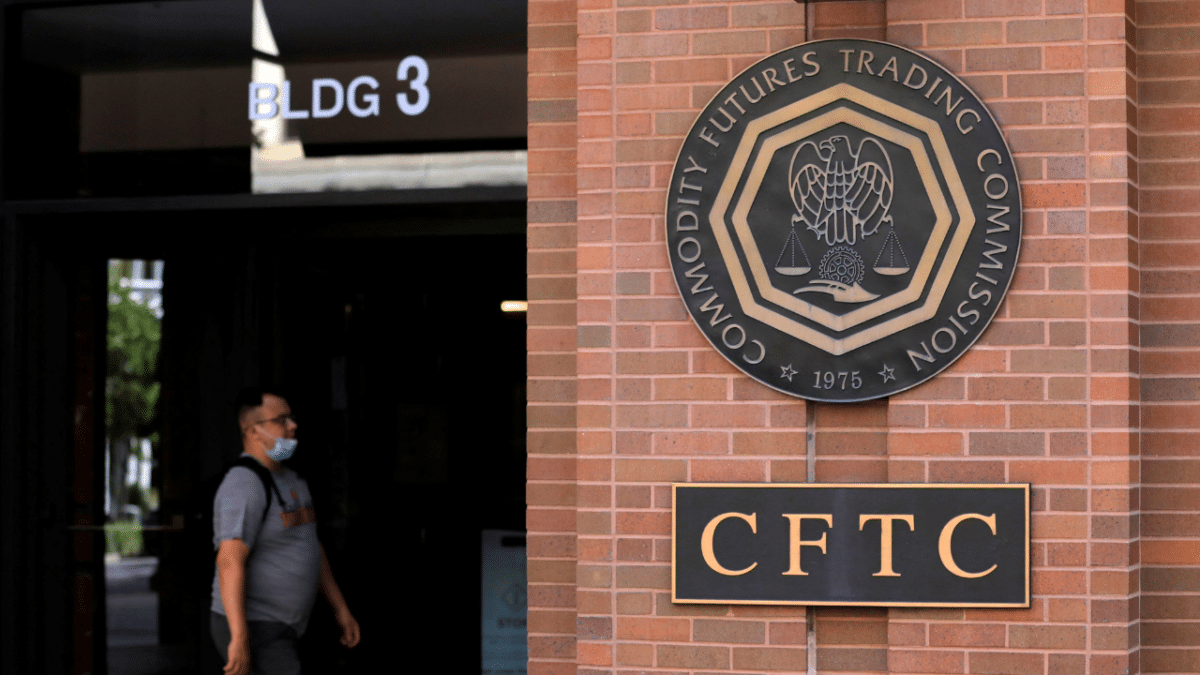
The Commodity Futures Trading Commission (CFTC) has asked a federal court to dismiss a lawsuit filed by Chicago Mercantile Exchange Inc. that challenges the agency’s approval of Bitcoin perpetual futures listed by KalshiEX LLC, arguing that the exchange operator lacks legal standing and that its claimed injuries are “entirely self-inflicted.”
The motion was docketed at 6:44 p.m. Eastern Time on September 2, 2026, in Chicago Mercantile Exchange Inc. v. Selig, Case No. 1:26-cv-02157, before Judge Colleen Kollar-Kotelly at the U.S. District Court for the District of Columbia.
The defendants, the CFTC and Chairman Michael S. Selig, moved to dismiss under Federal Rule of Civil Procedure 12(b)(1) for lack of jurisdiction and for failure to state a claim. The supporting memorandum, docketed as Document 30-1, is a 30-page “Statement of Points and Authorities,” with Martin Minot listed as counsel of record.
What the CFTC’s Motion Argues
The memorandum opens by describing CME’s suit as “much ado about nothing.” The agency writes that CME “does not argue that it could not list this same type of futures contract” and “does not argue that the Commission lacked authority to approve the listing of this type of contract.”
Instead, according to the brief, CME “claims that the Commission should have labeled them as ‘swaps’ rather than ‘futures.'” On the underlying legal question, the agency states plainly that “CME is wrong on the merits” and that “perpetual futures are futures.”
The standing argument forms the core of the motion. Citing the U.S. Supreme Court’s 2021 decision in TransUnion LLC v. Ramirez, 594 U.S. 413, 423 (2021), the CFTC writes that Article III of the U.S. Constitution requires a plaintiff to answer “What’s it to you?” and that CME “has no serious answer to that question.”
CME’s original complaint described “textbook competitive injury” from the approval, arguing that Kalshi, another designated contract market (DCM), could now offer products that compete for retail customers.
The CFTC responds that CME “makes no plausible allegation that its bottom line will be affected by the Order,” pointing out that CME has publicly stated its customers are not demanding perpetual futures and that its own trading data show volume on its cryptocurrency futures “increased after the Commission issued the Order.”
The Order, according to the agency, clarifies that “Kalshi and other DCMs [can] list for trading” perpetual futures on digital commodities. “Thus, even if CME’s vague assertions of competitive injury had any substance, those injuries are entirely self-inflicted and based on CME’s refusal to list perpetual futures for trading,” the brief states.
The CFTC further argues that the alleged injury is not redressable. Even if a court agreed the contracts should be labeled swaps, “Kalshi and other DCMs could simply offer the contracts as ‘swaps’ rather than ‘futures.'” Different tax, reporting, or recordkeeping treatment, the brief argues, would not repair CME’s alleged competitive harm.
Finally, the agency contends that CME falls outside the “zone of interests” of the Commodity Exchange Act (CEA). “Congress enacted the CEA to create a national system of futures markets with a national regulator and a self-regulatory structure to foster consumer protection and innovation,” the CFTC writes. “CME’s lawsuit seeks to use the CEA to protect its business from a competitor’s classification decisions and stifle innovation.”
How the Dispute Began
On May 28, 2026, KalshiEX submitted its BTCPERP contract for review under Commission Regulation 40.3. The next day, the CFTC issued an Order for Approval under Section 5c(c)(4) of the Commodity Exchange Act, announced in CFTC Release Number 9240-26.
The Order stated that BTCPERP, a cash-settled perpetual contract referencing the spot price of Bitcoin, could be listed as a futures contract and complied with the Act, including the Core Principles applicable to designated contract markets under Section 5(d) and Part 38 of the Commission’s rules.
The same day, the CFTC issued a Policy Statement Concerning the Listing of Perpetual Contracts, later published at 91 Federal Register 33,160. Perpetual futures, commonly called “perps,” are derivative contracts that allow traders to hold long or short exposure to an asset without a fixed expiration date, with periodic funding payments used to keep the contract price aligned with its spot reference.
BTCPERP uses the CF Benchmarks Bitcoin Real Time Index, trades in units of 1/10,000 Bitcoin, and marks positions to market continuously across 24 hours a day, seven days a week.
Kalshi began Bitcoin perpetual trading on June 3, 2026, followed by Ethereum on June 4. According to Kalshi and contemporaneous press reports, first-day volume exceeded $100 million and notional volume crossed $1 billion within about a week.
CME filed its 43-page complaint on June 18, 2026, naming Chairman Selig in his official capacity along with the Commission. The exchange asked the court to vacate the May 29 Order and the accompanying Policy Statement, and to declare that Bitcoin perpetual contracts and similar digital commodity perpetuals are swaps under the CEA, as amended by the Dodd-Frank Wall Street Reform and Consumer Protection Act.
CME argued that Chairman Selig, then the sole confirmed commissioner, approved Kalshi’s application one day after it was filed and without public comment. CME’s complaint said the CFTC did not address comments from an April 2025 request for comment on perpetual contracts and did not issue a final rule. The complaint also cited prior CFTC enforcement actions against Binance, BitMEX, Mango Markets, Deridex, and KuCoin in which the agency treated perpetual contracts as swaps.
CME Group Chairman and Chief Executive Terrence Duffy told CNBC on June 17, 2026, that perpetual futures “are actually swaps under the Dodd-Frank Act” and that CME would sue. A CFTC spokesperson that week called the planned suit “frivolous,” a characterization separate from the language used in the September 2 legal brief.
What Comes Next
The motion does not end the case. On August 13, 2026, Judge Kollar-Kotelly set a schedule requiring defendants to respond to the complaint by September 2, 2026, and CME to oppose any motion to dismiss by October 2, 2026. CME has not yet filed its opposition, and the court has not ruled.
The legal question remaining before the court is whether a contract with no expiry and a funding-rate mechanism that references Bitcoin qualifies as a “contract of sale of a commodity for future delivery” or a swap under the CEA. That classification affects listing procedures, customer eligibility, reporting requirements, and tax treatment, and will influence whether other designated contract markets can continue listing similar crypto perpetuals under the May 29 framework.
The CFTC’s motion was first widely circulated publicly through excerpts posted on X by Jake Chervinsky, chief executive of the Hyperliquid Policy Center (HPC), at 23:28 UTC on September 2, 2026. Document 30-1 had not yet appeared in the public RECAP archive at the time of publication.
Also Read: New Jersey Asks Supreme Court to Rule on Kalshi Sports Bets