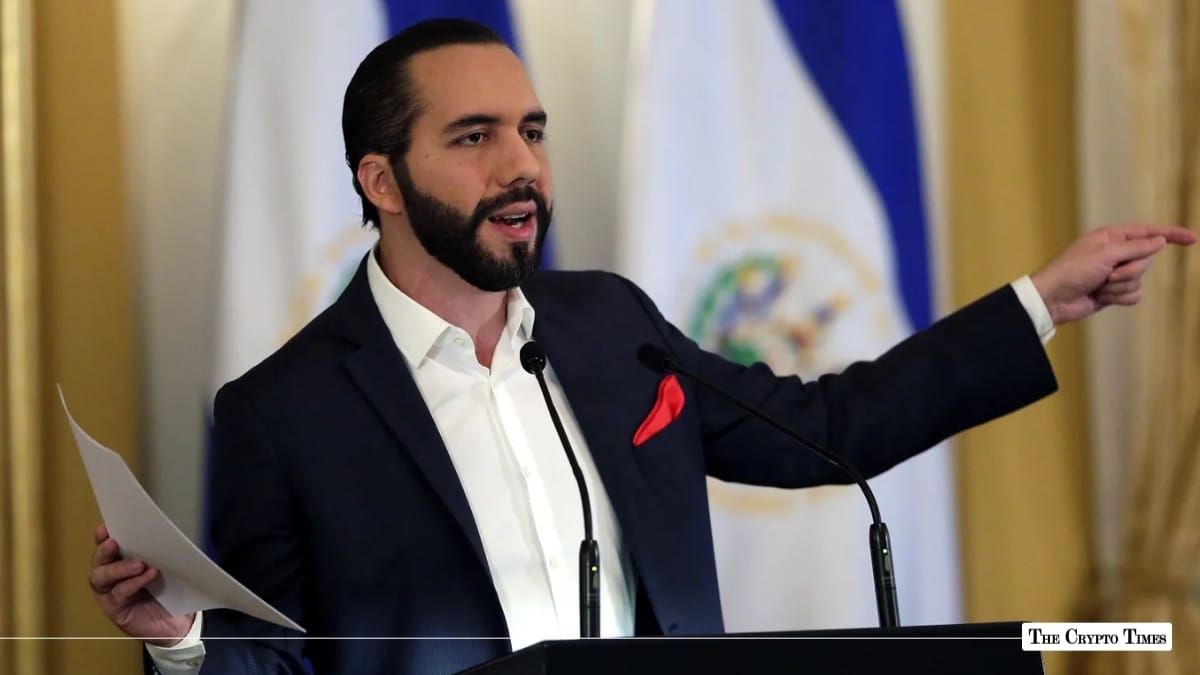
El Salvador President Nayib Bukele has publicly rejected a media report claiming that his government transferred the country’s Bitcoin reserves to a private operator as part of a new understanding with the International Monetary Fund (IMF), saying the report confused a change of ownership at the state-backed Chivo digital wallet with the country’s separate Strategic Bitcoin Reserve.
Bukele called the report “totally false” and told his followers to read the underlying Fund document themselves, saying it shows only that shares in Chivo were transferred, not the sovereign coin stockpile that El Salvador began building in September 2021.
The dispute grew out of an IMF press release no. 26/285 issued on September 3, 2026, in which the Fund said staff and Salvadoran authorities had reached a staff-level agreement on the combined second and third reviews of the country’s 40-month arrangement under the Extended Fund Facility (EFF), a lending program the IMF uses for countries with medium-term balance-of-payments needs.
The release said Board approval would allow El Salvador to receive around $140 million (SDR 101.96 million), and set out several updates on the country’s Bitcoin policy that later became the focus of the public argument.
What the IMF actually said
On the Chivo wallet, the mobile payments application launched by the Salvadoran government in September 2021 alongside the Bitcoin Law, the Fund wrote that “public participation in the e-wallet Chivo has been substantially unwound,” adding that “majority ownership and operational control have been transferred to a private operator, while a minority stake and custodial responsibilities for customer assets have been retained by the government.”
The IMF statement did not name the private operator, disclose the sale terms, or list wallet addresses that changed hands.
On the country’s holdings, the Fund treated the two topics as separate. It said Salvadoran authorities had provided documentation verifying that “Bitcoin accumulation since the first review reflects private donations and that no public resources were used.”
It added that “no further Bitcoin accumulation beyond the documented donations is expected,” and said the two sides had agreed to modernize the legal, regulatory and supervisory framework for digital assets, and to tighten governance and risk management for public-sector crypto holdings. The IMF official account on X shared the announcement on September 3, 2026, at 23:12 UTC.
The first review of the EFF, referenced in the new statement, was completed in mid-2025. The Fund had said in a July 2025 briefing that official BTC holdings had not increased since the loan agreement, and that apparent additions were internal wallet movements, as covered previously in The Crypto Times report on the IMF’s wallet-shuffle assessment.
How El País framed the same document
Spanish daily El País published a report on September 4, 2026, at 21:03 CEST, under the byline of Bryan Avelar, saying El Salvador had transferred “majority ownership and control” of more than 7,763 cryptocurrencies, valued at more than $632 million, to a private operator, citing the IMF statement.
The article added that the government would keep a minority stake and custodial responsibility “over the assets,” and that the Fund had not named the firm or the terms of the deal. It placed the change inside the third review of the $1.4 billion EFF program.
The numerical figure in the El País article tracks the total in El Salvador’s public reserve tracker rather than a Chivo customer balance. That is where the two versions collide: the IMF applied the phrase “majority ownership and operational control” to the Chivo e-wallet, while the El País report applied that same phrase to the more than 7,763 coins held by the government.
Bukele’s response
President Bukele replied through his account on X on September 4, 2026, at 23:30:52 GMT, saying he does not usually respond to what he described as false reporting, but had chosen to do so in this case. He wrote that outlets were “lying to their readers” and that the claim El Salvador had transferred its Bitcoin reserves to a private party was “totally false.”
He linked back to the same IMF press release that El País had cited, and said the text refers only to the transfer of Chivo shares, an operation, according to him, that had been offered publicly about a year and a half earlier, and “NOT the Strategic Bitcoin Reserve.”
Bukele also pointed readers to other parts of the IMF release, including references to a primary fiscal surplus, growth above expectations, investor confidence linked to security gains, and what the Fund described as significant poverty reduction supported by more efficient public services.
The National Bitcoin Office account, posted on September 5, 2026, at 02:16:18 GMT, “El Salvador just bought more Bitcoin,” a line that still frames reserve growth as a purchase. Office director Stacy Herbert quote-posted that message at 03:37:04 GMT the same day. Neither post named a private operator or said the Strategic Bitcoin Reserve had been transferred.
The size of the reserve in question
According to figures reported from the government tracker at bitcoin.gob.sv on September 4, 2026, El Salvador’s Strategic Bitcoin Reserve stood at about 7,764 BTC. The dollar value of that pile moves with the market price of Bitcoin, which is why the El País figure of “more than $632 million” and other outlets’ valuations near $618 million to $628 million on September 4, 2026, differ.
The starting figure at the time the EFF was formalized in late 2024 was about 5,968 BTC, meaning the reserve has grown by close to 1,800 BTC over the course of the program.
Part of that growth includes a widely reported addition of 1,090 BTC in November 2025, an event that was covered at the time in The Crypto Times report on the $100 million-scale purchase and which drew questions about how the transaction fit within El Salvador’s IMF commitments.
The Fund’s September 3, 2026, release says accumulation since the first review reflects documented private donations. It does not itemize the November 2025 addition by name. Treating that 1,090 BTC block as a confirmed donation is an inference, not a line in the IMF text.
The IMF release does not name the Chivo operator or the donors. It does not publish a wallet list that separates reserve coins, other state coins, and Chivo customer assets. That is the documentation gap a staff report would need to close.
The Chivo wind-down was written into the program
The Chivo transfer did not surface for the first time in the September 3, 2026, statement. The EFF, which the IMF Executive Board approved in February 2025 after a December 2024 staff-level agreement, required El Salvador to make private-sector Bitcoin acceptance voluntary, collect taxes in United States dollars, cap voluntary public-sector Bitcoin accumulation, and wind down public participation in Chivo. The original terms of that deal were reported in The Crypto Times coverage of the $1.4 billion agreement.
Bukele’s statement that the Chivo share transfer was on the table roughly 18 months earlier is consistent with that timeline. What is new in the September 3, 2026, release is the Fund’s confirmation that the transfer of majority ownership and operating control has now taken place.
Program economics and what happens next
The IMF said the country’s real gross domestic product (GDP) grew faster than expected in 2025 and is projected to expand by 4.5% in 2026, supported by investment, private consumption, remittances, tourism and capital inflows. The Fund said the non-financial public sector primary surplus is expected to rise from 2.9% of GDP in 2026 to 3.7% in 2027, in line with a fiscal-responsibility target of cutting public debt to 80% of GDP by 2030.
The September 3, 2026, staff-level agreement is not a final disbursement. The Fund said the arrangement is subject to Executive Board approval and to completion of agreed prior actions, with staff preparing a report for the Board after management clearance. The next document to watch is the staff report that will accompany the combined second and third reviews, which is where wallet tables, prior-action checklists and any tighter definition of “public-sector Bitcoin holdings” would normally appear.
Retail use of BTC as a payment method has been a separate track, and one that has narrowed since El Salvador rolled back the private-sector legal-tender obligation in 2025, a shift discussed in The Crypto Times report on declining Bitcoin adoption in El Salvador.
Until the staff report is published, the narrow, verifiable position is this: the IMF has said that majority control of Chivo has moved to a private operator, and both the IMF’s published wording and President Bukele’s public denial indicate that the Strategic Bitcoin Reserve itself has not been transferred. The El País report treated those two facts as the same event. In the text now available, they are not.
Also Read: Polish Parliament Fails to Override President’s Crypto Bill Veto