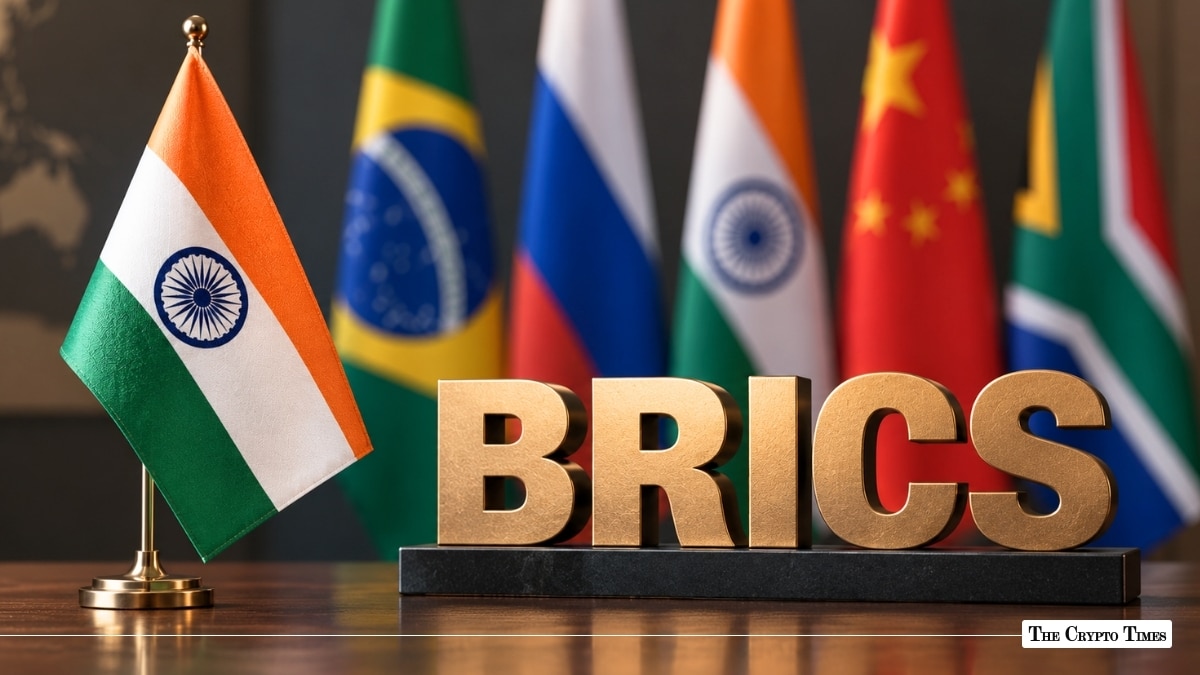
India is backing the use of central bank digital currencies for cross-border payments among BRICS countries but is not supporting a single payment network for the bloc.
As per Moneycontrol’s report, officials briefed on the talks say Modi’s government prefers using CBDCs to settle bilateral trade among BRICS members instead of creating one payments system for the bloc. Publicly, India has only said CBDC links and fast-payment links are still under discussion.
With India chairing BRICS this year, the issue is expected to feature in discussions among finance ministers and central bank governors ahead of the leaders’ summit in New Delhi.
India’s two-part approach
Under the proposal, member countries could connect their respective CBDC systems for cross-border transactions. India also supports settling more trade in local currencies rather than using the US dollar or another third currency.
People familiar with the matter say a unified BRICS payments and settlement system is unlikely to be agreed upon at this weekend’s New Delhi summit. That is a prediction, not a decided outcome. India is concerned that such a framework could make BRICS appear explicitly anti-dollar or anti-Western.
The bloc has been exploring ways to reduce reliance on existing international payment infrastructure, including SWIFT. The issue gained greater attention after several Russian banks were excluded from SWIFT following Russia’s invasion of Ukraine in 2022.
Local currencies gain ground
The use of local currencies has already increased in trade between some BRICS members.
Around 96% of India’s trade with Russia is now conducted through established rupee-ruble mechanisms, according to Ivan Nosov, head of Sberbank in India. Almost all trade between Russia and China is settled in yuan and rubles, Russian news agency Interfax reported.
India has separately been working to expand the international use of the rupee. Reserve Bank Governor Sanjay Malhotra recently said the central bank would continue efforts to promote local currencies for cross-border payments and trade.
“We will continue our efforts to internationalize the rupee and promote the use of local currencies for cross-border payments and for trade,” Malhotra said.
Economists say the shift toward local-currency settlement could also affect how countries manage their foreign-exchange reserves. Sonal Varma, a Singapore-based economist at Nomura Holdings Inc., said local-currency settlement can help countries preserve dollar reserves for strategic imports while allowing routine trade financing to be conducted in domestic currencies.
BRICS considers CBDC links
India is conducting pilot testing of the digital rupee, while China and Russia have also been developing and testing their respective central bank digital currencies. BRICS members could also discuss connecting their instant payment systems, which are primarily used for retail transactions.
India’s retail digital rupee has been in pilot testing since December 2022. Unlike UPI, which transfers money between bank accounts, the e-rupee is digital money issued by the Reserve Bank of India and stored in a digital wallet.
India has already connected its Unified Payments Interface, or UPI, with Singapore’s PayNow for remittances. Prime Minister Narendra Modi has called for expanding similar payment links to countries with large Indian diaspora populations.
These arrangements could allow countries to connect existing payment systems without creating a single BRICS-wide network.
India’s Ministry of External Affairs spokesman Randhir Jaiswal said it was too early to conclude what would emerge from the discussions among finance ministers and central bank governors and urged reporters to wait for the joint statement.
Jaiswal said India’s approach to BRICS cooperation, including financial matters, was “development focused.”
The upcoming meetings and the leaders’ summit on September 12-13 will indicate whether BRICS members move forward with CBDC links and local-currency settlement while leaving a unified payments network off the agenda.
Also Read: India’s FIU Orders Takedown of 15 Offshore Crypto Apps Over AML Non-Compliance