Key Highlights
- Ark Invest’s Lorenzo Valente criticized Cardano founder Charles Hoskinson over his recent comments on Bitcoin.
- Hoskinson argued Bitcoin is “frozen in time” and warned quantum computing could challenge its long-term dominance.
- Cardano’s ADA token fell more than 3% in the past 24 hours amid the renewed debate.
Lorenzo Valente, the director of research at Ark Invest, has heavily criticized the proof-of-stake blockchain platform Cardano and its founder, Charles Hoskinson, following his comment on Bitcoin.
In an X post on Friday, Valente stated that “It’s 2026, and we’re still talking about Cardano. We’re still inviting Charles to conferences, treating Cardano as newsworthy, accepting its sponsorship money, and giving it airtime on podcasts.”
“Then we wonder why this industry struggles for credibility. We deserve the reputation we have. No serious industry keeps rewarding irrelevance like this.”
Hoskinson argued that Bitcoin is “frozen in time” and difficult to change. Speaking on The Starting Block on Friday, he highlighted Cardano’s formal on-chain governance as better positioned to handle existential technical challenges. “The issue with Bitcoin is it’s frozen in time,” he said, noting that early frustrations with Bitcoin’s inflexibility helped inspire Ethereum’s development.
He also mentioned that a possible quantum-computing threat could test Bitcoin’s ability to coordinate upgrades and ultimately cost BTC its position as the world’s largest cryptocurrency.
ADA slips over 3% in the past 24 hours
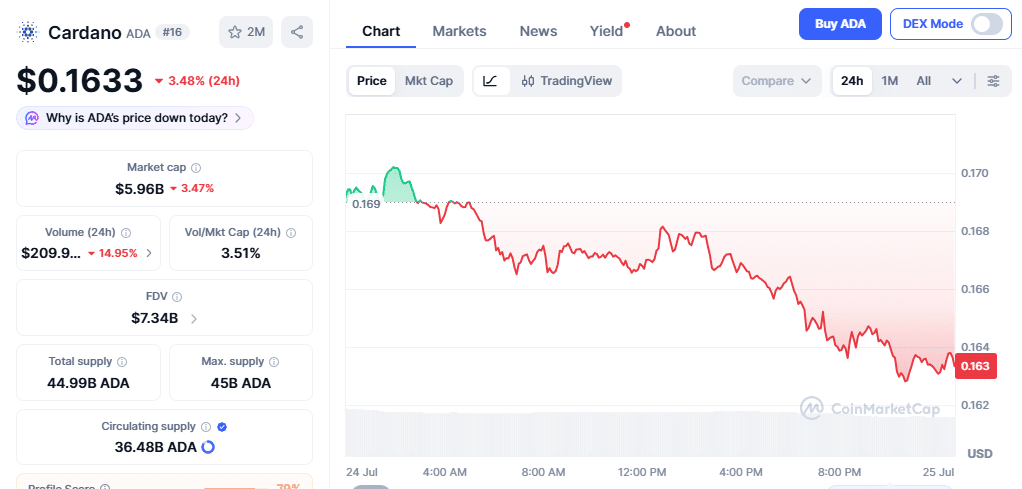
Cardano’s native token ADA is currently trading at $0.1633, down 3.48% over the past 24 hours. The cryptocurrency’s market capitalization stands at approximately $5.96 billion, reflecting a 3.47% decline.
24-hour trading volume reached $209.9 million, while the token traded between a low of $0.1628 and a high of $0.1702 in the period. ADA remains far below its all-time high of $3.10 recorded in September 2021.
Cardano governance upgrade
Cardano successfully activated the Van Rossem hard fork on July 18, 2026. The upgrade to Protocol Version 11 was the first hard fork in Cardano’s history driven entirely through decentralized governance under the Voltaire era.
It was initiated, debated, and ratified by delegated representatives, the constitutional committee, and stake pool operators without direct orchestration by founding entities. Industry observers have described it as a major procedural milestone for onchain decision-making.
Valente’s criticism highlights growing criticism
Despite this technical achievement, market reaction to ADA has been muted. The token has struggled with broader crypto market sentiment and competition from faster-moving blockchain projects.
While Cardano excels in governance theory, it continues to lag in real-world adoption and developer activity compared to rivals. The industry’s continued focus on Hoskinson, critics like Lorenzo Valente argue, distracts from more innovative projects and damages crypto’s credibility.
Lorenzo Valente’s criticism highlights growing frustration with the network’s outsized attention relative to its market impact. In 2026, ADA’s low price and modest adoption underscore persistent questions about delivery versus promises. Hoskinson’s vocal Bitcoin critiques may further alienate parts of the industry rather than strengthen Cardano’s position.
Without substantial ecosystem growth, the network may continue struggling to justify its relevance in an increasingly competitive blockchain space.
Also Read: IREN Stock Drops Over 5% to $38.38 Today After Early Gains