
Strategy Inc. (NASDAQ: MSTR), the Bitcoin treasury company formerly known as MicroStrategy, saw its shares decline sharply in the latest trading session, reflecting ongoing volatility tied to cryptocurrency markets and shifting investor sentiment.
On July 23, 2026, the stock closed at $93.63, marking a drop of $6.38 or 6.38% from the previous day’s close of $100.01. The session highlighted the continued sensitivity of the company’s valuation to Bitcoin price movements, as the digital asset traded below the $65,000 level amid broader economic concerns including rising oil prices and capital expenditure worries in the tech sector.
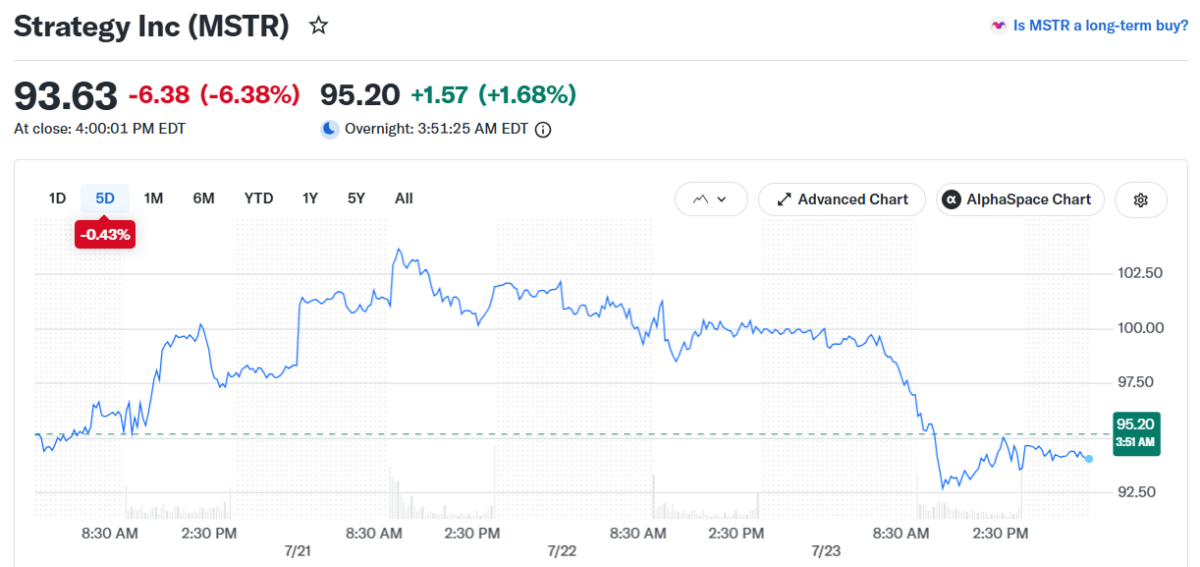
Trading activity showed the stock opening near $97.06 before experiencing significant intraday swings. Shares reached a high of $97.51 early in the session but quickly retreated, bottoming at $92.34 before settling at the closing level. Volume came in at approximately 16.52 million shares, which fell short of the average daily volume near 20.2 million, suggesting somewhat restrained participation despite the notable price move.
The company’s market capitalization stood at roughly $34.2 billion by the end of regular trading, placing it well below peaks seen during stronger Bitcoin rallies in prior periods. After-hours trading provided a modest rebound, with shares hovering around $94.56, up nearly 1% from the close.
Intraday Volatility Reflects Crypto Correlation
The sharp decline underscored Strategy’s well-documented correlation with Bitcoin performance. As one of the largest corporate holders of the cryptocurrency, the company’s stock has long functioned as a leveraged proxy for Bitcoin exposure among public market investors. When Bitcoin faced renewed pressure and slipped below key psychological thresholds, equity holders reacted swiftly by trimming positions.
Notably, the selloff occurred against a backdrop of geopolitical and macroeconomic headwinds that weighed on risk assets more broadly, with crypto-linked names such as Coinbase and other digital asset equities also posting losses.
Strategy’s 52-week trading range of $81.81 to $419.95 illustrates the extreme swings the stock has endured. The current price sits closer to the lower end of that spectrum, reflecting a challenging stretch in which Bitcoin weakness has compressed the premium once attached to the company’s treasury strategy. Beta readings near 3.5 further confirm the amplified movements relative to the broader market.
Despite the lower volume on the day, the price action demonstrated that even moderate selling pressure can produce outsized percentage moves given the stock’s volatility profile.
Company-specific factors also played a role. Strategy has recently emphasized building cash reserves through at-the-market equity offerings rather than aggressively accumulating additional Bitcoin. Recent filings indicated periods in which the firm raised hundreds of millions of dollars in cash while making no new Bitcoin purchases, prioritizing liquidity to support preferred dividend obligations and operational needs. This shift has prompted debate among investors about the pace of Bitcoin-per-share growth, a metric long central to the bullish narrative surrounding the stock.
Corporate Focus Shifts Toward Liquidity Management
Management’s decision to bolster U.S. dollar reserves to levels exceeding $3 billion has provided a buffer against near-term funding pressures but has simultaneously raised questions about the firm’s commitment to pure Bitcoin accumulation.
In earlier years, Strategy under the guidance of Executive Chairman Michael Saylor became synonymous with aggressive Bitcoin purchases funded by equity and convertible debt issuances. The more measured approach in recent weeks appears aimed at navigating a lower Bitcoin price environment without forced liquidations of the core treasury.
The company continues to operate its enterprise analytics software business alongside the Bitcoin strategy, offering tools such as Strategy One and related data platforms. However, investor attention remains overwhelmingly focused on the digital asset holdings and the capital structure supporting them.
With earnings scheduled for approximately July 30, 2026, market participants will be watching closely for updates on Bitcoin yield metrics, cash position details, and any commentary on future acquisition plans. Previous quarters have featured significant mark-to-market adjustments on digital assets that can heavily influence reported results.
Consensus price targets average in the vicinity of $300, with some firms projecting significantly higher levels based on scenarios of Bitcoin recovery and continued capital-raising capacity. These optimistic views rest on the assumption that Strategy can maintain or expand its Bitcoin holdings without excessive dilution once market conditions improve.
Critics, meanwhile, point to decelerating accretion metrics and the risks inherent in trading near modified net asset value multiples close to 1x during periods of Bitcoin weakness.
Read: Swedbank Boosts MSTR Stake as Strategy’s Bitcoin Treasury Faces Growing Scrutiny
Longer-Term Implications for Investors
Looking ahead, the path for MSTR shares will likely continue to track Bitcoin’s trajectory closely. A sustained recovery in the cryptocurrency could quickly restore investor confidence and expand the valuation premium, while further declines risk testing recent support levels near the 52-week lows.
The firm’s substantial cash position offers flexibility, reducing the immediate need to sell Bitcoin or issue equity under unfavorable conditions. At the same time, the elevated beta means that any positive catalyst in crypto markets would be expected to produce outsized gains for shareholders.
Institutional and retail interest in Strategy remains notable given its unique positioning as both a software provider and a Bitcoin vehicle. The name change from MicroStrategy to Strategy Inc. in 2025 was intended in part to better reflect this dual identity and the centrality of the digital asset strategy.
As the company approaches its upcoming earnings release, attention will center on management’s assessment of the current environment and any adjustments to capital allocation priorities.
Also read: Coinbase Can Make Its Vault Quantum-Safe, Bitcoin Is the Harder Problem