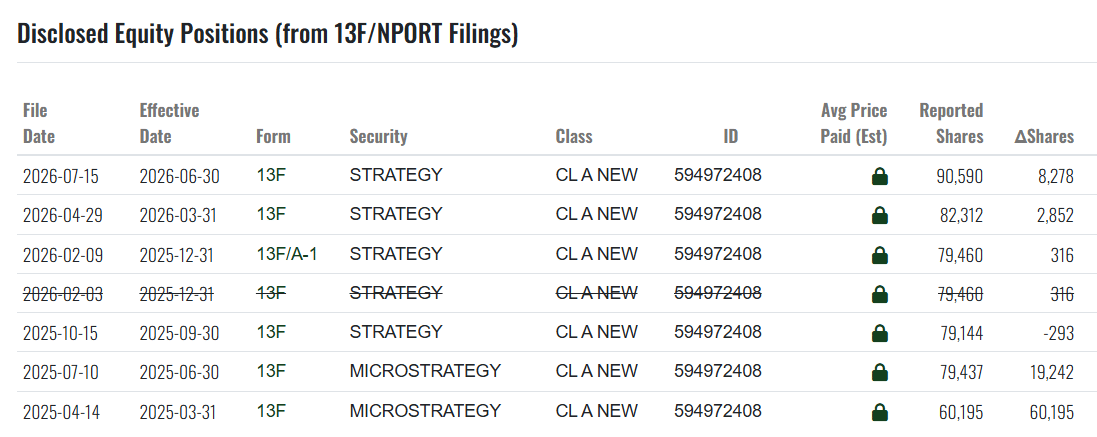
Swedbank AB, Sweden’s third-largest bank with roughly $264 billion in assets, has increased its position in Strategy Inc. (NASDAQ: MSTR) by 8,278 shares, bringing its total holdings to 90,590 shares valued at approximately $8.81 million.
The update was revealed in the bank’s latest SEC 13F filing for the second quarter of 2026, continuing a multi-quarter trend of gradual accumulation in the Bitcoin-focused company.
Market analysts interpret these moves as client-driven investments managed through Swedbank’s asset management arm rather than proprietary trading by the bank itself. At roughly $9 million, the position remains modest relative to Swedbank’s enormous balance sheet, reflecting measured interest rather than aggressive allocation.
The development comes amid heightened institutional adoption of Bitcoin-related assets in Europe. Nordic banks, traditionally conservative on volatile investments, are increasingly exploring digital asset strategies through regulated channels. Strategy’s model—aggressively acquiring Bitcoin via equity and debt offerings—has attracted TradFi attention as Bitcoin matures as an asset class.
Swedbank’s latest purchase aligns with a pattern observed in prior filings. The Swedish lender had previously added shares in earlier quarters, growing its stake from around 79,437 shares in 2025 to over 82,312 by May 2026.
Strategy as Premier Bitcoin Treasury Vehicle
Strategy Inc., rebranded from MicroStrategy, stands as the world’s largest corporate Bitcoin treasury company and the leading publicly traded proxy for institutional Bitcoin exposure. Instead of holding Bitcoin directly—often complicated by custody, accounting, and regulatory issues—many traditional players allocate to MSTR shares. These shares trade in close correlation with Bitcoin prices because of the company’s aggressive treasury strategy.
As of mid-2026, Strategy holds over 843,775 BTC, acquired through disciplined capital markets activity. The company’s model involves issuing equity, convertible notes, and innovative digital credit instruments such as perpetual preferred stock (STRC) to fund further Bitcoin purchases. This approach has created a self-reinforcing “Bitcoin flywheel” that appeals to institutions seeking leveraged exposure without direct balance-sheet risk.
Institutional interest in MSTR has surged throughout 2026. Several major banks and asset managers have disclosed positions, viewing Strategy as a regulated, liquid gateway into Bitcoin’s performance.
Swedbank’s move fits this broader trend, where European institutions cautiously allocate to Bitcoin proxies while monitoring macroeconomic conditions and cryptocurrency policy developments. MSTR’s deep liquidity and established governance make it a preferred vehicle compared to spot Bitcoin ETFs or direct holdings for certain mandates.
Recent Scrutiny and Strategic Actions
Despite its success as a Bitcoin treasury pioneer, Strategy has faced increased scrutiny in 2026 over its capital structure, dilution risks, and liquidity management. The company’s aggressive fundraising—raising tens of billions through at-the-market equity offerings, convertible debt, and novel preferred stock series—has drawn analyst attention regarding potential shareholder dilution and long-term sustainability.
In May 2026, Strategy completed a $1.5 billion debt repurchase using cash reserves and proceeds from new issuances, while simultaneously adding thousands of BTC to its holdings. It has also introduced a Bitcoin Monetization Program, authorizing the sale of limited BTC quantities to fund preferred stock dividends and replenish USD reserves.
In late June and early July, Strategy sold approximately 3,588 BTC for around $216 million, marking a departure from its long-standing “never sell” narrative, though net Bitcoin accumulation remained strongly positive.
Critics have raised concerns about a possible “death spiral” scenario in prolonged bear markets, citing high leverage and dividend obligations on perpetual instruments. Some analysts warn that significant Bitcoin price declines could pressure liquidity and force more substantial monetization.
Market Optimism and Trust in Strategy Inc.
However, Strategy executives, including leadership under CEO Phong Le and founder Michael Saylor’s influence, maintain confidence in their dynamic capital allocation model. They emphasize metrics like Bitcoin per share yield (reported at 13.3% YTD in one period) and the success of digital credit products, which have scaled rapidly to over $15 billion notional.
“We’re the largest holder of Bitcoin in the world. We’re the largest purchaser of Bitcoin in the world. And we’ll continue to be,” said Phong Lee in a recent Bloomberg interview.
The company has defended its strategy by highlighting accretive Bitcoin acquisitions—purchasing at rates exceeding miner production—and ongoing innovation in financial instruments that broaden investor access to Bitcoin economics.
For Swedbank and similar institutions, these dynamics underscore both the opportunity and risks inherent in MSTR exposure. While the proxy offers convenient Bitcoin beta, it ties performance to Strategy’s execution of its treasury policy amid market volatility. As Bitcoin solidifies its role as a strategic reserve asset, companies like Strategy continue to test the boundaries of corporate finance innovation.
As a latest push to MSTR’s market confidence, Swedbank’s latest filing reinforces sustained institutional demand for Bitcoin-tied equities. It demonstrates that even conservative European banks are allocating capital to leaders in the space, even as the underlying companies navigate scrutiny over leverage and monetization tactics. This evolution points to deeper integration between traditional finance and digital assets, with Strategy remaining at the forefront of that convergence.
Also read: BlackRock Hits Record $15.3T AUM as Bitcoin ETF Sheds $3.3B in Q2