Key Highlights
- Former Rep. Patrick McHenry urged Congress to pass the CLARITY Act, describing it as landmark legislation for digital asset regulation.
- He compared the bill’s significance to the Telecommunications Act of 1996, calling it a forward-looking framework for emerging technology.
- McHenry said the legislation would provide regulatory clarity, encourage innovation, create jobs, and protect consumers from arbitrary enforcement.
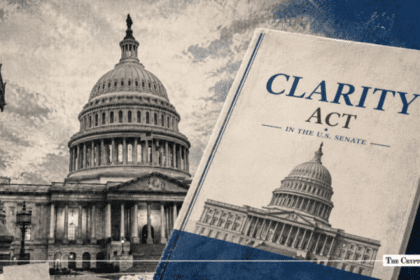
Former U.S. Representative Patrick McHenry, who served as Chairman of the House Financial Services Committee, urged Congress to pass the CLARITY Act, describing it as legislation aimed at bringing regulatory certainty to the cryptocurrency industry.
In an opinion piece published on Thursday, McHenry argued that after more than two decades in Congress, he has seen how forward-looking laws can drive national progress, while outdated rules leave the U.S. playing catch-up. He described the CLARITY Act as an opportunity for proactive governance in the digital asset space, comparing it to the Telecommunications Act of 1996.
“The crypto market structure legislation currently moving through Congress, the CLARITY Act, is unlike anything we’ve seen since the Telecommunications Act of 1996: a large-scale, forward-looking effort to embrace technological change and introduce consumer safeguards for a nascent technology,” McHenry wrote.
McHenry says Congress faces a critical decision
McHenry argued that Congress is at a critical crossroads. He said the U.S. can either reinforce its position as the global technology and financial leader or risk ceding ground to adversaries actively challenging U.S. dominance.
He argued that U.S. financial policy has long been reactive, shaped by past crises rather than future opportunities. While legislation such as the Dodd-Frank Act addressed problems exposed by the 2008 financial crisis, he said regulators remain unprepared for emerging technologies.
McHenry said the CLARITY Act represents a shift. Unlike most major financial legislation since the 2008 crisis, this bill is not born from turmoil but from strategic foresight. He drew parallels to the Gramm-Leach-Bliley Act of the late 1990s, noting the potential for comprehensive, forward-thinking policy.
“The framework in the CLARITY Act can ensure entrepreneurs feel confident in creating jobs and building businesses without fear of arbitrary or unexplained crackdowns,” he explained.
Why bipartisan support matters
McHenry also highlighted bipartisan support as a key strength. He noted that the GENIUS Act for stablecoins passed both chambers with strong backing, and various crypto market structure proposals have drawn sponsors across party lines. This consensus, he believes, signals that lawmakers recognize digital assets are here to stay.
The stakes extend beyond crypto. Other nations are advancing aggressive regulatory frameworks, attracting global capital and innovation. McHenry argued the CLARITY Act offers the best path for the United States to maintain leadership in 21st-century finance by creating the world’s safest, most resilient regulatory environment grounded in the rule of law and property rights.
As Congress considers the bill, McHenry’s message is clear: the decision is about more than digital assets. It is about whether America will lead the future economy or merely react to events after they unfold. “I hope that decision is obvious,” he concluded.
House to hold CLARITY Act hearing on July 17
Congress is also actively working on the crypto market structure. On Friday, July 17, at 10 AM ET, the House Financial Services Committee’s Digital Assets Subcommittee will hold its first dedicated field hearing in New York City, titled “Building the Future of Finance: How the CLARITY Act Unlocks Innovation.”
Chaired by Rep. French Hill, the hearing will be the House’s first major CLARITY Act event since the Senate version advanced. By holding the hearing in New York, lawmakers aim to gather input from exchanges, banks, asset managers, and custodians on how regulatory clarity could affect digital asset innovation.
Also Read: Swedbank Boosts MSTR Stake as Strategy’s Bitcoin Treasury Faces Growing Scrutiny