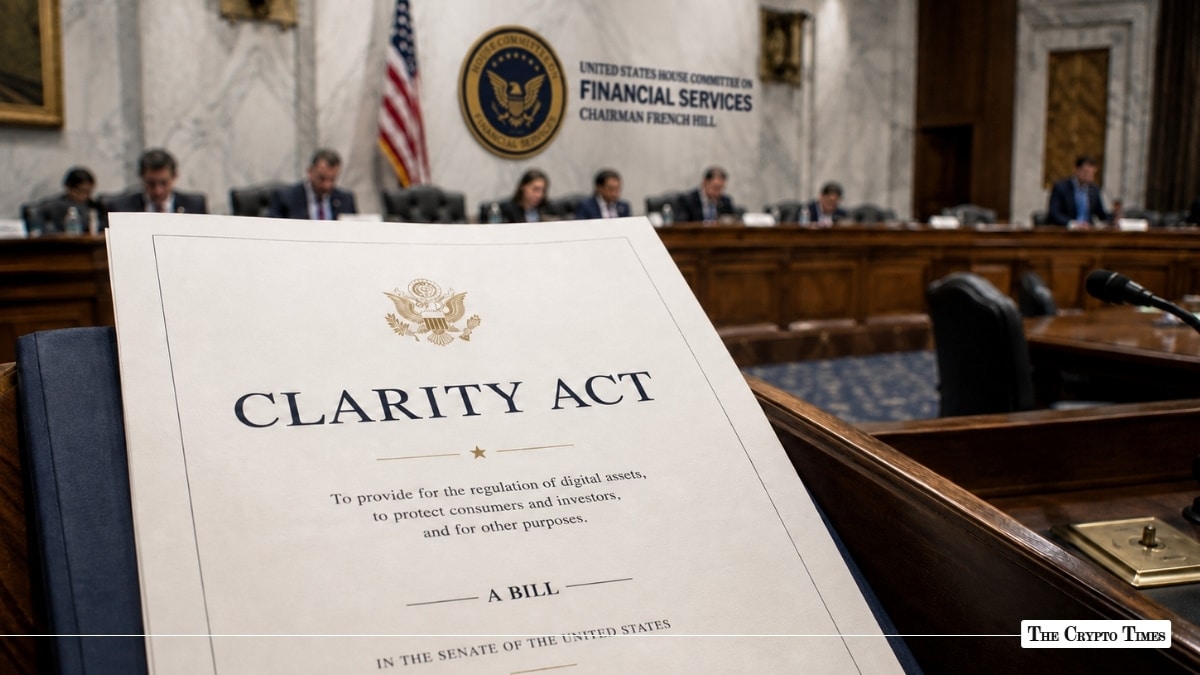
Congress is taking the crypto market-structure debate out of Washington and into the heart of Wall Street. On Friday, July 17, at 10 AM ET, the House Financial Services Committee’s Subcommittee on Digital Assets, Financial Technology, and Artificial Intelligence will convene a field hearing in New York City titled “Building the Future of Finance: How the CLARITY Act Unlocks Innovation.”
It is the House’s first dedicated CLARITY Act event since the Senate version reached the floor calendar, and its framing is no accident.
The choice of both venue and title signals a deliberate strategy: to make the closing argument for the bill about American innovation, jobs, and competitiveness, at the precise moment the legislation’s fate hangs in the balance.
The Hearing
Chairman French Hill scheduled the field hearing as part of a two-pronged July agenda that also includes the July 15 appearance by Fed Chair Kevin Warsh on monetary policy. By holding the CLARITY session in New York rather than a Capitol Hill committee room, lawmakers are pointing the discussion directly at the exchanges, banks, asset managers, and custodians that would operate under the framework. Industry witnesses are expected to testify on how clear rules would let them build digital-asset products they have so far held back on deploying against an undefined rulebook.
Why New York
The timing is the tell. The hearing lands as the Senate works to finalize a merged version of the bill reconciling the Banking and Agriculture Committee texts, with floor action targeted for the following week. A high-profile, industry-friendly event in the financial capital is designed to generate momentum and put a spotlight on the economic upside just before senators are asked to vote.
It dovetails with a parallel push from the bill’s Senate champions. Senator Cynthia Lummis has spent recent days hammering the competitiveness argument, warning that regulatory limbo is driving builders abroad. “We have driven too many talented developers offshore due to legal uncertainty,” she said. “They want to build here. Let them. Pass the CLARITY Act.”
The field hearing amplifies that same message from the House side, and reframes the debate around a question harder to argue against than consumer risk: whether the US wants to host the next generation of financial technology or cede it overseas.
The Dueling Narratives
The “unlocks innovation” framing is also a direct rebuttal to the argument that has become the bill’s most dangerous obstacle. Just days earlier, Senator Elizabeth Warren branded the CLARITY Act “a ticket to sanctions evasion,” citing a former National Security Council official’s warning about anti-money-laundering loopholes; a charge the crypto industry’s advocacy arm Stand With Crypto pushed back on hard. Anti-trafficking advocates and some faith-based organizations have raised parallel concerns that the bill’s Section 604 developer protections could create gaps exploitable by criminals.
The July 17 hearing, in effect, stages the industry’s side of that argument in its strongest possible setting. But it also underscores the core tension lawmakers must resolve: whether they can deliver the innovation and clarity the sector craves without weakening the consumer-protection, illicit-finance, and ethics safeguards critics are demanding.
Where CLARITY Stands
At its core, the CLARITY Act sorts digital assets into legal categories, handing the Commodity Futures Trading Commission (CFTC) authority over digital commodities such as Bitcoin and Ether, under a maturity test, while leaving investment-contract assets with the Securities and Exchange Commission (SEC). That jurisdictional clarity is the framework the industry has sought for years.
Getting there remains the hard part. The bill passed the House in July 2025 and cleared the Senate Banking Committee 15-9 in May, but it has stalled on the floor calendar amid three interlocking disputes: an ethics standoff over officials’ crypto holdings, sharpened by ventures tied to the Trump family; the Section 604 developer-protection provision that has split law enforcement; and a fight over stablecoin yield. It still needs roughly seven Democratic votes to clear a 60-vote cloture threshold, yet only Ruben Gallego and Angela Alsobrooks backed it in committee, both with caveats. Prediction market Polymarket now prices 2026 passage near 43%, down more than 20 points as negotiations have dragged.
The urgency driving the New York event is structural. The August recess is widely viewed as the last realistic gate before the legislative calendar collides with the November midterms; a slip into 2027 would push the framework before a Congress of unknown composition. Should the Senate pass a merged text, House leaders have signaled they would move a companion bill rather than convene a conference committee, compressing the path to a single House vote. That is why the industry has spent weeks pressing the timeline, with more than 1,200 tech companies and over 200 crypto firms urging a floor vote, and allocators reportedly withholding capital until the rules are set.
Why It Matters
The field hearing is as much a messaging exercise as a legislative one: a bid to fix the closing narrative on jobs, competitiveness, and onshoring innovation before senators cast the votes that decide the bill’s fate. Whether that reframing can move the handful of undecided Democrats who hold the outcome in their hands is the open question. The opposition’s concerns over illicit finance and ethics have not been resolved, and a polished hearing in Manhattan will not, by itself, resolve them. But by taking the CLARITY Act to the doorstep of the institutions that would live under it, House Republicans are betting that the most persuasive argument for US crypto rules is the one about what America stands to lose without them.
Also Read: Crypto Week Ahead: CLARITY Act, Fed Chair Warsh Testimony, & Inflation Data