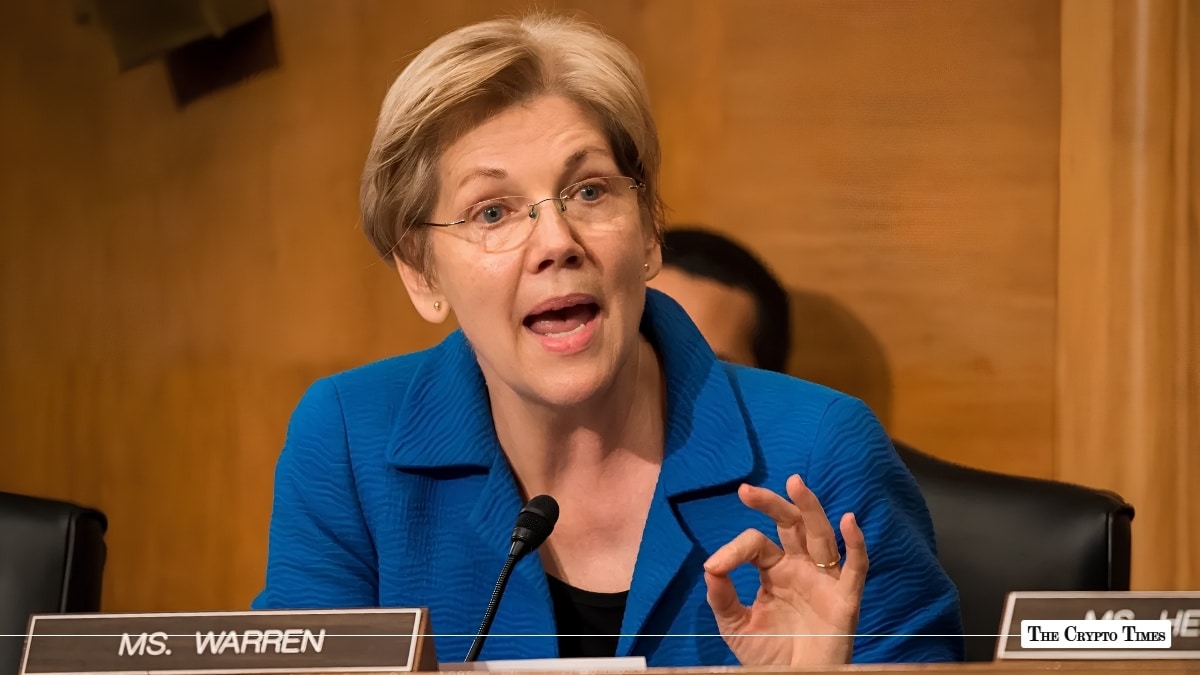
The battle over America’s landmark crypto market-structure bill has found a new and politically potent front: national security. On July 9, Stand With Crypto, the advocacy organization founded by Coinbase, pushed back publicly against Senator Elizabeth Warren (D-MA) after she declared that “as currently drafted, the Clarity Act is a ticket to sanctions evasion.”
The group’s rebuttal was direct: the bill “dedicates an entire title to illicit finance and sanctions compliance for digital asset firms, expanded Treasury special measures, and blockchain intelligence tools to detect sanctions evasion.” Its conclusion: “It makes evasion harder, not easier.”
The exchange crystallizes what has become one of the most consequential arguments over the stalled legislation, and one that could sway the handful of undecided senators who will determine its fate.
Warren’s case
Warren’s post drew on a Fortune op-ed by Richard Nephew, a sanctions-policy expert who previously served as the National Security Council’s Director for Iran. Nephew argued that the CLARITY Act, as written, would “solidify glaring, dangerous and shocking loopholes” and strip away standard obligations imposed on financial institutions to protect national security after the September 11, 2001 attacks. His central concern is decentralized finance: while Section 201 of the bill extends anti-money-laundering requirements to some crypto intermediaries, he contends it does not clearly require every business that operates, administers, profits from, or facilitates DeFi services to maintain AML programs, monitor for suspicious activity, and report it.
Warren has paired that argument with concrete data. She has repeatedly pointed to reporting that the exchange CoinEx processed roughly $3.84 billion in transactions tied to sanctioned Iranian entities since 2019, including wallets US officials have linked to the Islamic Revolutionary Guard Corps, as well as scrutiny of Nobitex, Iran’s largest exchange. Citing a FinCEN alert warning that Iran was using digital currencies to evade sanctions, even coercing ships in the Strait of Hormuz into paying tolls in crypto, Warren argues the bill “would make this problem worse.” She has also noted that the Fraternal Order of Police, the largest organization of sworn law-enforcement officers, has raised concerns.
The industry’s rebuttal
Supporters counter that the bill strengthens, rather than weakens, the government’s hand. Stand With Crypto’s argument mirrors one that Senator Cynthia Lummis (R-WY), a lead champion of the legislation, has pressed for weeks: that the CLARITY Act contains “16+ illicit finance safeguards, not loopholes.”
Lummis has highlighted three provisions in particular — Section 201, which applies Bank Secrecy Act and AML rules to crypto; Section 303, which creates new sanctions authorities targeting Iran and grants Treasury power to restrict or ban transactions tied to foreign money-laundering concerns; and Section 305, which lets exchanges and stablecoin issuers freeze suspected illicit funds while law enforcement obtains orders, with a good-faith liability shield. The bill also allocates $150 million for illicit-finance enforcement. “If you don’t like crypto, then say it,” Lummis wrote, “but stop these baseless attacks.”
The industry’s deeper point is that clear jurisdiction is itself a security tool: giving the SEC and CFTC defined authority, supporters argue, is more enforceable than the current gray zone in which responsibility is contested.
The point both sides skate past
There is a crucial nuance beneath the sound bites. The illicit flows Warren cites, occurred under the current regulatory regime, not under the framework the CLARITY Act would create. That does not settle the argument; it reframes it. The real question is not whether crypto is being used for sanctions evasion today (it demonstrably is), but whether this specific bill would make detection and enforcement better or worse.
That, in turn, hinges almost entirely on how it treats DeFi and non-custodial developers — the same Section 604 / Blockchain Regulatory Certainty Act fight that has divided law-enforcement groups, drawn a defense from Senator Ron Wyden, and secured a rare endorsement from the National Organization of Black Law Enforcement Executives. In other words, the sanctions debate and the developer-protection debate are two faces of the same unresolved question.
What is Stand With Crypto?
For readers unfamiliar with the group now trading blows with a sitting senator, Stand With Crypto is a nonprofit advocacy organization launched by Coinbase in 2023 to mobilize crypto users as a political constituency. It maintains a grading system that scores lawmakers from A to F on their crypto positions, claims a membership in the millions, and has become one of the most visible arms of the industry’s political operation, alongside the well-funded Fairshake network of super PACs. Its intervention here is a sign of how central the sanctions argument has become to the bill’s prospects, and how organized the industry’s response has grown.
The bigger picture: a bill running out of runway
The clash lands at a precarious moment. The CLARITY Act has sat on the Senate calendar since June 1 with no floor vote scheduled, blocked by three interlocking disputes: an ethics standoff over officials’ crypto holdings, the Section 604 developer-protection fight, and a battle over stablecoin yield. The Senate returns from recess on July 13 with only about three weeks before the August break — the window analysts widely view as the last realistic chance for passage this year. The bill cleared the House 294-134 in July 2025 and the Senate Banking Committee 15-9 in May, but it still needs roughly seven Democratic votes to overcome a filibuster, and prediction markets now price its 2026 odds near a coin flip, down from about 74% a month ago. Lummis has warned that missing this window could delay market-structure legislation until 2030.
Against that backdrop, Warren’s timing is strategic. By branding the bill a national-security risk — an argument that resonates across party lines in a way that consumer-protection critiques may not — she raises the political cost for any fence-sitting Democrat considering a yes vote. The industry, through Stand With Crypto and Lummis, is working just as hard to neutralize that framing before it hardens.
Why it matters
The sanctions-evasion charge may be the single most dangerous argument the CLARITY Act faces, precisely because it reframes a financial-regulation bill as a national-security question. Both sides are now claiming the security high ground: the op-ed shared by Warren says the bill reopens doors the US closed after 9/11, while the industry says it hands regulators sharper tools than they have today.
The resolution will likely come down to the fine print on DeFi obligations, and whether negotiators can craft language that satisfies law-enforcement skeptics without gutting the developer protections the industry considers non-negotiable. With the recess clock ticking, that reconciliation is the whole ballgame.
Also Read: White House Defends SEC Picks Ahead of CLARITY Act Debate