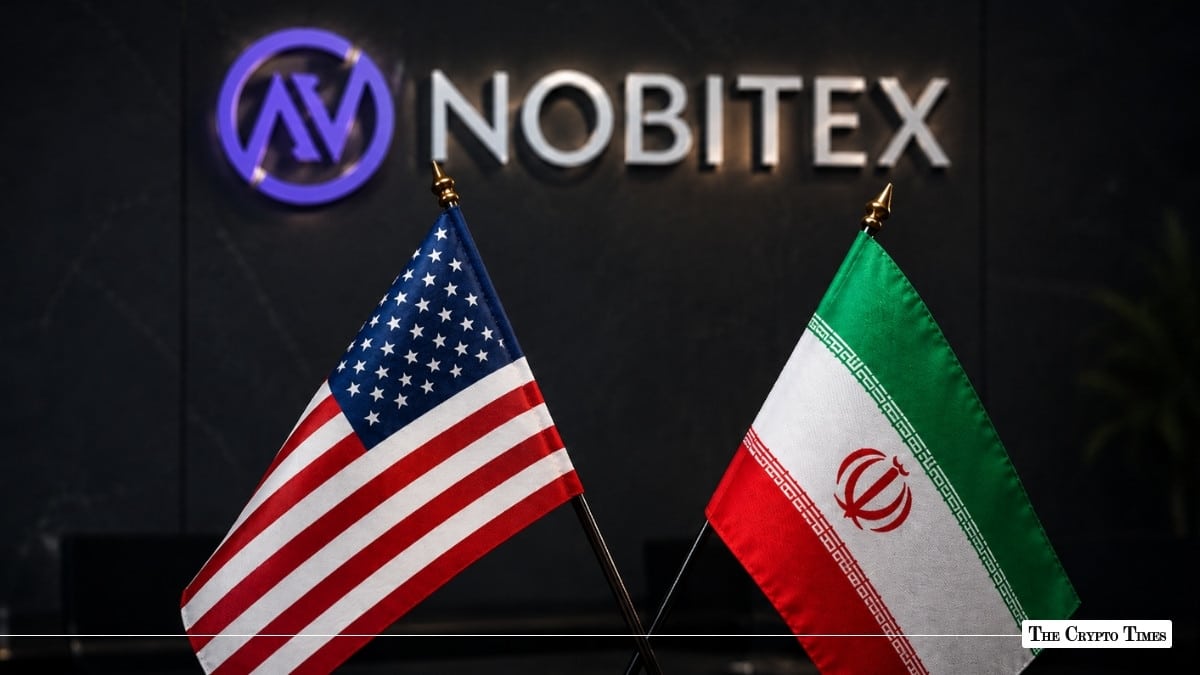
The United States government has launched its most aggressive offensive against state-sponsored cryptographic financial networks to date. On Tuesday, the U.S. Department of the Treasury officially blacklisted Nobitex, Iran’s dominant digital asset exchange, alongside three parallel domestic platforms. The coordinate enforcement sweep effectively severs these exchanges, their underlying wallet nodes, and their executive boards from the global financial system.
According to the Treasury’s release, last year Nobitex played a key role in enabling users to move funds despite international sanctions. The designation also extends to Wallex, Bitpin, and Ramzinex, three other major exchanges operating in Iran. The sweeping action forms part of the Trump administration’s “Economic Fury” campaign against Iran.
Treasury tightens pressure on Iran
Officials said Nobitex played a central role in Iran’s cryptocurrency market, processing more than half of the country’s digital asset inflows in 2025. The agency accused the exchange of helping users move funds across borders, evade sanctions, and facilitate transactions linked to Iran’s Islamic Revolutionary Guard Corps (IRGC).
Treasury Secretary Scott Bessent said Iranian authorities have increasingly relied on cryptocurrency networks to move money and bypass financial restrictions. “While Iran’s economy is in free fall, the regime has chosen to co-opt digital asset technologies for its own corrupt agenda, including evading sanctions and transferring wealth out of the country. Iran’s current economic chaos is proof that President Trump’s maximum pressure campaign has been a success.”
With regard to the other Iranian exchanges, Treasury data shows Wallex handled about 12% of the country’s crypto inflows in 2025, while Bitpin accounted for roughly 10%. Ramzinex, which launched in 2018, has processed more than $2.45 billion in transactions.
Bessent said the department would continue targeting financial networks connected to Iran, including those operating through cryptocurrency markets. “As promised, Treasury will continue to follow the money in support of Economic Fury, whether it is through the banking system or through digital assets, to prevent the regime from developing a nuclear weapon.”
Targeting leadership and elite capital routes
The Treasury’s enforcement action explicitly targets the leadership architecture powering these platforms. Among those individually sanctioned are Nobitex Chairman and Co-Founder Amir Hossein Rad and current CEO Seyed Ali Khoee.
Federal investigators highlighted that multiple co-founders of the exchange maintain direct structural bloodlines to the influential Kharrazi family, anchoring the platform directly into Iran’s ruling religious and military establishment.
The sanctions dossier further alleges that Nobitex acted as a specialized capital protection mechanism, deliberately shifting and insulating regime assets during active U.S. military operations and coordinating internal asset flight even amidst localized state internet blackouts.
The billion dollar freeze
The latest designations come as Washington increases pressure on Iran’s digital asset networks. Treasury Secretary Scott Bessent said last week that U.S. authorities had seized about $1 billion worth of cryptocurrency tied to Iranian exchanges and wallets since the start of the enforcement campaign.
The crackdown has also extended beyond government agencies. In April, stablecoin issuer Tether froze $344.2 million in USDT linked to Iran’s central bank. Separate blockchain data shows more than $152 million worth of USDT remains frozen across hundreds of blacklisted wallet addresses, highlighting growing efforts to restrict access to funds linked to sanctioned entities.
Also Read: SEC Unveils 2030 Strategy With Focus on Crypto Rule Clarity