
Strategy Inc. (NASDAQ: MSTR), the prominent Bitcoin treasury company chaired by Michael Saylor, announced on Monday that it has increased its USD cash reserves by approximately $450 million.
The update stems from sales under the company’s at-the-market (ATM) equity offering program during the week of July 6–12. Strategy sold roughly 4.82 million shares of its Class A common stock (MSTR), generating a notional value of about $466.7 million. These proceeds, net of commissions, contributed directly to the bolstered USD reserves, which are earmarked for dividend payments on preferred stock series, interest on debt obligations, and overall liquidity management.
Notably, no Bitcoin was sold or acquired during the period, leaving the company’s BTC holdings unchanged at 843,775 coins with a historical aggregate cost basis of $63.69 billion and an average purchase price of approximately $75,476 per BTC and $3.0 billion in USD reserves, according to the latest Form 8-K filing with the Securities and Exchange Commission (SEC).
Michael Saylor, founder and chairman, highlighted the development on X (formerly Twitter), stating: “Strategy has increased its USD Reserve by $450 million. As of 7/12/2026, we hodl ₿843,775 in our BTC Reserves and $3.0 billion in our USD Reserves.”
The announcement underscores the firm’s dual-reserve approach—maintaining a massive Bitcoin position while opportunistically building cash buffers through capital markets activity.
Dilution Remains a Core Trade-Off for MSTR Shareholders
While the cash infusion strengthens the balance sheet, it comes at the cost of shareholder dilution—a persistent point of contention among long-term MSTR investors. By issuing millions of new shares via the ATM program, Strategy expands its equity base, spreading ownership across more shares.
This week’s sale of 4.82 million MSTR shares adds to prior issuances under expanded programs, including a $21 billion MSTR stock offering announced in March 2026.
Critics like Peter Schiff argue that repeated equity raises erode per-share value for existing holders, even as the company accumulates more Bitcoin or cash. In essence, shareholders are funding the treasury strategy through diluted ownership. Meanwhile supporters counter that the approach has fueled extraordinary BTC accumulation—Strategy’s holdings represent one of the largest corporate Bitcoin treasuries globally—and that the market has rewarded the stock’s performance tied to Bitcoin’s price appreciation.
The company’s capital structure now includes multiple series of perpetual preferred stock (such as STRC, STRF, STRK, and STRD) alongside common shares. These instruments provide additional funding avenues but introduce complex dividend obligations. The $3 billion USD reserve is explicitly intended to service these commitments, providing a buffer amid volatile crypto markets.
Strategy’s Bitcoin-per-share metric—which currently sits at 207,776 in Sats (1 BTC = 100,000,000 Sats)—a key performance indicator watched by investors, will likely face pressure from the latest issuance. While the company has historically converted dilution into BTC growth during favorable market windows, periods like this—where cash is stacked instead of Bitcoin—test investor patience.
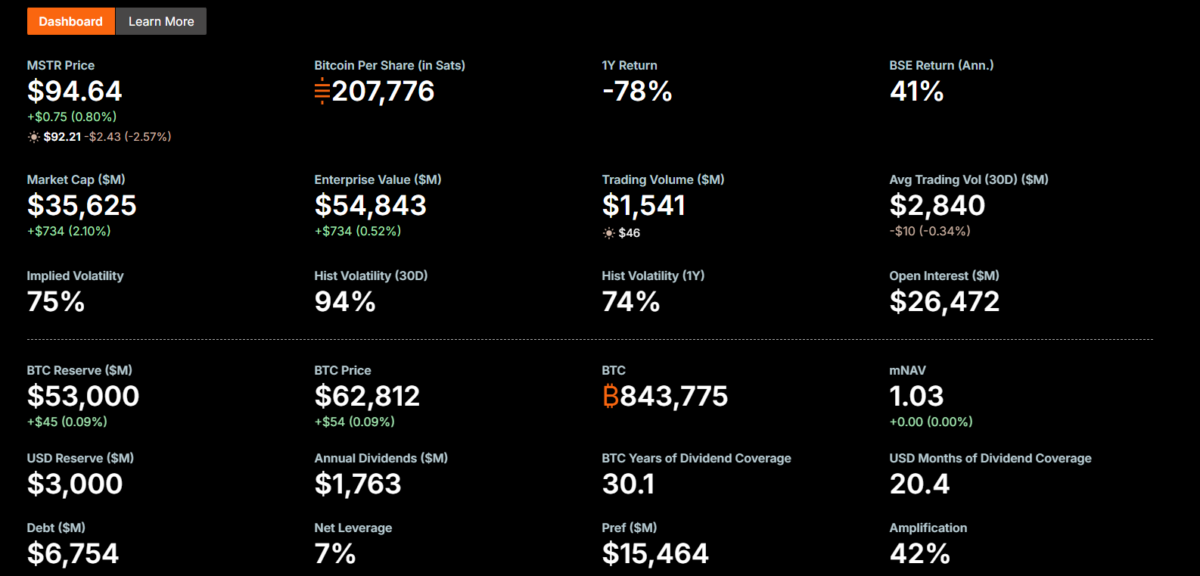
The filing notes no repurchases under share buyback programs during the week, further emphasizing the net dilutive effect.
Broader Context and Market Implications
Strategy pioneered the corporate Bitcoin treasury model years ago, leveraging debt and equity to amass BTC as a primary reserve asset. This hybrid approach—sometimes called “Bitcoin yield” via capital structure arbitrage—has inspired imitators but also drawn scrutiny over sustainability and dilution risks.
As of the latest update, Strategy’s BTC holdings reflect disciplined long-term conviction, with no sales recorded. The average acquisition cost of $75,476 positions the portfolio favorably if Bitcoin trades significantly higher, but near-term price action will determine whether recent cash raises prove prescient or overly conservative.
Wall Street’s reaction will likely hinge on Bitcoin’s trajectory and perceptions of dilution versus balance-sheet resilience. In a bull market, MSTR shares have historically amplified BTC upside; in sideways or bearish conditions, dilution concerns intensify.
Looking Ahead
This latest move illustrates Strategy’s flexible playbook: raise capital when markets permit, deploy into BTC opportunistically, and maintain liquidity reserves for obligations. For MSTR shareholders, the strategy delivers leveraged Bitcoin exposure but demands tolerance for ongoing equity dilution. As the company scales its reserves—both digital and fiat—the balance between growth and ownership preservation remains the central tension.
Also read: Why Michael Saylor’s Strategy Is Selling Bitcoin After Years of Buying