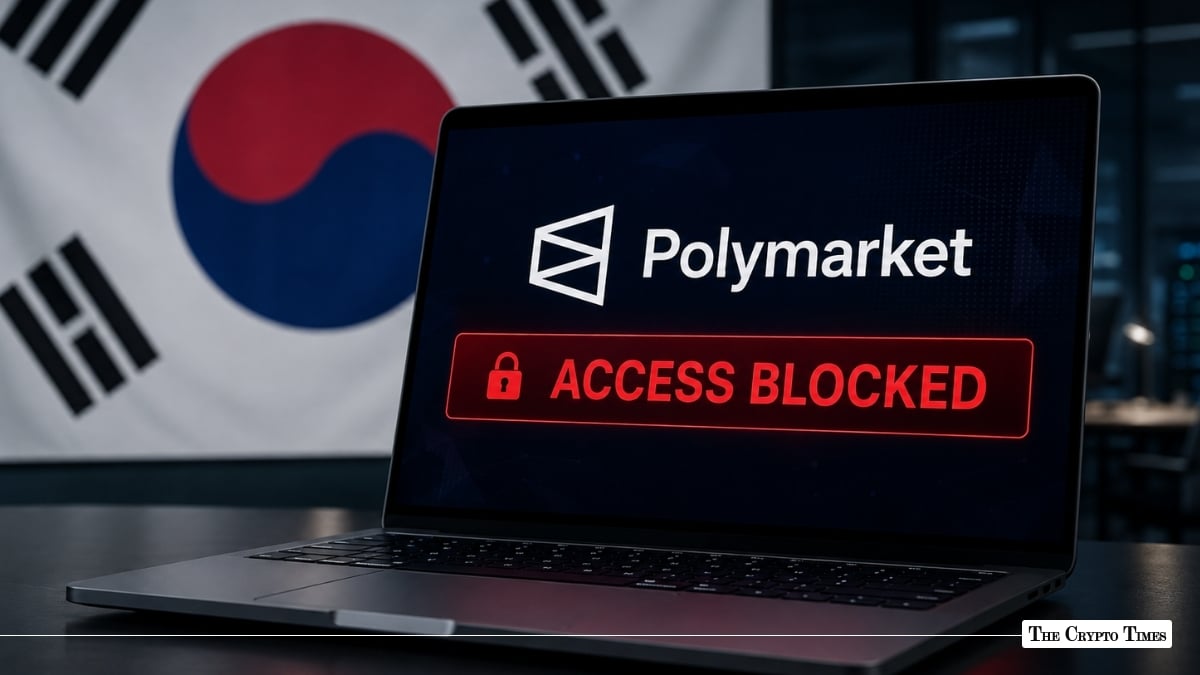
South Korea has formally shut the door on Polymarket. On August 18, 2026, the country’s Broadcasting, Media and Communications Standards Commission (formerly the Korea Communications Standards Commission, or KCSC) issued a corrective action ordering domestic internet service providers to block access to the crypto-native prediction market platform, concluding that the service constitutes a “substantive illegal gambling environment” under domestic law, according to a report by News1.
The decision brings a definitive end to a regulatory review that had been running since May, and it marks the first time a Korean media watchdog has moved to fully cut off retail access to a decentralized prediction market at the network level. The commission described the block as “unavoidable,” noting that Polymarket had continued to accept Korean traders even as the country’s gambling framework left no room to treat event-outcome wagers as anything other than illegal betting.
How the Regulator Reached the Decision
The path to today’s block began on May 21, 2026, when the KCSC opened a formal review into whether Polymarket qualified as an illegal gambling site under South Korean law. Regulators zeroed in on the platform’s mechanics, where users buy YES or NO shares in binary event outcomes using USDC on Polygon, and stated that the service required deeper examination than a traditional sportsbook because of its blockchain-based settlement model.
By early July, the commission decided to give Polymarket’s operator a chance to submit a written defense before ruling. In a statement issued on July 6, the regulator said it wanted to “provide an opportunity for the company to state its position to thoroughly verify the legality of Polymarket and its service operation methods.” That window has now closed, and the outcome, as of today, is a full corrective order for ISPs to restrict connections to the site.
The Criminal Probe That Preceded the Block
The regulatory block did not happen in a vacuum. It arrived on top of a separate, and unprecedented, criminal investigation. As The Crypto Times reported in June, the Gangwon Provincial Police Agency opened South Korea’s first criminal probe into domestic Polymarket users on June 5, 2026, at the direct request of the National Police Agency.
The trigger was the country’s June 3 local elections. Korean traders had reportedly funneled more than $52 million into election-related contracts on Polymarket, including heavy activity around the Seoul mayoral race and a market on whether President Lee Jae-myung would leave office in 2026. Investigators are examining users under Article 246 of South Korea’s Criminal Act, which covers gambling and habitual gambling offenses. Those found guilty face fines of up to 10 million won, or approximately $6,500.
Under existing law, only Sports Toto, operated by the Korea Sports Promotion Foundation, is authorized to offer regulated betting, with wagers capped at 100,000 won per bet (around $65). Any wagering outside this narrow channel, whether domestic or offshore, is treated as private gambling and subject to prosecution. Korean gambling laws also apply extraterritorially, meaning citizens can, in principle, be charged for placing bets abroad.
Global Pattern of Enforcement
South Korea now joins a rapidly expanding list of jurisdictions that have moved against Polymarket. Singapore was one of the first to blacklist the platform back in January 2025 via its Gambling Regulatory Authority. France, Germany, Italy, Poland, Portugal, Hungary, Ukraine, the Netherlands, Belgium, Brazil, Australia, Argentina, and Indonesia have since imposed restrictions ranging from full ISP-level bans to close-only trading modes, according to Polymarket’s own geoblocking documentation.
Portugal’s SRIJ ordered Polymarket out within 48 hours in January 2026 after more than €103 million traded on its presidential election. Indonesia’s Ministry of Communications blocked the platform in May over markets tied to President Prabowo Subianto’s term length. In the United States, Polymarket returned to the market in late 2025 under CFTC oversight through the acquisition of QCX LLC, though several states including Nevada, Minnesota, and Wisconsin have issued cease-and-desist orders over event contracts.
Prior to the Korean block, Polymarket was accessible in more than 100 countries. It now sits restricted or geofenced in over 40 jurisdictions worldwide.
A Booming Business Under Pressure
The Korean ban lands at a moment when Polymarket has been aggressively expanding its business and infrastructure. Earlier this month, The Crypto Times reported that the company was chasing a $20 billion valuation in a new $1 billion fundraise, just months after closing at a $15 billion valuation with backing that reportedly included D.E. Shaw & Co. Intercontinental Exchange, the parent of the NYSE, made a $2 billion strategic investment into Polymarket earlier this year and agreed to distribute its market data globally.
The platform has also rolled out major product upgrades, including a TWAP-based pricing model for crypto markets launched on August 7 and a Chainlink-powered real-time data streaming integration aimed at reducing oracle manipulation. In July, Blockchain.com integrated Polymarket into its app ahead of the FIFA World Cup 2026 semifinals, a market that alone generated over $4.25 billion in trading volume.
The company’s monthly trading volume peaked at $10.57 billion in March 2026, roughly six times the level of six months earlier, according to on-chain data. That growth has also drawn scrutiny to its governance layer, with a Bloomberg analysis earlier this year highlighting how only nine wallets control nearly half of UMA voting power used to resolve disputed Polymarket contracts.
What Happens Next for Korean Users
With the corrective order now in place, Korean internet service providers are expected to begin routing blocks against Polymarket’s primary domains in the coming days. Users with open positions face uncertainty over how the platform will treat Korean IP addresses going forward, as Polymarket has typically shifted newly restricted jurisdictions into close-only mode, allowing existing positions to be exited but blocking new orders.
For domestic traders, the criminal exposure has not gone away. The Gangwon Provincial Police probe remains active, and legal experts in Seoul have warned that further enforcement actions against individual bettors are likely now that the media regulator has formally classified the platform as illegal gambling. Polymarket has yet to publicly comment on the KCSC’s final ruling.
The Crypto Times has reached out to Polymarket at 09:00 UTC for a comment.
Also Read: Ripple Partners With Jeonbuk Bank on South Korea Cross-Border Payments