Prediction market giant Polymarket has emerged as a dominant force in the prediction market space, with its 2026 FIFA World Cup Winner contract shattering records and underscoring the platform’s explosive growth in sports betting.
Data as of July 15, 2026 shows that the market has amassed $4.25 billion in total trading volume, making it one of the largest single-event contracts in the platform’s history and a clear indicator of mainstream adoption for decentralized prediction markets.
The World Cup Winner market, launched on July 2, 2025, featured over 50 outcomes corresponding to participating nations plus an “Other” category. Traders buy Yes or No shares on their preferred team, with correct shares redeeming for $1 upon resolution.
The current frontrunner is Spain at approximately 58%, followed by England at 23% and Argentina at 19%. Individual team volumes reflect intense interest, with Argentina alone seeing over $138 million traded on its shares.
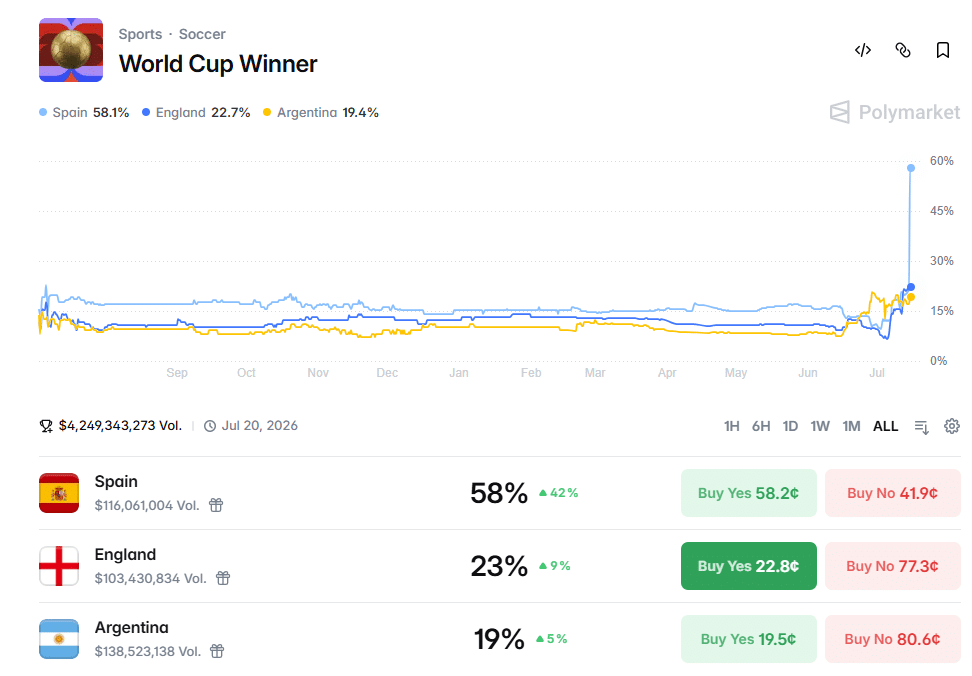
This figure eclipses many traditional sports betting records and even Polymarket’s own 2024 U.S. presidential election market. The platform’s international exchange hit a monthly record of $10.8 billion in June 2026, largely fueled by World Cup activity, while broader prediction market volumes across competitors like Kalshi exceeded tens of billions.
The tournament’s global appeal and knockout-stage drama could be attributed as key drivers behind this mammoth volume. With the final set for July 19 at MetLife Stadium in New Jersey, trading activity has intensified as teams advance.
How Polymarket’s Mechanics Drive Engagement
Unlike traditional sportsbooks, Polymarket operates as a decentralized platform where prices reflect real-time crowd wisdom. Shares can be bought, sold, or held until resolution, allowing users to react to match outcomes, injuries, or tactical shifts. This secondary market dynamic creates continuous opportunities, with daily volumes spiking during high-stakes games.
These markets are settled according to official FIFA results, with early No resolutions for eliminated teams. This transparency, combined with blockchain settlement on Polygon, builds trust and reduces counterparty risk. The platform’s hybrid model, offering both regulated U.S. access and international options, has broadened its user base significantly.
The market page hosts thousands of comments, with traders debating everything from Spain’s tactical superiority to Argentina’s veteran resilience led by Lionel Messi. High liquidity ensures tight spreads and deep order books, making it attractive for both retail participants and larger players seeking to hedge or speculate.
Broader Implications for Crypto and Prediction Markets
Polymarket’s World Cup success highlights the maturation of prediction markets as a legitimate financial primitive. Total World Cup-related volume across Polymarket has contributed to platform-wide records, positioning it as a rival to centralized betting giants. Industry observers note that the $4.25 billion figure not only surpasses the Super Bowl’s prediction market activity but also demonstrates crypto-native tools’ ability to handle mainstream sporting events at scale.
This surge comes amid growing regulatory clarity. Polymarket’s U.S. entity operates as a CFTC-regulated designated contract market, while its international arm provides broader access. Such dual structures could serve as a model for future DeFi applications in regulated environments. Moreover, the data generated—real-time probabilities on global events—offers valuable insights for analysts, journalists, and even traditional bookmakers.
The World Cup has also boosted ancillary innovation. Users trade player props, exact scores, and even novelty markets like halftime performers or presidential attendance. This ecosystem effect strengthens network effects, drawing in new users who then explore other categories like politics, crypto prices, and economics.
Integrity Questions Amid Explosive Growth
Despite the euphoria surrounding the World Cup markets, Polymarket is not without controversy. As the platform handles record volumes, questions around resolution integrity have surfaced.
Most notably, two traders recently filed a lawsuit in New York Supreme Court against Polymarket and CEO Shayne Coplan over the resolution of a Strategy Bitcoin sale market. The contract asked whether Strategy would sell any Bitcoin by May 31, 2026. Although Strategy’s SEC 8-K confirmed a 32 BTC sale within that window, Polymarket resolved the market as “No,” arguing confirmation came after the deadline.
The plaintiffs allege breach of contract and retroactive rule changes, claiming losses of hundreds of thousands of dollars. This dispute, while unrelated to the World Cup markets, underscores the importance of clear, consistent resolution rules as Polymarket scales.
As the semifinals and final approach, expect further volatility in the $4.25 billion World Cup Winner market. A Spain vs. England matchup currently leads exact finals odds at 53%. With billions already committed, the final resolution will test the platform’s scalability and deliver payouts worth tens of millions to successful traders.
What it Means for Crypto Users
Polymarket’s World Cup Winner market isn’t just a betting phenomenon; it’s a showcase for blockchain’s real-world utility. By turning sports fandom into tradable, information-efficient markets, it bridges crypto with mainstream entertainment. As volumes climb toward a potential $10 billion tournament total across platforms, Polymarket solidifies its role as the “World’s Largest Prediction Market.”
For crypto enthusiasts, this represents more than hype: it validates decentralized finance’s capacity for high-stakes, high-liquidity applications. Whether you’re trading shares or simply watching probabilities shift, the 2026 World Cup on Polymarket is redefining how the world engages with uncertainty—one share at a time.
Also read: Hyperliquid Meets SEC Crypto Task Force Over U.S. Regulations