On June 30, 2026, a new player entered the stablecoin race. A consortium called Open Standard unveiled Open USD (OUSD), a dollar-pegged stablecoin backed by more than 140 companies spanning payments, banking, technology, and crypto. The project drew immediate attention for its bold proposition: making stablecoins cheaper and more useful for businesses while challenging the long-standing dominance of Tether’s USDT and Circle’s USDC.
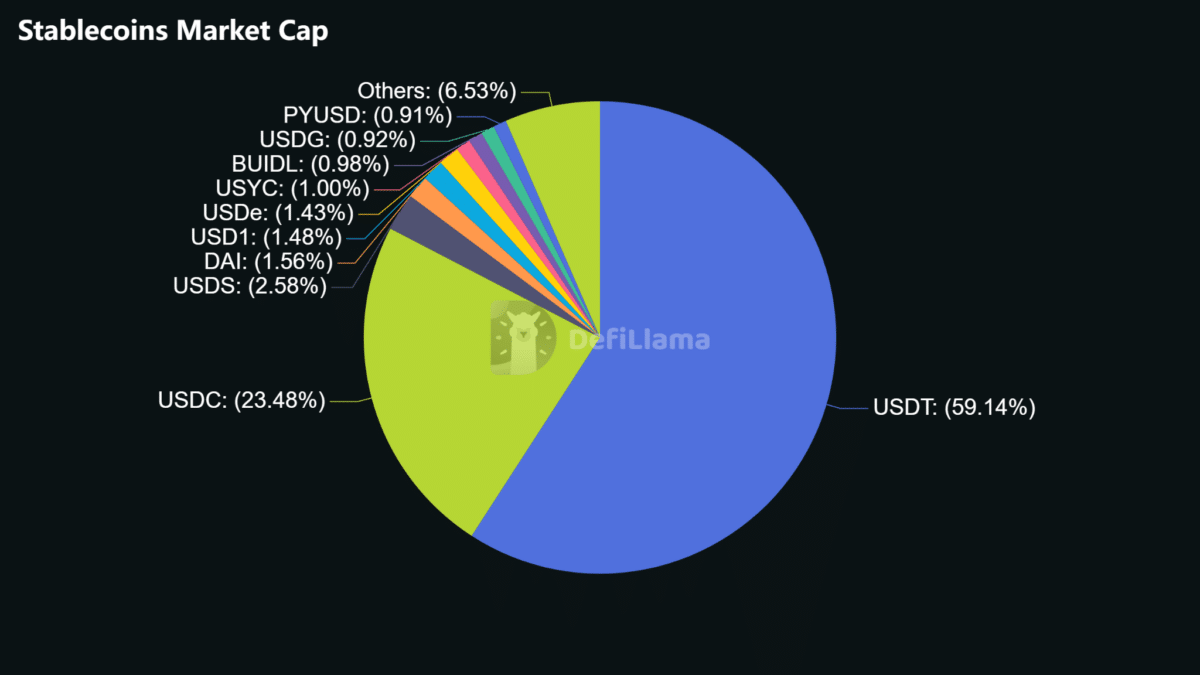
Stablecoins are digital dollars designed to hold a steady value of roughly $1. They power fast, low-cost transfers across both crypto and traditional finance. As of mid-2026, the total stablecoin market cap exceeds $314 billion, according to DefiLlama. Tether and Circle have dominated it for years. This new effort raises a real question: can a broad coalition change the game?
The stablecoin duopoly today
Tether’s USDT and Circle’s USDC together control the vast majority of the stablecoin market. As of mid-2026, USDT holds roughly 59% market share at about $189 billion in circulation, while USDC holds approximately 24% at around $73–77 billion, per DefiLlama. Together, they account for roughly 83% of the space.
Tether has built its lead through wide availability, especially in less-regulated and emerging markets, and strong liquidity in crypto trading. It has faced questions about transparency in the past, but remains the go-to for users needing quick, global dollar access. Tether’s model focuses on accessibility, making it popular for trading pairs and cross-border movements where speed and reach matter most.
Circle’s USDC stands out for its focus on regulation and compliance. It works closely with traditional finance and has strong integrations across blockchain networks. USDC earns interest on its reserves, mainly safe assets like U.S. Treasuries held in a BlackRock-managed fund, and has built a solid reputation with institutions. Circle has emphasized transparency through regular attestations and has secured licenses in multiple jurisdictions, including the U.S. and the EU.
Both companies benefit from a simple model: users send dollars, the issuer holds reserves, and the issuer keeps most of the interest earned. This has been highly profitable, especially as interest rates rose in recent years. Reserve income produced roughly 96% of Circle’s revenue in its most recent filings. But businesses using these stablecoins at scale often face fees for minting or redeeming and have little say in how the coins develop over time.
These strengths have created high barriers. Network effects matter enormously: more users and integrations make a stablecoin more valuable, which attracts even more activity. In Q1 2026, USDC represented 63% of all stablecoin transaction volume, according to Visa Onchain Analytics data cited in Circle’s earnings release. (Circle’s CEO separately noted that third-party estimates, including Solana volumes, put USDC’s share closer to 80%.)
Still, not everyone is happy. Large companies want lower costs, more control, and a way to share in the economics of a system they help grow. This is where Open USD sees an opening.
What is Open USD?
Open USD comes from Open Standard, an independent company set up to run the project. It is led by founding CEO Zach Abrams, co-founder of Bridge, the stablecoin infrastructure firm that Stripe acquired for $1.1 billion in 2024. The project is not owned by one big issuer. Instead, it aims to act as shared infrastructure backed by many players.
The consortium lists support from over 140 companies across payments, banking, tech, and crypto. Major names include Visa, Mastercard, Stripe, American Express, BlackRock, BNY, Coinbase, Google, Shopify, DBS, Standard Chartered, Ripple, IBM, Fireblocks, Solana, Polygon, and Aave, among others. Stripe has said it plans to make OUSD the default stablecoin for businesses on its platform. Coinbase has confirmed integration support on its Base network.
Open USD is a fully reserved, dollar-pegged stablecoin. Every token is intended to be backed 1:1 by cash or safe short-term assets held at major financial institutions, following U.S. regulatory standards. It is scheduled to go live later in 2026, initially on Plasma and Solana, with plans for broader availability across networks including Polygon, Stellar, and Aptos. Reserves are expected to be managed compliantly at established institutions.
Three key design principles
Built for scale: Businesses can mint and redeem OUSD with no fees and no artificial volume limits. This addresses a common complaint about high costs at large scales. Traditional stablecoins can become expensive precisely when companies need to move large amounts quickly and frequently.
Earn by default: Partners share most of the earnings from reserves, after a small management fee for operations. This flips the usual model where one issuer keeps most of the yield. The goal is to give everyone using and promoting the coin a financial reason to grow it. Instead of value concentrating on a single company, it flows back to the ecosystem.
Govern collaboratively: Open Standard operates as an independent company with a board that includes partners. Decisions aim to serve the group rather than a single entity. This is meant to create neutrality and reduce dependence on one company’s roadmap. No single participant has full control.
These features target enterprise needs: payments, remittances, marketplaces, trading, and more. Proponents argue it could unlock wider adoption by making stablecoins feel like true shared infrastructure, similar to how early payment networks developed.
Stablecoin comparison
| Aspect | Tether (USDT) | Circle (USDC) | Open USD (Proposed) | Paxos USDG |
|---|---|---|---|---|
| Core Leadership | Paolo Ardoino | Jeremy Allaire | Zach Abrams (Bridge/Stripe) | Charles Cascarilla |
| Issuer Model | Single issuer | Single issuer | Consortium | Consortium |
| Mint/Redeem Fees | Varies | Varies | Zero for partners | Varies |
| Yield Distribution | Issuer retains | Issuer retains | Shared with partners | Shared with partners |
| Governance | Centralized | Centralized | Collaborative board | Consortium-led |
| Supply (Jul 2026) | ~$189B | ~$73–77B | Not yet live | ~$3B |
| Launch/Status | Live (2014) | Live (2018) | Later 2026 | Live (late 2024) |
Market reaction and immediate impact
The announcement hit markets fast. Circle’s stock (CRCL) dropped approximately 16% on June 30, closing near $62.63 at a four-month low, in its worst single-session decline since listing. Trading volume surged as investors repriced USDC’s revenue model. Because roughly 96% of Circle’s income derives from reserve interest, a rival built to share that yield with distribution partners struck directly at its profit engine.
By July 2, CRCL had recovered partially, posting a 4%+ gain as analysts debated whether the selloff was overdone. Clear Street managing director Owen Lau called it “an overreaction,” pointing out that prior consortium stablecoins have struggled to gain real traction.
Meanwhile, Tether appeared less directly affected, likely due to its different market position: USDT’s dominance is concentrated in crypto trading and emerging-market corridors rather than the enterprise payments segment OUSD targets. The news fueled broader talk about stablecoin competition intensifying, especially after the GENIUS Act (signed July 2025) established a formal federal framework for stablecoin regulation.
How Open USD targets the duopoly’s economics
The disruption angle is clearest in the business model. Traditional issuers earn from reserve interest and retain the bulk of it. Open USD wants to pass most of that value to partners who drive usage. This could encourage big networks like Visa, Mastercard, and Stripe to promote OUSD more actively because they stand to gain directly from increased volume.
Zero fees and no caps could make it attractive for high-volume users who currently pay to move in and out of stablecoins. Collaborative governance offers a voice to participants, which single-issuer models lack. If successful, this could erode the “winner-take-most” dynamics. More competition might lead to better terms industry-wide and faster innovation.
The economic shift is particularly relevant for payments companies and platforms that handle large flows. By aligning incentives across the value chain, Open USD hopes to create a self-reinforcing network where participants are motivated to integrate and expand usage.
Challenges and scepticism in the market
Partnership clarity
Within days of the announcement, reports emerged that several South Korean companies listed as partners had not made firm commitments. Samsung Electronics stated there had been “no official consultations” and that the company did not know what role it would play. Dunamu (operator of Upbit, South Korea’s largest crypto exchange), Shinhan Financial Group, K Bank, and KakaoBank gave similar accounts, saying they had only expressed a willingness to review the proposal.
One unnamed representative told Korean outlet Chosun Biz that the company had learned of its inclusion through domestic news coverage and was “perplexed to be included as members.”
Open Standard’s announcement described its partners as having “signed up to use Open USD,” a phrase that implies commitment. The Korean firms describe their involvement as preliminary and exploratory. Core backers like Stripe and Coinbase have made clearer statements of support, but the episode highlights a common issue with large consortia: turning logos into actual usage takes time and real alignment.
The Paxos USDG precedent
Open USD is not the first consortium-model stablecoin. Paxos launched the Global Dollar Network (USDG) in late 2024, backed by Robinhood, Kraken, and Galaxy Digital, with a similar revenue-share structure.
As of mid-2026, USDG has grown to approximately $3 billion in supply. That is meaningful growth, but it lags far behind USDC’s $73 billion and USDT’s $189 billion.
Execution risks
Consortia can struggle with slow decisions and competing interests. History offers a warning: Meta’s Libra (later Diem) assembled a similarly impressive roster of backers in 2019, spent years seeking approvals, and sold its assets in early 2022 without ever launching at scale.
In an X post, ARK Invest’s Lorenzo Valente has raised doubts about whether a consortium of this size can move fast enough, citing a cold-start liquidity problem, a lack of established trading pairs, and governance friction from too many stakeholders. Launch is still months away, so details on the exact issuer, custodians, full legal structure, and day-to-day operations remain limited.
Incumbent response
Circle CEO Jeremy Allaire pushed back firmly. He argued that network effects, deep liquidity, regulatory licenses, and proven usage give USDC lasting advantages. He noted that free mint/redeem promises can be hard to sustain at true scale and that sharing all yield might lead to underinvestment.
Allaire also posted on X that Circle’s “stablecoin partnership with Coinbase remains as strong as ever” and added a pointed one-liner after the Korean denials surfaced: “Integrity matters.”
Meanwhile, Tether continues its own path, reporting $1.04 billion in Q1 2026 net profit and $8.23 billion in excess reserves. Both incumbents have strong moats built over the years.
Balanced outlook: Potential and reality
Open USD represents a serious attempt to rethink stablecoin design. Its focus on shared benefits and enterprise scale addresses real frictions in today’s market. With heavyweight backers in payments and finance, it has credible distribution potential that could accelerate adoption in areas like cross-border payments, corporate treasury, and decentralized finance.
At the same time, the path to meaningful disruption is not guaranteed. Tether and Circle have spent years building moats: liquidity, trust, integrations, and compliance infrastructure. Consortium projects often face coordination challenges, as the early questions about partner commitments show. Real success will depend on actual transaction volume after launch, not announcement hype.
The stablecoin market is still growing rapidly, expanding 32% year-over-year to above $314 billion as of mid-2026. In that environment, more competition could benefit users through lower costs and better products without necessarily destroying the leaders. A larger overall market may allow room for multiple strong players.
Open USD is one of the most ambitious challenges yet to the current setup. Whether it becomes a major player, a niche option, or simply forces the incumbents to improve their terms remains to be seen. For now, it has sparked important conversations about who should control and benefit from digital dollars.
Also Read: What Is Open USD (OUSD) Stablecoin? Features, Backers, and How It Differs From USDC
Disclaimer:
Some elements of this content may have been enhanced with the help of our artificial intelligence (AI) assistants for purposes such as basic refinement, review, image generation, and translation to deliver high-quality news in a shorter time frame. However, all AI-assisted content is reviewed and approved by our team to ensure accuracy, fairness, and editorial integrity.