The digital asset equity landscape enters July 2026 in a state of severe technical correction and profound strategic transition. After reaching an all-time high of $126,272 on October 6, 2025, Bitcoin (BTC) opened July 2026 near $58,300, down over 53% from its peak and its lowest level in more than 21 months.
The broader cryptocurrency market capitalization has contracted to $2.11 trillion, dragging the Crypto Fear & Greed Index to a reading of 11, indicating extreme market pessimism. This downturn has been driven by a confluence of factors, including persistent spot ETF outflows, delayed regulatory legislation, and capital flight toward traditional artificial intelligence (AI) and semiconductor equities.
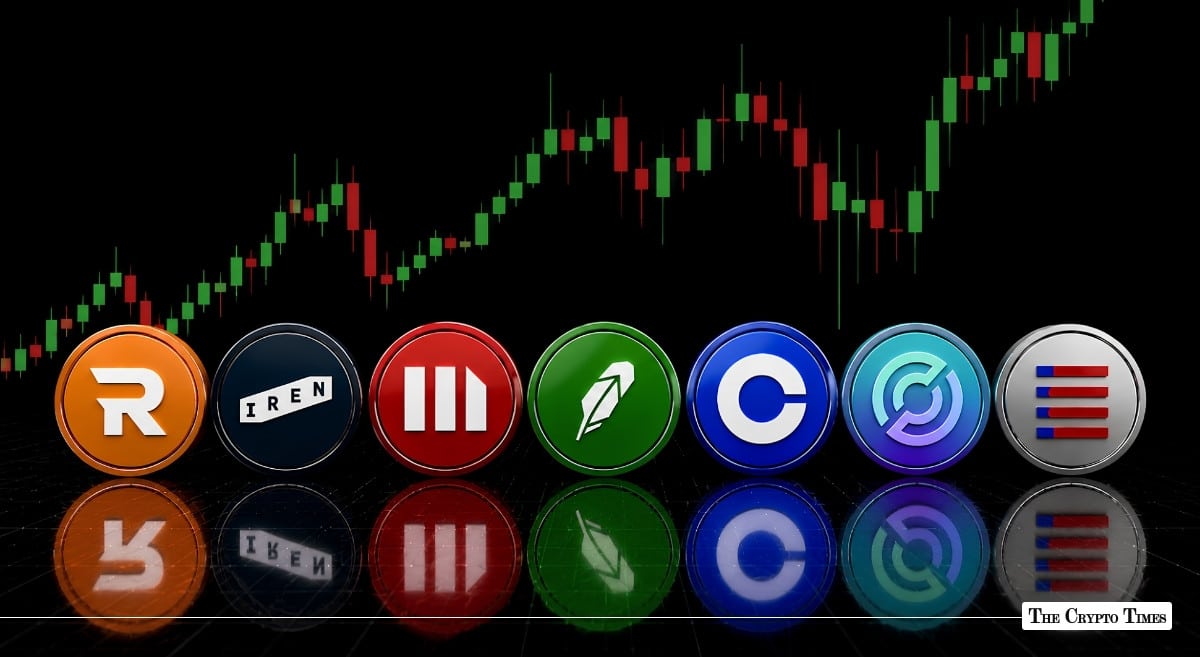
Beneath this broad-market selloff lies a critical divergence: institutional operators are rapidly decoupling from pure-play cryptocurrency mining and instead repurposing their gigawatt-scale power pipelines to secure high-margin AI and High-Performance Computing (HPC) data center contracts.
This evaluation examines the premier cryptocurrency and digital asset equities — with updated Wall Street price targets from major banks and asset managers — highlighting how macroeconomic tightening and operational restructurings are sorting the industry into distinct regulatory and infrastructural leaders.
Crypto Market Macro Backdrop: Bitcoin Price Crash, Fed Rate Hikes, and CLARITY Act Delay in H2 2026
The closing stretch of June 2026 delivered three consecutive macroeconomic disruptions that severely impacted digital asset equities heading into the second half of the year. On June 24, a massive global AI chip selloff dragged Bitcoin below the critical $60,000 threshold for the first time in months. This was compounded by the sudden collapse of the Bürgenstock peace ceremony and a hotter-than-expected May PCE inflation report on June 25, which showed headline PCE climbing to 4.1% year-on-year and core PCE rising to 3.4% — the highest headline reading since April 2023.
This high inflation print has validated Bank of America’s forecast of three consecutive interest rate hikes in the second half of 2026, specifically targeted for September, October, and December. Markets have reacted swiftly, with CME FedWatch December hike odds rising above 37%, while Goldman Sachs has deferred all rate cut expectations into 2027.
Consequently, the July 29 FOMC meeting will serve as a crucial barometer under Fed Chairman Kevin Warsh‘s newly established framework, in which he has dropped formal forward guidance — meaning the tone and phrasing of the FOMC statement are expected to carry significantly more weight than the actual rate decision. The Fed has held its benchmark rate at 3.50%–3.75% for four straight meetings.
On the regulatory front, the symbolic July 4 goal set by the White House for the CLARITY Act to clear Congress on America’s 250th birthday will be missed. The Senate’s adjournment on June 25 until July 13 has effectively shut down this window, forcing the market to price in ongoing regulatory uncertainty.
The bill, which cleared the Senate Banking Committee 15-9 but requires 60 Senate floor votes and a meaningful bloc of Democratic crossovers to break a potential filibuster, currently has its 2026 passage odds priced at roughly 48% on Polymarket. Meanwhile, stablecoin regulation is tightening through the GENIUS Act, with five joint US regulators proposing bank-grade Know-Your-Customer (KYC) rules for primary market stablecoin transactions, forcing a clear division between compliant issuers and regulatory laggards.
| Macroeconomic / Legislative Catalyst | Metric / Status as of July 1, 2026 | Financial Implications for Crypto Equities |
|---|---|---|
| May PCE Inflation (YoY) | Headline: 4.1% / Core: 3.4% | Hawkish pressure; strengthens higher-for-longer rate thesis |
| Federal Reserve Rate Policy | Rate held at 3.50%–3.75%; Bank of America projects 3 hikes in H2 2026 (Sep, Oct, Dec) | Postpones rate cuts to 2027; increases cost of capital |
| CLARITY Act Passage Odds | ~48% on Polymarket; Senate adjourned until July 13 | Sustained regulatory drag; delays institutional custody frameworks |
| GENIUS Act Stablecoin KYC | Proposed by FinCEN, Fed, OCC, FDIC, and NCUA | Restricts primary stablecoin flows to CIP-compliant issuers |
| Bitcoin H1 ETF Outflows | Cumulative $4.4 billion supply overhang by end-June | Continuous mechanical selling pressure on BTC spot price |
Strategy (MSTR) Stock: Bitcoin Treasury Strain, mNAV Compression, and Analyst Price Targets
The macro-driven decline in Bitcoin has triggered an acute crisis within the capital structures of major corporate holders. Strategy Incorporated (MSTR) — formerly MicroStrategy, which rebranded to “Strategy” in February 2025 — has long functioned as a leveraged corporate proxy for Bitcoin sentiment. However, as Bitcoin fell below $59,000, MSTR shares slid to around $85–$86 by July 1, 2026 — marking an eleventh consecutive monthly loss and an intraday low near $82.10, the stock’s weakest level since February 2024. That represents an approximately 79% decline over the trailing twelve months and roughly 84% below the stock’s all-time high near $540 in November 2024.
For the first time in several years, the company’s modified Net Asset Value (mNAV) — the multiple of its equity or enterprise value to the fair value of its Bitcoin holdings — has compressed toward parity.
On a basic and diluted basis, mNAV now sits below 1.0, while enterprise-value-based mNAV hovers just above parity, against on-balance-sheet Bitcoin of roughly $50 billion and a market capitalization near $30 billion.
When a corporate treasury trades near or below its mNAV, issuing common stock to purchase additional Bitcoin becomes mathematically dilutive rather than accretive to existing shareholders. Consequently, Strategy has shifted away from at-the-money (ATM) common share issuance and toward preferred stock issuance and share buybacks.
This pivot introduces significant balance sheet friction. Strategy’s annual preferred dividend and interest obligations have surged from roughly $300 million at the start of 2026 to approximately $1.2 billion, while on-chain analytics firm CryptoQuant has warned that dividend coverage has collapsed from over seven years to roughly 14 months.
The STRC preferred stock, a key funding instrument, fell to an all-time low near $74, well below its $100 par value. On June 29, 2026, Strategy’s board authorized a new Digital Credit Capital Framework: up to $2 billion of buybacks ($1 billion common, $1 billion preferred), a STRC preferred dividend raised to 12% (effective July 1), and a BTC Monetization Program permitting the sale of up to $1.25 billion of Bitcoin if needed.
The company said its USD reserve stood at roughly $2.55 billion as of June 28 — about 17.4 months of preferred dividend and interest coverage, against annual obligations of approximately $1.76 billion. Ahead of that framework, Strategy sold 32 BTC between May 26 and 31, 2026 — its first Bitcoin sale since December 2022, breaking a multi-year “never sell” posture.
For the broader market, the impairment of Strategy’s “Flywheel” model — where it consistently acted as an incremental buyer of last resort — removes a major source of programmatic buy pressure. With the company holding approximately 847,363 BTC at an average cost near $75,651, its holdings face massive unrealized losses in the neighborhood of $14 billion.
This structural vulnerability has triggered securities investigations by firms such as Rosen Law Firm, while insider sales by executives like CEO Phong Le and Director Jarrod Patten continue to weigh on investor sentiment.
Similar mNAV compression is apparent globally, with Japan’s Metaplanet and Nakamoto trading at mNAV ratios of 0.9 and 0.92, respectively, signaling a systemic halt in corporate treasury accumulation.
Wall Street price targets on MSTR remain net-bullish even as several desks trim their numbers. On July 1, 2026, TD Cowen’s Lance Vitanza cut the firm’s target to $260 (from $400) while keeping a Buy, attributing the reduction to a weaker Bitcoin outlook rather than any change at the company — a move mirrored by other research houses that have clustered targets in the $260–$265 range.
Benchmark (Mark Palmer) still holds the Street-high target at $570 (trimmed from $705), Bernstein carries an Outperform near $450, and BTIG sits at $350. At the conservative end, Canaccord Genuity (Joseph Vafi) sits near $163–$185, while Wells Fargo has been the notable bear at $54. Citi’s base case ties a $100,000 Bitcoin price to CLARITY Act passage, which would push the value of Strategy’s stack toward $84 billion.
The blended 12-month consensus has compressed toward the low-$300s (with a Strong Buy skew) but still implies substantial upside from current levels — a gap that reflects genuine disagreement over Bitcoin’s trajectory and whether Strategy’s leverage creates outsized upside or undue dilution risk. Strategy is scheduled to report earnings on July 29, 2026.
| Corporate Proxy | Ticker | Stock Price ($) | Market Capitalization ($) | Balance Sheet Strategy & Constraints |
|---|---|---|---|---|
| Strategy (fmr. MicroStrategy) | MSTR | ~$85–86 | ~$28–30B | Holds ~847,363 BTC at avg cost ~$75,651; mNAV near parity; ATM common issuance paused; ~$1.2B preferred dividend/interest gap; first BTC sale since 2022 |
| Japan Metaplanet | MTPLF | — | — | Enterprise mNAV at 0.9; capital program impaired by BTC spot contraction |
| Nakamoto | — | — | — | Enterprise mNAV at 0.92; programmatic buying paused due to dilution risks |
Bitcoin Miners Pivot to AI Data Centers: The Great Mining Restructuring
Following the April 2024 halving event, pure-play Bitcoin mining has faced severe margin compression, which has been exacerbated by rising global network difficulty and the sharp depreciation of Bitcoin’s spot price in H1 2026. In response, the industry is undergoing a massive structural transformation.
Rather than remaining exposed to volatile block rewards, leading public miners are leveraging their secured power capacity, grid connections, and fiber access to pivot toward Artificial Intelligence and High-Performance Computing (HPC) data center hosting.
This “time to compute” thesis is driving institutional interest because constructing greenfield power transmission pipelines for hyperscale AI campuses can take up to five years, whereas existing miners already possess massive, contracted utility-scale connections.
CleanSpark (CLSK) Stock: Meta Data Center Talks, AI/HPC Pivot, and Analyst Price Target
CleanSpark is navigating this transformation with 1.8 GW of contracted power capacity across the United States, of which 808 MW is currently utilized. In May 2026, the company maintained an operational hashrate of 50.0 EH/s, producing 671 BTC while holding 13,470 BTC in treasury.
Despite reported Q2 net losses of $378.3 million — driven by Bitcoin price corrections and elevated operating leverage — CleanSpark’s stock, trading near $14.55 to $17.14, remains a primary target for institutional allocators.
The company’s actual Q2 2026 EPS of -$1.52 missed the Wall Street estimate of -$0.41 (some desks modeled -$0.56), while revenue of $136.4 million missed expectations by roughly 10%. The balance sheet carries $1.8 billion in long-term debt against $1.0 billion in stockholders’ equity, though its liquidity remains high with a current ratio of 10.54, alongside roughly $460 million in cash after a $1.15 billion convertible raise.
The core catalyst for CleanSpark is its advanced discussions with Meta Platforms to anchor a roughly 250 MW hyperscaler lease at its Sandersville, Georgia data center campus — reported as active negotiations, not yet a signed contract.
This transition from pure-play miner to digital infrastructure developer has drawn significant Wall Street interest. On analyst targets, the referenced Citizens “Market Outperform” call carries a $27 target on the high side, while Maxim and Macquarie both moved to $22, Keefe Bruyette sits at $16, and Bernstein reiterated a Buy; FactSet’s average target is around $20.50.
However, high short interest at 46.23% of the float underscores the execution risks associated with converting industrial mining setups into high-availability AI tier data centers.
MARA Holdings (MARA) Stock: Long Ridge Acquisition, AI/HPC Load, and Analyst Price Target
MARA, trading at $14.64 with a market cap of $5.58 billion, reported a substantial Q1 net loss of $1.3 billion, missing EPS forecasts significantly at -$3.31 against an expected -$1.41. Despite a record energized hashrate of 72.2 EH/s (up 33% YoY), the company’s operating margin stood at -104.5% due to asset impairments and higher power costs.
In response, Marathon is executing a major pivot, marked by its $1.5 billion acquisition of Long Ridge Energy & Power, which cleared a key regulatory hurdle on June 8, 2026. This transaction increases Marathon’s owned and operated capacity by 65% to 2.2 GW (with a pathway to 2.4 GW), targeting over 600 MW of critical AI/HPC IT load. Long Ridge operates with a highly efficient incremental power cost of roughly $0.015 per kWh (about $15 per MWh), providing a structural advantage for AI host computing.
Marathon’s financial stress is underscored by a debt-to-equity ratio of 1.05 and a levered free cash flow of negative $1.36 billion over the last twelve months. However, the company proactively retired 33% of its outstanding convertible debt, reducing potential shareholder dilution by 46 million shares (9% on a fully diluted basis).
On analyst targets, MARA carries a Buy-leaning consensus around $13–$18, with Compass Point (Ed Engel) the Street high at $30 and B. Riley (Lucas Pipes) at the bearish end near $8; Cantor Fitzgerald recently trimmed to $10, Rosenblatt sits at $15, and H.C. Wainwright downgraded to Neutral. Several desks explicitly tie the higher targets to Long Ridge lifting 2026 EBITDA and the shift toward higher-multiple HPC revenue.
TeraWulf (WULF) Stock: Core42 and Fluidstack HPC Leases, and Analyst Price Targets
TeraWulf represents the most advanced AI transformation play in the sector, with its stock currently trading at $25.80 to $28.17, giving it a market cap of approximately $12.80 billion. WULF reported a Q1 2026 EPS loss of -$0.92 per share (versus estimates of -$0.18), though this headline figure was heavily distorted by non-cash charges, including $216 million in warrant fair value losses and $101 million in stock-based compensation, producing a GAAP net loss of roughly $428 million. Consensus 2026 EPS is projected around -$0.67, with net profitability expected by 2027.
In Q1 2026, TeraWulf’s high-performance computing (HPC) lease revenue surpassed its Bitcoin mining revenue for the first time, generating $21 million of its $34 million total revenue (a 117% sequential growth rate from $9.7 million in Q4 2025). TeraWulf maintains an industry-leading zero-carbon energy footprint, utilizing nuclear and hydro sources at an average power cost of approximately $0.035/kWh, and ended Q1 with roughly $3.1 billion in cash and restricted cash.
The company has secured over 522 MW in lease agreements with elite AI/HPC tenants, including Core42 and Fluidstack, which are projected to generate $630 million in annual high-margin revenue.
In mid-2026, TeraWulf further expanded its infrastructure with additional power-advantaged development sites (including a large-scale Kentucky campus adding roughly 480 MW of grid-connected power), extending its long-term development pipeline.
On analyst targets, WULF has attracted an unusually strong cluster of recent bullish coverage — Morgan Stanley raised its target to $66.50 from $42 (the Street high), Bernstein initiated at Outperform, Citi initiated at Buy, Cantor Fitzgerald sits at $24, Rosenblatt at $23, and Clear Street lifted to $36. The consensus target sits in the low-to-mid $30s with a Buy rating, reflecting confidence in the HPC-lease transition.
IREN (IREN) Stock: NVIDIA, Microsoft, and Dell AI Cloud Deals, and Analyst Price Target
IREN (trading near $45.50 to $60.85 with a market cap of $16.34 billion) has emerged as an institutional leader in the large-scale AI cloud capacity race. While consensus FY2026 loss forecasts deteriorated by 11% to -$0.70 per share, Wall Street maintains a highly constructive view, with Cantor Fitzgerald raising its target price to $99 on May 28, 2026. IREN has secured 84% of its projected $3.7 billion annualized recurring revenue (ARR) target for 2026 through milestone agreements with Microsoft, NVIDIA, and Dell Technologies.
Key operational details include a five-year, $3.4 billion AI cloud services contract with NVIDIA, supported by a purchase agreement with Dell to acquire air-cooled NVIDIA Blackwell GPU systems (part of a broader ~$5.8 billion GPU procurement program).
Additionally, NVIDIA received a five-year right to purchase up to 30 million IREN shares at $70 per share. To fund this massive expansion, IREN closed a $3.65 billion investment-grade GPU financing facility, covering 96% of its planned $5.81 billion GPU capital expenditure program.
This capital supports the development of AI cloud capacity across its Texas data centers, while its global pipeline has expanded to 5.8 GW across North America, Europe, and Australia. IREN’s separate five-year Microsoft AI cloud contract of approximately $9.7 billion — including a 20% Microsoft prepayment and a ~$5.8 billion Dell GPU purchase — underpins much of the ARR base and is expected to lift ARR toward $4.4 billion upon commissioning.
On analyst targets, Wall Street is broadly constructive on IREN, with an average 12-month target near $81 implying roughly 40% upside. Cantor Fitzgerald raised its target to $99 on May 28, 2026, and Jefferies initiated coverage at Buy with a $79 target in June, arguing the AI pivot unlocks long-term shareholder value and flagging that the Microsoft deal’s financing structure supports unlevered IRRs above 20%.
Zacks, by contrast, carries a more cautious Rank #4 (Sell). IREN shares have risen sharply over the past year despite the H1 2026 drawdown, reflecting the market’s willingness to value it partly as an AI infrastructure name rather than a pure Bitcoin miner.
Riot Platforms (RIOT) Stock: AMD AI Data Center Lease and Analyst Price Targets
Riot Platforms, trading at $27.38 with a market cap of $10.35 billion, is navigating a strategy of operational diversification. In Q1 2026, Riot reported total revenue of $167.2 million, up slightly from $161.4 million in Q1 2025. However, Bitcoin mining revenue fell 21.7% to $111.9 million, offset by $33.2 million in new data center revenue and a 59.7% surge in engineering revenue to $22.2 million.
Riot reported a substantial net loss of $500.5 million, heavily impacted by a $326.7 million negative fair value adjustment on its Bitcoin treasury. Despite these paper losses, Riot maintains a rock-solid balance sheet.
As of March 31, 2026, the company held $282.5 million of cash on hand ($205.7 million unrestricted) and 15,679 Bitcoin, equating to approximately $1.1 billion in liquid crypto assets. With $2.39 billion in stockholders’ equity and manageable long-term debt of $587.7 million, Riot has the financial runway to execute its infrastructure build-out to 35 EH/s. Riot’s AMD AI data center lease was doubled to 50 MW of contracted capacity, reinforcing its transition to a revenue-generating data center operator.
On analyst targets, Riot has become one of the loudest re-rating stories in the group, up around 88% in 2026. In early-to-late June, Keefe Bruyette & Woods raised its target to $37 (from $23), Clear Street went to $38 (from $26), Jefferies initiated at Buy with $37, BTIG lifted to $40 (from $28), and Bernstein reiterated Buy.
The consensus mean still sits near $26–$28 with a Buy rating (Street high $45), reflecting the tension between the data-center pivot thesis and the company’s ongoing cash burn.
| Mining Operator | Ticker | Stock Price ($) | Market Cap ($) | Q1/Q2 2026 Revenue / Loss (GAAP) | Core AI Data Center Catalyst & Pipeline |
|---|---|---|---|---|---|
| IREN Limited | IREN | $45.50 | $16.34B | Loss consensus: -$0.70/sh; targeting $3.7B ARR by end of 2026 | $3.4B NVIDIA GPU contract; Dell Blackwell agreement; $3.65B GPU financing facility; ~$9.7B Microsoft deal |
| TeraWulf Inc. | WULF | $28.17 | $12.80B | Q1 Rev: $34M (HPC lease: $21M); Q1 EPS: -$0.92 | 522 MW leased to Core42 & Fluidstack; multi-GW development runway |
| CleanSpark | CLSK | $17.14 | $4.398B | Q2 Rev: $136.4M; Q2 EPS: -$1.52; Net loss: $378M | Advanced talks with Meta for ~250 MW hyperscaler lease at Sandersville |
| Marathon Digital | MARA | $14.64 | $5.582B | Q1 Rev: $174.6M; Q1 EPS: -$3.31; Net loss: $1.3B | $1.5B Long Ridge Energy acquisition for 600+ MW critical AI/HPC load |
| Riot Platforms | RIOT | $27.38 | $10.35B | Q1 Rev: $167.2M (Eng: $22.2M); Net loss: $500.5M | Infrastructure scaling to 35 EH/s; 50 MW AMD AI lease |
Crypto Exchange and Fintech Stocks: Stablecoin Revenue, AI Agents, and Diversification
While mining operations manage massive physical infrastructure capital, financial intermediaries and exchanges are capturing steady revenue streams through transaction fee diversification and interest income. These enablers are increasingly leveraging AI agent deployment and tokenized real-world assets (RWAs) to offset declines in retail spot trading volume.
Coinbase (COIN) Stock: Stablecoin Revenue, “Everything Exchange” Model, and Analyst Price Target
Coinbase, trading at $169.62 with a market cap of $44.69 billion, currently sits just above a crucial historical support zone between $142.60 and $157.62 — a range from which it has generated substantial peak returns across six separate cycles. In Q1 2026, Coinbase reported total revenue of $1.55 billion (down 23.7% YoY) and a GAAP net loss of $667 million, primarily due to non-cash mark-to-market adjustments on its asset holdings.
However, the underlying operational metrics show strong structural resilience: subscription and services revenue reached $727 million (up 13% YoY), driven by a 61% surge in stablecoin revenue to $364 million as average USDC balances held on Coinbase platforms hit an all-time high of $17.8 billion.
The launch of “Coinbase for Agents” has put automated, AI-driven crypto trading at the center of Coinbase’s long-term valuation. By expanding into registered AI advisors, tokenized equities, and CFTC-regulated derivatives — and completing a $2.9 billion acquisition of derivatives exchange Deribit — Coinbase is actively shifting from a cyclical retail brokerage toward an “Everything Exchange” model.
On analyst positioning, Coinbase holds a Buy/Moderate Buy consensus with a 12-month mean target around $230–$294; Cantor Fitzgerald (Ramsey El Assal) raised its target to $250, Bernstein reiterated Buy, and BTIG (Andrew Harte) anchors the bullish end near the $400–$420 Street high, while Needham (John Todaro) sits at the conservative end near $120.
On the buy side, Cathie Wood’s ARK Invest has repeatedly bought the COIN dip through 2026, with a thesis built on Coinbase’s leadership in compliant tokenized real-world assets, its institutional custody moat, and recurring revenue from the Base Layer-2 network.
Robinhood (HOOD) Stock: Gold Subscriptions, Bitstamp, and Analyst Price Target
Robinhood has completed a highly successful transition into an institutional-grade financial powerhouse, with its stock trading near $89.49 and market capitalization reaching $77.81 billion. In Q1 2026, Robinhood posted revenue of $1.07 billion (up 15% YoY) and a net income of $350 million, translating to a massive net margin of 40.87%.
Growth is heavily supported by the company’s Gold subscription tier, which reached a record 4.3 million subscribers (up 36% YoY). While retail crypto trading volumes have cooled, the acquisition of Bitstamp has kept Robinhood’s global digital asset ecosystem highly liquid.
Analysts maintain a “Strong Buy” rating on HOOD stock, with an average target of $108.77, citing its exceptional operational leverage and expanding commission-free crypto footprint across international markets. On the asset-manager side, Robinhood is a top-10 position across ARK Invest’s flagship ARKK ETF after Cathie Wood repeatedly added HOOD shares on 2026 weakness, treating the pullback as an accumulation opportunity rather than a warning.
Block (XYZ) Stock: Cash App, Bitcoin Treasury, and Analyst Price Target
Under CEO Jack Dorsey, Block continues to utilize its mobile payments ecosystem to programmatically accumulate Bitcoin. Since October 2020, Block has built a substantial balance sheet allocation, purchasing $50 million and $170 million in initial rounds, and subsequently implementing a corporate policy to dedicate 10% of monthly Bitcoin profits back into programmatic BTC purchases.
Currently trading at $72.35 to $78.94 with a market cap of $45.65 billion, Block (which trades on the NYSE under the ticker XYZ, having moved from SQ in its 2025 rebrand) is seeing accelerating product velocity.
The integration of the Square and Cash App ecosystems through initiatives like “Neighborhoods” and AI-driven workflow optimization has improved its gross profit outlook. On analyst targets, TD Cowen reiterated a Buy with a $101 price target, while Citi maintained a Buy while trimming its target to $85, and Truist held at $72 with a Hold rating.
| Financial Brokerage / Payments | Ticker | Stock Price ($) | Market Capitalization ($) | Q1 2026 Key Performance Metrics | Strategic Valuation Driver |
|---|---|---|---|---|---|
| Coinbase Global | COIN | $169.62 | $44.68B | Q1 Rev: $1.55B; Net loss: $667M; Stablecoin Rev: $364M | Subscription revenue scaling; “Coinbase for Agents” launching; USDC yields |
| Robinhood Markets | HOOD | $89.49 | $77.81B | Q1 Rev: $1.07B; Net Income: $350M; Gold subs: 4.3M | Net margins at 40.87%; international Bitstamp custody scaling |
| Block, Inc. | XYZ | $76.00 | $45.65B | TTM Rev: $24.48B; Cash App GP growth: 38% | Holds ~8,027 BTC; programmatic 10% profit accumulation |
Crypto Ecosystem and Altcoins: NODE ETF, Bittensor (TAO), Chainlink (LINK), and RWA Plays
For institutional asset managers seeking diversified exposure, the VanEck Digital Assets Mining ETF (NODE) provides a balanced investment vehicle across the sector’s premier infrastructure, exchange, and payments providers. Rather than executing individual equity allocations, institutional portfolios utilize thematic exchange-traded funds to navigate high beta volatility while maintaining strict liquidity controls.
The structural weightings of the NODE ETF reflect a strategic preference for operational diversification, balancing pure-play miners with financial exchanges and energy providers. Outside the traditional equity domain, emerging on-chain protocols are capturing capital rotation through stablecoin yield optimization and decentralized compute marketplaces.
In the decentralized AI sector, Bittensor (TAO) operates as a primary marketplace where over 120 subnets compete for emissions, trading at $205 to $210 with pending spot ETF filings from Grayscale and Bitwise. Similarly, Render Network (RENDER) has integrated Salad Technologies to add 60,000 consumer GPUs to its decentralized rendering fleet, offering a high-beta hedge to physical data centers.
In the real-world asset (RWA) rotation, Chainlink (LINK) remains critical, powering Project Pangea in Zurich alongside 50 major banks to execute atomic settlement for the $9.6 trillion-a-day foreign exchange market.
Emerging micro-cap platforms such as Venice Token (VVV), a privacy-focused decentralized AI platform on Base, and Solstice (SLX), a Solana-native institutional yield layer managing over $500 million in TVL, represent high-growth alternatives as capital rotates into on-chain applications.
| NODE ETF Asset / Token Asset | Ticker / Symbol | Portfolio Weight / Market Price | Core Operational Focus | Strategic Value Proposition |
|---|---|---|---|---|
| Cipher Mining | CIFR | 6.42% of NODE | Industrial Bitcoin Mining | Secured grid contracts; target 25.1 EH/s by end of year |
| Galaxy Digital | GLXY | 4.35% of NODE | Institutional Financial Services | Brokerage, asset management, and banking gateway |
| Core Scientific | CORZ | 3.93% of NODE | AI & High-Performance Computing | Pivot of physical hosting facilities to AI hyperscaler workloads |
| Bittensor | TAO | $205.00 to $210.00 | Decentralized AI Marketplace | Settlement layer for machine learning subnets; December emission halving |
| Render Network | RENDER | $1.50 to $1.65 | Distributed GPU Compute | Salad Technologies partnership; scaling decentralized AI node fleets |
| Venice Token | VVV | $13.00 to $14.00 | Privacy Decentralized AI | Founded by Erik Voorhees; over 2 million registered users on Base |
| Solstice | SLX | $0.28 to $0.37 | Institutional Yield Layer | Managed validator ops; USX stablecoin; Upbit & Bithumb listings |
Wall Street Analyst Price Target Snapshot: Crypto Stocks for H2 2026
The table below consolidates the updated Wall Street analyst price targets referenced throughout this evaluation, spanning bulge-bracket banks, boutique research houses, and dedicated digital-asset desks.
| Stock | Ticker | Consensus Rating | Consensus / Mean Target | Notable Bullish Call | Notable Bearish Call |
|---|---|---|---|---|---|
| Strategy | MSTR | Strong Buy (compressing) | Low-$300s | Benchmark $570; Bernstein $450; BTIG $350 | TD Cowen cut to $260; Wells Fargo $54; Canaccord ~$163–185 |
| IREN Limited | IREN | Buy | ~$81 mean | Cantor Fitzgerald $99; Jefferies $79 | Zacks Rank #4 (Sell) |
| TeraWulf | WULF | Buy | Low-to-mid $30s | Morgan Stanley $66.50; Clear Street $36; Cantor $24 | Legacy lows near $3 (stale) |
| CleanSpark | CLSK | Buy | ~$20.50 | Citizens $27; Maxim/Macquarie $22 | Keefe Bruyette $16 |
| Marathon Digital | MARA | Buy | ~$13–$18 | Compass Point $30 | B. Riley ~$8; Cantor $10 |
| Riot Platforms | RIOT | Buy | ~$26–$28 | BTIG $40; Clear Street $38; KBW/Jefferies $37 | Consensus low ~$13 |
| Coinbase Global | COIN | Buy / Moderate Buy | ~$230–$294 | BTIG ~$400–420; Cantor $250 | Needham ~$120 |
| Robinhood | HOOD | Strong Buy | ~$108.77 | Street bulls above $108 | — |
| Block | XYZ | Buy-leaning | ~$85–$101 | TD Cowen $101 | Truist $72 (Hold) |
Analyst price targets are 12-month forward estimates compiled from public sell-side disclosures; the underlying research notes are proprietary to each issuing firm. Targets are not investment recommendations and are subject to substantial market, economic, and company-specific risk.
Big Asset Managers Positioning in Crypto Stocks: ARK Invest, Goldman Sachs, and BlackRock
Beyond sell-side price targets, the buy-side behavior of major asset managers offers a read on institutional conviction during the H1 2026 drawdown.
ARK Invest (Cathie Wood) has been the most visible dip-buyer, leaning into equity weakness across its ARKK, ARKW, and ARKF funds. Through 2026, ARK repeatedly accumulated Coinbase (COIN), Robinhood (HOOD), Circle (CRCL), and Bullish (BLSH) on down days, funding part of the rotation by trimming Chinese technology names such as Alibaba and Baidu. Robinhood ranks among ARK’s top-10 holdings, and Wood’s crypto thesis remains anchored to a long-term $1.5 million Bitcoin target and explicit support for the CLARITY Act. The firm’s concentrated basket effectively expresses a view that the sector selloff is a buying opportunity rather than a structural break.
Goldman Sachs, by contrast, has restructured rather than retreated. Its Q1 2026 13F disclosure showed the bank exiting its XRP and Solana ETF exposure and cutting its Ethereum position by around 70%, while retaining direct Bitcoin exposure and equity stakes in crypto infrastructure — a “keep the core, drop the speculative satellites” posture that lets Goldman participate in a strong crypto year while capping downside.
BlackRock, Apollo, and a16z have surfaced on the primary side, appearing among the backers of Circle’s token sale for its new Arc blockchain – a signal that the largest traditional asset managers continue to underwrite stablecoin and tokenization infrastructure even amid the equity-market drawdown.
H2 2026 Crypto Stock Outlook: Institutional Capital Allocation Matrix
The digital asset equity landscape in July 2026 is defined by a deep structural divide. For institutional allocators, the current market correction presents a highly asymmetric entry window, provided that investments are directed toward operators with clear infrastructural or regulatory advantages. The primary trend is to prioritize companies with clear power pipeline access and immediate monetization capabilities in the high-performance computing space.
The capital blockages within pure-play mining have triggered a self-reinforcing migration. Because traditional debt and dilutive stock issuance are closed to underperforming BTC-only treasuries, the only viable path to recapitalize is to pivot to HPC/AI infrastructure. By securing multi-billion-dollar GPU financing facilities (such as IREN’s $3.65 billion package), miners are unlocking alternative, non-dilutive credit lines that bypass traditional banking limits.
TeraWulf and IREN represent the premier institutional selections, given their successful transition to high-margin HPC leases and multi-billion-dollar sovereign cloud and hyperscaler contracts. These operators have insulated their capital structures from Bitcoin’s direct halving headwinds and are valued on predictable, long-term annualized recurring revenue profiles.
For exchange-based and fintech exposure, Robinhood and Coinbase remain essential core holdings. Robinhood’s extreme net margin profitability and rapid expansion of its high-margin Gold subscription program provide solid valuation support, while Coinbase’s status as a structural beneficiary of stablecoin yields and institutional custody makes it the premier index proxy for any eventual H2 2026 market recovery.
The GENIUS Act KYC proposals are sorting stablecoins into regulatory extremes, positioning Coinbase (with its $17.8 billion USDC ecosystem balance) to capture massive compliance-driven yield premiums as offshore stablecoins face transaction blockades.
Conversely, traditional corporate treasuries relying purely on Bitcoin price appreciation, such as Strategy (MSTR), should be approached with caution. Until the mNAV compression is resolved and preferred stock dividend obligations are stabilized, these vehicles will face significant structural headwinds that limit their immediate upward momentum. Ultimately, the transition from speculative digital tokens to physical energy-backed digital infrastructure is the defining investment theme of the H2 2026 cycle.
Also Read: Why Wall Street is Divided: Michael Saylor’s Scarcity vs. Tom Lee’s Staking Empire
Disclaimer:
Some elements of this content may have been enhanced with the help of our artificial intelligence (AI) assistants for purposes such as basic refinement, review, image generation, and translation to deliver high-quality news in a shorter time frame. However, all AI-assisted content is reviewed and approved by our team to ensure accuracy, fairness, and editorial integrity.