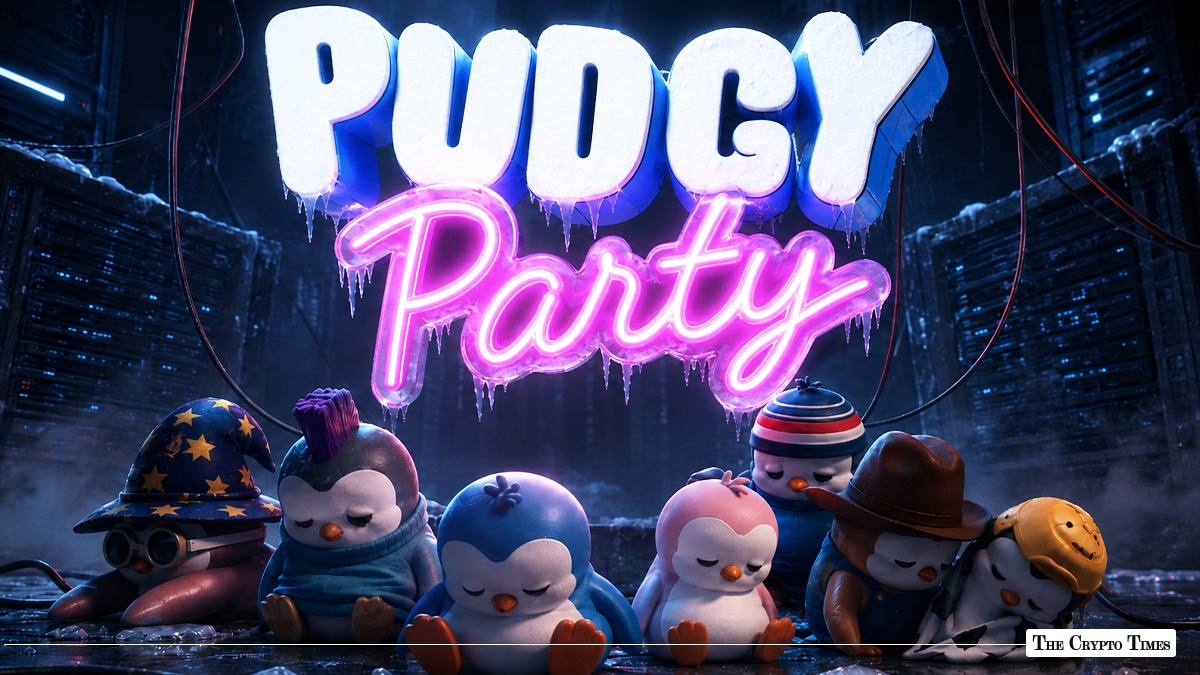
Pudgy Penguins has done what few NFT projects have ever managed: turn a crypto-native collection into a mainstream consumer brand. Its penguins are not only profile pictures or speculative assets. They are toys, GIFs, collectibles, memes, sporting collaborations, and now a growing gaming universe.
That is why the June 12 announcement from the official Pudgy Party account surprised many players.
The statement divulged that Pudgy Party, the project’s mobile party game built with Mythical Games, is being wound down. Further development has been halted. The team is instead shifting its focus to Pudgy World, its free browser-based game and now the flagship gaming product of the Pudgy Penguins universe.
On the surface, the move looks strange. Pudgy Party launched at No. 1 on the App Store, surpassed 1 million downloads, and helped spread the Pudgy Penguins IP far beyond crypto circles. It had fast-paced mini-games, NFT-based cosmetics, a strong mobile-first pitch, and a playful “wholesome chaos” identity. The game was also heavily promoted, including a Times Square activation in September 2025 to celebrate its early traction.
So why shut it down?
The answer is not simply that Pudgy Party failed. The better reading is that Pudgy Penguins has made a strategic decision to stop splitting resources between two gaming products and go all-in on the one it fully controls.
That makes business sense. But it also creates a trust problem for players who bought skins, invested time, and believed Pudgy Party would remain part of the long-term ecosystem.
Key Highlights
- Pudgy Penguins is winding down Pudgy Party, its Mythical Games-backed mobile title, despite the game reaching No. 1 on the App Store and crossing 1 million downloads.
- The team says it is shifting focus to Pudgy World, a browser-based game it fully controls, citing better scalability, storytelling potential, and deeper integration with the wider Pudgy Penguins universe.
- The decision has triggered backlash from players who spent money on skins and digital collectibles, as the team has not yet clarified whether Pudgy Party assets will migrate, receive rewards, or be compensated.
- The shutdown highlights a broader Web3 gaming challenge: strong IP can drivebroader sentiment, Dogecoin’s structure remains intact with potential for a breakout above $0.16.
What Was Pudgy Party?
Pudgy Party launched globally on August 29, 2025, as a mobile party game developed in partnership with Mythical Games (the studio behind NFL Rivals, FIFA Rivals, and Blankos Block Party). It was positioned as a light, social, fast-paced game using the Pudgy Penguins IP.
The format was familiar to mainstream gamers: quick races, obstacle-course chaos, knockout rounds, customization, seasonal events, and leaderboard-style competition. It drew obvious comparisons to games like Fall Guys, but with a softer Pudgy Penguins identity built around cute characters, social play, and casual mobile accessibility.
The game was also designed as a Web2-friendly Web3 product. Players could download it from the Apple App Store or Google Play, play for free, and engage with blockchain elements only if they wanted to go deeper.
Its Web3 layer came through digital collectibles and cosmetics. At launch, Pudgy Party included non-tradable and limited-edition tradable items, with certain costumes and skins capable of being turned into NFTs and traded through Mythical’s marketplace. This gave the game a crypto-native asset layer without making wallets or tokens the first thing a user had to understand.
Early performance was strong. Pudgy Party hit No. 1 on the App Store, built a daily player base, and crossed 1 million installs from Apple and Google’s stores within weeks of launch. BlockchainGamer.biz reported in October 2025 that it had become Mythical Games’ fastest-ever mobile game while activity on the Mythos chain also hit an all-time high for daily active unique wallets (DAUWs). The chain’s daily active wallets peaked at 112,249 on September 29, 2025, up from the previous high of just under 109,000 set in early March 2025.
For a Web3 mobile game, those numbers mattered. Many blockchain games struggle to move beyond crypto-native audiences. Pudgy Party appeared to have found a more accessible formula: recognizable IP, simple gameplay, mobile distribution, and optional Web3 ownership.
The June 12 Shutdown Announcement
On June 12, 2026, the official Pudgy Party X account posted an “Important update” announcing that the team had decided to wind down Pudgy Party and halt further development.
The statement framed the decision positively. The team said it was proud of Pudgy Party’s achievements, including its App Store success, large daily community, and more than 1 million downloads. It also credited the game with helping spread the Pudgy Penguins IP “far and wide.”
But the statement then made the central argument: Pudgy World is on track to surpass Pudgy Party’s milestones and go further.
The team cited three main advantages for Pudgy World: scalability, storytelling potential, and its ability to introduce people to the full Pudgy Penguins universe. It also emphasized that Pudgy World is “wholly ours,” a key phrase that explains much of the strategic pivot.
Pudgy Party was a collaboration with Mythical Games. Pudgy World, by contrast, is the in-house browser-based world the team now sees as the core gaming entry point for the entire IP.
In simple terms, Pudgy Penguins is moving away from a successful but collaborative mobile game toward a fully controlled flagship experience.
Why Did Pudgy Penguins Shut Down Pudgy Party?
The official reason is resource concentration. Pudgy Penguins is redirecting its gaming focus to Pudgy World.
The deeper reason is control.
Pudgy Party helped prove that the Pudgy IP could work in gaming. It generated downloads, visibility, and attention. But it was still a mobile title built with an outside partner, distributed through app stores, and structured around a specific game loop.
Pudgy World gives the team something different: a browser-native world built on infrastructure Pudgy Penguins fully owns. The project’s parent company, Igloo Inc., built a custom Layer-2 network called Abstract following a strategic funding round of over $11 million led by Founders Fund in mid-2024. Pudgy World runs on this owned infrastructure, giving the team complete vertical integration: own chain, own world, own characters, own monetization stack.
That distinction matters.
A mobile party game is usually built around short sessions. Users open the app, play a few rounds, unlock cosmetics, and then leave. While that can work well for acquisition and virality, it is harder to use as the foundation for a broad narrative universe.
Pudgy World is built around exploration, quests, character customization, mini-games, fishing, social interaction, and a story involving Pengu and Polly. It is set across 12 towns in a world called The Berg. It runs directly in the browser with no download required.
That makes it more flexible as a long-term IP product. New towns, quests, characters, events, collectibles, toy redemptions, and token-linked experiences can be layered into one persistent world.
The strategic prioritization had been telegraphed months in advance. In February 2026, Pudgy Penguins released Polar Pair-Up, a standalone casual matching game deployed on Abstract; explicitly framed as “one of the most popular mini-games planned for Pudgy World.” This gave both the chain and players a low-risk way to test the underlying systems before the main launch in March 2026.
From a business perspective, there are four likely reasons behind the pivot.
First, Pudgy World gives Pudgy Penguins more ownership over the product roadmap. If the team wants gaming to become a central pillar of the brand, it needs control over design, updates, monetization, blockchain integration, and storytelling.
Second, browser distribution reduces friction. Users do not need to download a large mobile app or pass through Apple and Google’s app store environments. They can enter directly from a link, campaign, toy QR code, or social post.
Third, Pudgy World fits the broader brand strategy better. Pudgy Penguins is no longer just trying to launch a game. It is building a consumer IP ecosystem across toys, licensing, digital collectibles, social content, and tokenized community participation.
Fourth, maintaining two games is expensive. Even strong brands have limited development, marketing, and community bandwidth. Supporting Pudgy Party while scaling Pudgy World, toys, partnerships, the PENGU ecosystem, and other product lines would spread the team thin.
In that context, the shutdown looks less like panic and more like prioritization.
Why Pudgy World Became the Flagship Bet
Pudgy World launched publicly in March 2026 as a free-to-play browser game. The team and early coverage positioned it as a “Club Penguin” style experience for the Web3 era, but with blockchain largely hidden in the background.
That point is important.
One of the biggest problems in Web3 gaming has been that many products feel like financial dashboards with gameplay added later. Pudgy World appears to reverse that order. The game leads with characters, quests, world-building, and social interaction. Crypto comes second.
That is exactly the direction the Pudgy Penguins brand has been moving in for years. Its toys have QR codes that connect physical products to digital experiences. Its GIFs have reached massive audiences outside crypto. Its partnerships with mainstream brands and sports properties show that the company is trying to make Pudgy Penguins a cultural IP, not just an NFT collection.
Pudgy World is therefore more than a game. It is a funnel.
A May 2026 Pudgy Media update said the brand surpassed 100 billion views on GIPHY and continued its Manchester City collaboration. A separate official blog post detailed a Pudgy Penguins x Manchester City collectible and apparel set, showing the project’s continued push into sports and consumer culture.
Additionally, more than 2 million Pudgy Penguins toys sold by mid-2025, generating $13 million+ in retail sales by January 2026 with $20 million+ projected for 2026, across more than 10,000 retail locations including 3,100 Walmart stores, Target, Amazon, and Walgreens. A Visa Pengu Card also launched in March 2026, enabling real-world utility at approximately 150 million merchants worldwide.
Plus, Pudgy Penguins is positioning itself for a potential public stock listing by 2027, which would mark one of the first Web3-native IPs to bridge into traditional capital markets.
A child can enter through a toy. A fan can enter through a meme. A crypto user can enter through PENGU, which is the project’s token. An NFT holder can enter through traits and identity. A football fan can enter through a Manchester City collectible. A consumer can enter through a Visa Pengu Card transaction. All of those paths can converge in the same browser world.
That is harder to do inside a mobile party game with a narrower gameplay loop.
The Community Backlash
The strategic logic does not erase the community frustration.
The announcement triggered immediate criticism from players, especially those who spent money on Pudgy Party cosmetics and tradable NFT skins. The community flooded the announcement post with hundreds of replies and quote tweets within hours. The biggest unanswered question is what happens to those assets.
If a player bought a skin because it had in-game utility, that utility becomes uncertain when the game is wound down. If a player treated Pudgy Party assets as collectibles, the shutdown weakens the reason those items had value in the first place.
This is where the “Web3 ownership” pitch becomes complicated.
In theory, NFTs let players own digital items beyond the control of a game publisher. In practice, many gaming NFTs still depend on a specific game environment for their usefulness. A skin may remain on-chain, but if the game it was made for is no longer supported, its practical value can decline sharply.
That is the core of the backlash.
Players are not only upset that a game is ending. They are upset because some paid for assets that were connected to that game.
As of publication, the official shutdown announcement did not detail a public refund program, migration path, or compensation plan for Pudgy Party players. That leaves several open questions:
- Will Pudgy Party skins migrate to Pudgy World?
- Will players receive legacy rewards or badges?
- Will holders of premium skins receive any form of compensation?
- Will Mythical’s marketplace continue supporting Pudgy Party assets in any meaningful way?
Until the team answers those questions, the pivot will remain controversial among the most invested players.
Was Pudgy Party a Failure?
Calling Pudgy Party a failure is too simple.
By the usual standards of Web3 gaming, Pudgy Party achieved meaningful distribution. It launched globally, reached No. 1 on the App Store, crossed 1 million downloads, and created visibility for the Pudgy Penguins brand.
Those are not failure metrics.
The more accurate conclusion is that Pudgy Party may have succeeded at the job it was best suited for: awareness and acquisition. It proved that the Pudgy IP could attract mobile gamers. It helped move Pudgy Penguins from NFT culture into consumer gaming culture.
But that does not mean it was the right long-term flagship product.
A game can be successful as a campaign and still not be the best place to concentrate the next several years of development. That appears to be Pudgy Penguins’ conclusion.
The shutdown suggests the team believes Pudgy World can deliver more strategic value than Pudgy Party, even if Pudgy Party had real traction.
The Bigger Lesson for Web3 Gaming
The Pudgy Party wind-down also says something larger about Web3 gaming.
Strong IP can get users in the door, but it does not automatically solve retention, monetization, or asset-value expectations. That is one of the hardest lessons in GameFi.
Downloads are not the same as loyalty. NFT sales are not the same as durable gameplay demand. A token or marketplace can increase early excitement, but it can also raise financial expectations that traditional games do not have to manage.
In traditional gaming, if a free mobile game shuts down, users may be disappointed. In Web3 gaming, the reaction can be sharper because players often see their assets as investments, not just entertainment purchases.
That changes the trust equation.
If a project encourages ownership, trading, and scarcity, it must also think carefully about what happens when a game sunsets. Migration, interoperability, compensation, and clear communication become part of the product promise.
Pudgy Penguins is not the only one facing this problem. Across blockchain gaming, projects have struggled to balance fun-first design with asset markets. When the asset layer becomes too important, players behave like investors. When the game layer is not strong enough, investors leave once incentives fade.
Pudgy Penguins’ answer appears to be: make the game feel like a normal game first, then use blockchain in the background.
That is a more mature approach. But the Pudgy Party shutdown shows that even mature Web3 brands still have to manage the legacy of earlier asset experiments.
What Happens Next?
Pudgy World now carries the weight of Pudgy Penguins’ gaming strategy.
If the team executes well, the move could strengthen the brand. A single flagship world gives Pudgy Penguins a cleaner story, better control, and more room to integrate toys, NFTs, PENGU, quests, and community identity.
If execution is weak, the shutdown could damage trust among players who already feel burned by Pudgy Party.
The most important next step is communication. Pudgy Penguins needs to clarify what happens to Pudgy Party players and their assets. Even if there is no full refund or direct migration, a clear plan would reduce uncertainty and ease community sentiments to some extent.
The team also needs to prove that Pudgy World can retain users beyond the initial excitement. Browser access is convenient, but long-term success will depend on content cadence, social features, progression, rewards, storytelling, and emotional attachment.
Final Take
Pudgy Penguins shut down Pudgy Party because it is choosing focus over fragmentation.
The mobile game was not a meaningless experiment. It gave the brand mainstream gaming visibility, strong download numbers, and proof that Pudgy Penguins could work outside NFT marketplaces. But Pudgy World gives the team something Pudgy Party could not fully provide: ownership, scalability, narrative depth, and a unified entry point into the broader Pudgy universe.
That makes the pivot strategically sound. But it is not cost-free.
Players who bought skins or invested time in Pudgy Party deserve clarity. Web3 gaming cannot sell ownership as a benefit and then treat game shutdowns like ordinary mobile-app decisions. Asset continuity matters. Communication matters. Trust matters.
The real story is not that Pudgy Penguins failed at gaming. It is that one of crypto’s strongest consumer brands is narrowing its gaming strategy around a product it believes can become bigger than a mobile game.
Pudgy Party was the test. Pudgy World is now the bet.
FAQ
Why did Pudgy Penguins shut down Pudgy Party?
Pudgy Penguins said it is winding down Pudgy Party and halting further development so it can focus on Pudgy World, its browser-based flagship game. The team says Pudgy World offers better scalability, stronger storytelling potential, and a better way to introduce users to the full Pudgy Penguins universe.
Was Pudgy Party unsuccessful?
Not exactly. Pudgy Party launched at No. 1 on the App Store, crossed 1 million downloads, and helped spread the Pudgy Penguins IP. The shutdown appears to be more of a strategic pivot than a simple failure.
What is Pudgy World?
Pudgy World is a free browser-based game where users can customize penguins, explore towns, complete story-driven quests, collect fish, play mini-games, and connect with friends. It is set across 12 towns in a world called The Berg, runs on Pudgy Penguins’ own Layer-2 chain Abstract, and is designed to work without a download.
What happens to Pudgy Party skins and NFTs?
That remains unclear. As of publication, the shutdown announcement did not provide a detailed public plan for refunds, migration, or compensation. This is the biggest unresolved issue for players who spent money on skins or digital collectibles.
Is this a rug pull?
Based on the public information available, Pudgy Penguins framed the move as a strategic shutdown and resource reallocation, not an exit scam. However, players’ concerns are legitimate because paid assets may lose utility if they do not migrate or receive some form of legacy value.
Why is Pudgy World more important to the Pudgy Penguins strategy?
Pudgy World is fully controlled by the Pudgy Penguins team, runs in the browser, supports deeper storytelling, and can act as a central hub for toys, NFTs, PENGU, and the wider Pudgy IP ecosystem.
What is the biggest lesson from this shutdown?
The biggest lesson is that strong IP can drive downloads, but Web3 games still need long-term retention, clear asset policies, and careful communication when products are discontinued.