Every Bitcoin buyer has paused over the “buy” button with the same thought: is today the right day to do this? Stock traders have argued about Monday slumps and Friday sell-offs for decades. But Bitcoin never sleeps; it trades 24 hours a day, 7 days a week, so the old rules may not apply.
To put the question to rest, CoinGecko analysed 4,753 days of Bitcoin price data spanning May 1, 2013 to May 8, 2026, roughly 13 years of every daily move. The headline finding isn’t the day of the week at all. It’s the calendar: buying Bitcoin on a US federal holiday delivered about four times the next-day return of an ordinary day.
Here’s what the data actually says, including the parts most “best day” articles quietly leave out.
The Short Answer
If you only want the one-line version:
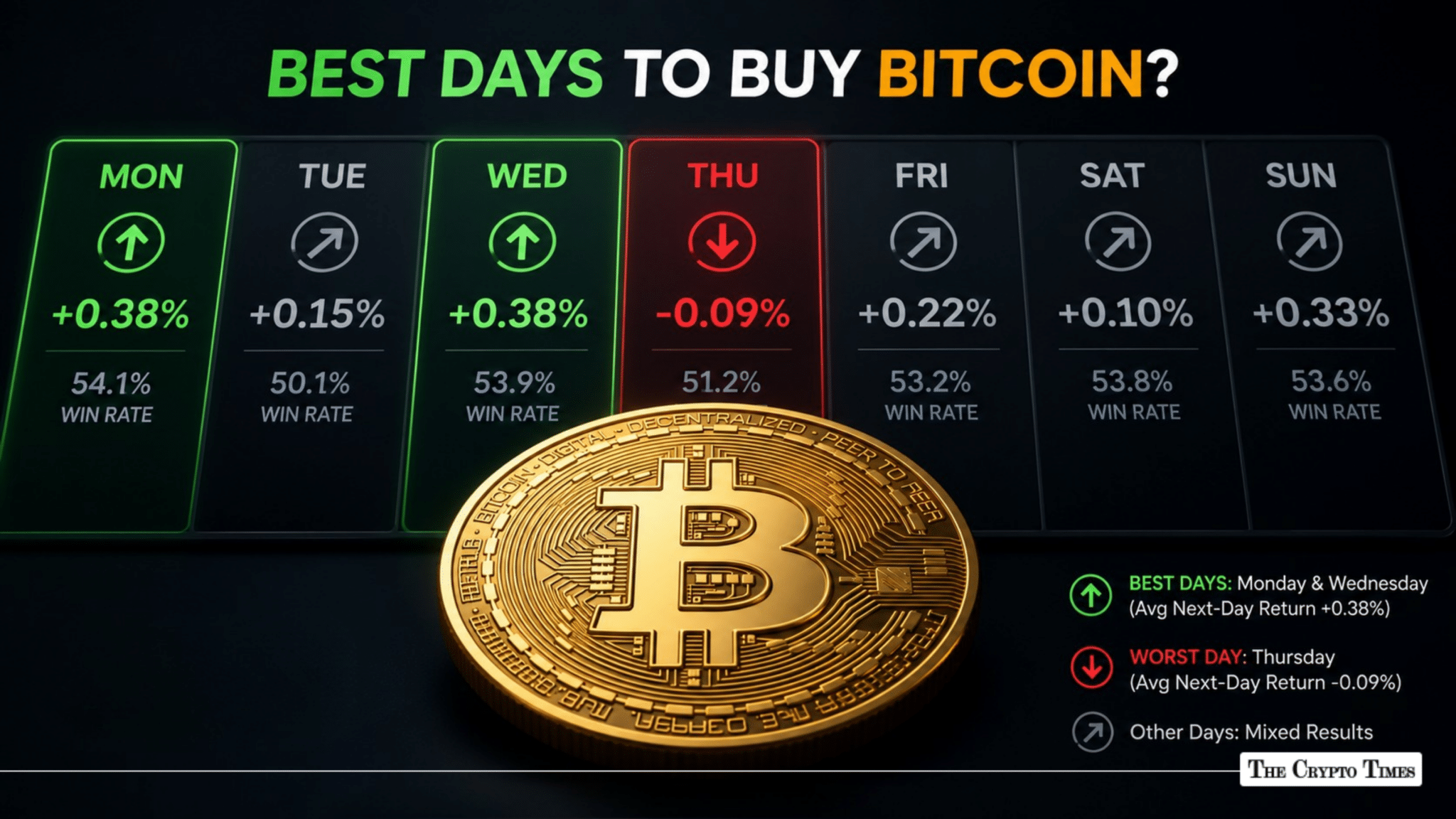
- Best weekdays (short term): Monday and Wednesday, tied at +0.38% average next-day return.
- Worst weekday: Thursday, the only day with a negative average at −0.09%.
- Strongest signal overall: US federal holidays at +0.77% vs +0.19% on normal days.
- The catch: Hold for a year and the day you bought on barely matters — every weekday lands within a 2.4-point band of annual return.
Everything below is the why, the caveats, and how to actually use it.
Finding 1: The “Holiday Effect” Is the Real Story
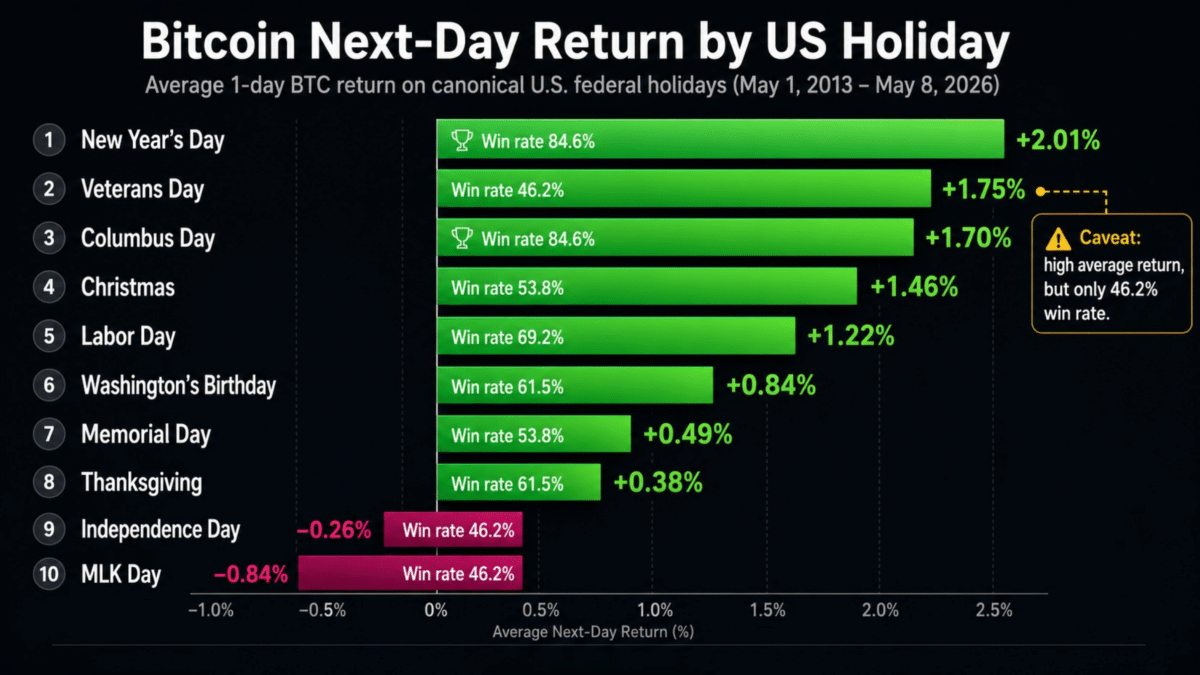
The most striking pattern in CoinGecko’s dataset isn’t weekday-related at all. Purchases made on US federal holidays averaged a +0.77% next-day return, against just +0.19% on non-holidays, and holidays beat non-holidays in 11 of the 14 calendar years in the study. That’s a genuinely surprising, rarely-reported edge.
But “holidays are better” hides a lot of variation. Some holidays were excellent. Others lost money. And at least one looks great until you check how the average was built.
| Holiday | Avg 1-Day Return | Win Rate | Verdict |
|---|---|---|---|
| New Year’s Day | +2.01% | 84.6% | Strongest and most reliable |
| Columbus Day | +1.70% | 84.6% | Strong and consistent |
| Christmas Day | +1.46% | 53.8% | Good average, coin-flip odds |
| Labor Day | +1.22% | 69.2% | Solid |
| Veterans Day | +1.75% | 46.2% | ⚠️ Misleading — see below |
| Independence Day | −0.26% | 46.2% | Weak |
| MLK Day | −0.84% | 46.2% | Weakest |
New Year’s Day is the standout. Bitcoin rose the next day in 11 out of 13 January 1st observations, an 84.6% win rate, even though the BTC price on that date swung from roughly $313 in 2015 to $93,507 in 2025. CoinGecko links this to the broader “January effect” seen in traditional markets, where fresh capital flows in at the start of the year and the December tax-loss-selling season ends, lifting risk assets.
Finding 2: Why You Can’t Trust the Average Alone
This is where most articles on this topic fall short, and where CoinGecko’s own analysis is refreshingly honest.
Veterans Day looks like a top-four holiday at +1.75%. It isn’t. Its win rate is only 46.2%, meaning Bitcoin fell more often than it rose the day after. The high average is propped up by just three enormous outliers (November 2014: +14.3%, November 2015: +10.4%, November 2024: +10.2%). Strip out those few days and the “edge” evaporates. For Veterans Day, the median and the win rate tell the truth; the mean lies.
The reverse happens with MLK Day. Its −0.84% average is dragged down by a single brutal day, which is January 15, 2018, when Bitcoin dropped −18.65% at the start of that year’s bear market. Yet even after accounting for that outlier, MLK Day remained the weakest holiday in the set.
The lesson generalises to every number in this article: a high average built on a handful of explosive days is not a strategy. Always read the win rate next to the average.
Finding 3: Monday and Wednesday Edge the Week — Barely
Now to the question everyone actually searches for. Across all seven days:
| Day | Avg 1-Day Return | Win Rate | Avg 365-Day Return |
|---|---|---|---|
| Monday | +0.38% | 54.1% | +142.15% |
| Tuesday | +0.15% | 50.1% | +143.16% |
| Wednesday | +0.38% | 53.9% | +142.57% |
| Thursday | −0.09% | 51.2% | +143.12% |
| Friday | +0.22% | 53.2% | +144.56% |
| Saturday | +0.10% | 53.8% | +144.20% |
| Sunday | +0.33% | 53.6% | +144.11% |
Monday and Wednesday share the top spot at +0.38%, with Sunday close behind at +0.33%. Thursday is the lone negative day. But notice the win rates: even the best day, Monday, was positive only 54.1% of the time. That’s a real but modest tilt, closer to a slightly weighted coin than a sure thing.
Finding 4: The Weekend “Effect” Doesn’t Exist for Bitcoin
In equities, the weekend matters because markets close — orders pile up, news accumulates, and Monday opens with a jolt. Bitcoin has no close, so that mechanism never fires.
The data confirms it: weekdays averaged +0.21% and weekends +0.22% — a one-hundredth-of-a-percent gap with no practical meaning. Saturday and Sunday behave like any ordinary weekday. If you’ve read that weekends are a secret discount window, this 13-year sample doesn’t support it.
Finding 5: Over a Year, the Day You Buy Stops Mattering
Here’s the most important chart for anyone who isn’t a day-trader. Stretch the holding period to 365 days and the weekday differences collapse: every day of the week lands between 142.15% and 144.56% average annual return — a spread of just 2.4 percentage points, trivial next to Bitcoin’s wild annual swings.
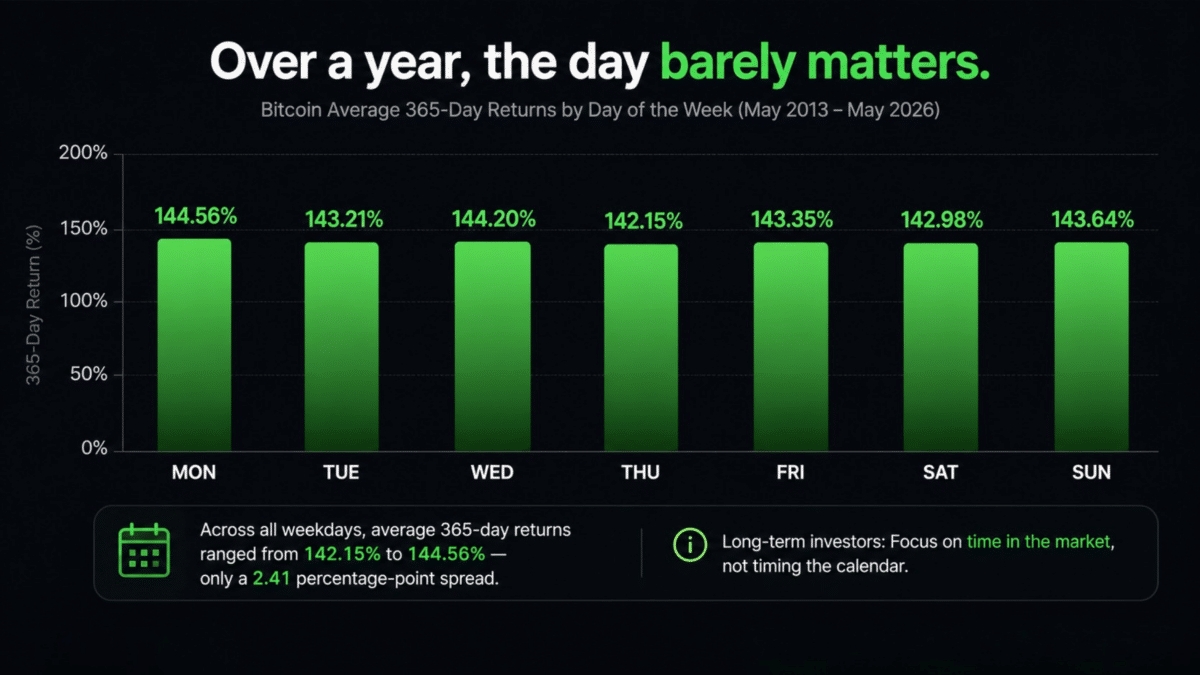
The holiday edge lingers a little longer (US holidays averaged 157.12% over a year versus 142.96% for non-holidays, a 14-point gap), but CoinGecko cautions against reading too much into it: at a one-year horizon, that gap mostly reflects whether a given holiday happened to fall in a bull or bear year — not any magic in the holiday itself. The genuine holiday signal lives in the next-day window, not the next-year one.
Translation: if you’re holding Bitcoin for a year or more, the day, week, or holiday you bought on is statistical noise.
Why Other “Best Day” Articles Disagree With Each Other
If you’ve searched this before, you’ve probably seen confident, and contradictory, answers. One widely-cited backtest crowns Monday at +0.51% (data since 2014). Another analysis names Saturday the winner (data since 2016). Several traders swear by Sunday evening. An older study from the 2011–2019 era declared Tuesday the champion.
They’re not all wrong — they’re all date-range-dependent. Change the start year, the snapshot time, or the market cycle, and the “best day” shifts. This is exactly why CoinGecko’s larger, more recent 4,753-day sample is useful, and also why nobody should treat any single weekday as a rule. The honest takeaway across every study is the same: the edge is small, unstable, and not worth reorganising your finances around.
What This Means in Practice
For most people, the useful response to “what’s the best day to buy Bitcoin?” is a strategy, not a weekday.
Dollar-cost averaging (DCA) is the approach the data quietly endorses. Coinbase describes it as investing a fixed amount on a regular schedule regardless of price — you buy more when prices are low and less when they’re high, which smooths out volatility and removes the pressure of timing the market. Because the 365-day data shows the entry day barely affects long-term outcomes, a disciplined recurring buy captures the long-term trend without the stress.
So:
- If you trade short-term: Monday, Wednesday, or an upcoming US holiday offered the best historical averages — but they’re averages, not promises.
- If you DCA weekly: Monday or Wednesday is a reasonable default, but pick the day that fits your pay cycle and stick to it. The consistency matters far more than the weekday.
- If you’re a long-term holder: Stop optimising the day. Time in the market beat timing of the market across this entire dataset.
A Word on Risk
None of this changes the fundamental nature of the asset. FINRA warns that crypto assets are risky and often extremely volatile, that prices can move up and down “dramatically and unpredictably,” and that the risk of losing your entire investment is significant. They’re also less liquid than stocks and bonds. Calendar patterns are a curiosity at the margins; position sizing, fees, tax, and only investing what you can afford to lose are what actually protect you.
This article is for information only and is not financial advice. Do your own research and consider speaking to a licensed financial professional before investing.
The Verdict
Based on CoinGecko’s 13-year dataset: Monday and Wednesday were the best weekdays for next-day returns, Thursday the worst, and US holidays, led by New Year’s Day, the strongest short-term signal of all. But the most valuable line in the whole study is the one about the one-year horizon: hold long enough, and the day you bought on disappears into the noise.
The best day to buy Bitcoin probably isn’t Monday, Wednesday, or New Year’s Day. It’s the day your plan tells you to buy — and the day you can actually stick with.
FAQs
What is the best day of the week to buy Bitcoin?
In CoinGecko’s 13-year study, Monday and Wednesday tied for the highest average next-day return at +0.38% each. The edge is real but small — even Monday was only positive 54.1% of the time.
What is the worst day to buy Bitcoin?
As per the data, Thursday. It was the only weekday with a negative average next-day return, at −0.09%.
Is it better to buy Bitcoin on the weekend?
No meaningful difference. Weekdays averaged +0.21% and weekends +0.22% — a 0.01-point gap with no practical significance, because Bitcoin trades 24/7 and never “closes.”
What is the holiday effect in Bitcoin?
Buying on a US federal holiday averaged a +0.77% next-day return versus +0.19% on normal days — about 4x higher. New Year’s Day was the strongest, up the following day in 11 of 13 years.
Does the best day to buy Bitcoin matter for long-term holders?
Barely. Over a 365-day holding period, every weekday’s average return clustered between 142.15% and 144.56% — a 2.4-point spread that’s negligible next to Bitcoin’s volatility.
Should I just dollar-cost average instead?
For most long-term investors, yes. The data shows the entry day has little effect on one-year outcomes, so a consistent recurring buy captures the trend without the stress of timing the market.
Also Read: Bitcoin Price History: From Inception to Future Predictions
Disclaimer:
Some elements of this content may have been enhanced with the help of our artificial intelligence (AI) assistants for purposes such as basic refinement, review, image generation, and translation to deliver high-quality news in a shorter time frame. However, all AI-assisted content is reviewed and approved by our team to ensure accuracy, fairness, and editorial integrity.