The digital asset market has always been a financial rollercoaster, but June 2026 will be remembered as a month where the tracks gave way entirely. Investors often look to crypto-related stocks as a safer, regulated way to gain exposure to the digital asset economy without directly holding cryptocurrencies.
But this month, that strategy offered little shelter. Instead, a combination of falling crypto prices, shifting macroeconomic conditions, and shrinking trading volumes triggered a broad sector-wide sell-off.
By the final week of June, both industry heavyweights and smaller players were facing double-digit losses. If May was a warning sign of market cooling, June brought a full-scale downturn.
Below is a look at how major crypto-linked stocks, Coinbase (COIN), Strategy Inc (MSTR), Circle Internet Group (CRCL), IREN Ltd (IREN), Bitmine Immersion Technologies (BMNR), American Bitcoin Corp (ABTC), CleanSpark (CLSK), and MARA Holdings (MARA), performed during the month, based on the latest market feeds.
The crypto backdrop: Bitcoin breaks the floor
To understand why crypto equities collapsed in June, it is important to look at Bitcoin. The digital asset market entered the month attempting to stabilize, but several negative factors quickly weighed on sentiment. A rotation away from speculative technology investments, continued outflows from spot Bitcoin ETFs, and regulatory uncertainty collectively reduced investor appetite.
The turning point came in late June, when Bitcoin fell below the key $60,000 support level and briefly touched nearly $58,000-$59000, its lowest level in nearly 21 months. Ethereum also fell below $1,600 and was trading near $1,582 by late June, down roughly 23% for the month.
Crypto-related equities often amplify Bitcoin’s movements, meaning that when Bitcoin declines, these stocks typically fall even further.
Coinbase (COIN): The trading floor empties out
As the largest publicly traded cryptocurrency exchange in the United States, Coinbase’s revenue is closely tied to trading activity. When investors actively buy and sell digital assets, Coinbase benefits from higher transaction fees. During periods of lower activity, revenue tends to decline.
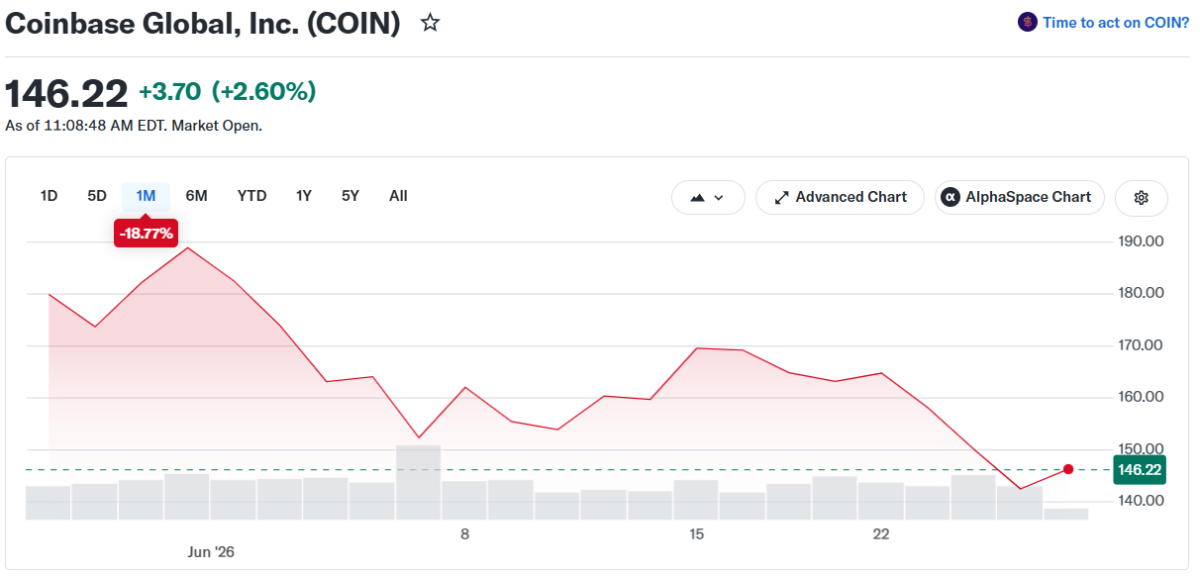
Coinbase started June with elevated volatility and briefly attempted to rally. However, the stock entered a steady decline as institutional ETF demand weakened. A mid-month recovery attempt faded after Bitcoin broke below key support.
The pressure came on top of a challenging Q1 2026, in which the company posted a net loss of $394 million and subsequently cut 14% of its workforce, approximately 660 employees, in May. Despite launching a wave of new products under its “Everything Exchange” strategy and completing a $2.9 billion acquisition of derivatives exchange Deribit on June 25, the stock continued to slide.
By late June, COIN had fallen to around $140 before recovering slightly to trade around $146.22. The stock declined approximately 18.77% during the month, reflecting weaker trading activity and reduced market participation.
Strategy Inc (MSTR): The ultimate Bitcoin proxy takes a hit
No publicly traded company is more closely tied to Bitcoin than Strategy Inc. Through its aggressive treasury strategy, the company has effectively transformed itself into a leveraged Bitcoin investment vehicle. While that approach has benefited shareholders during bull markets, it has also increased downside risk during market declines.
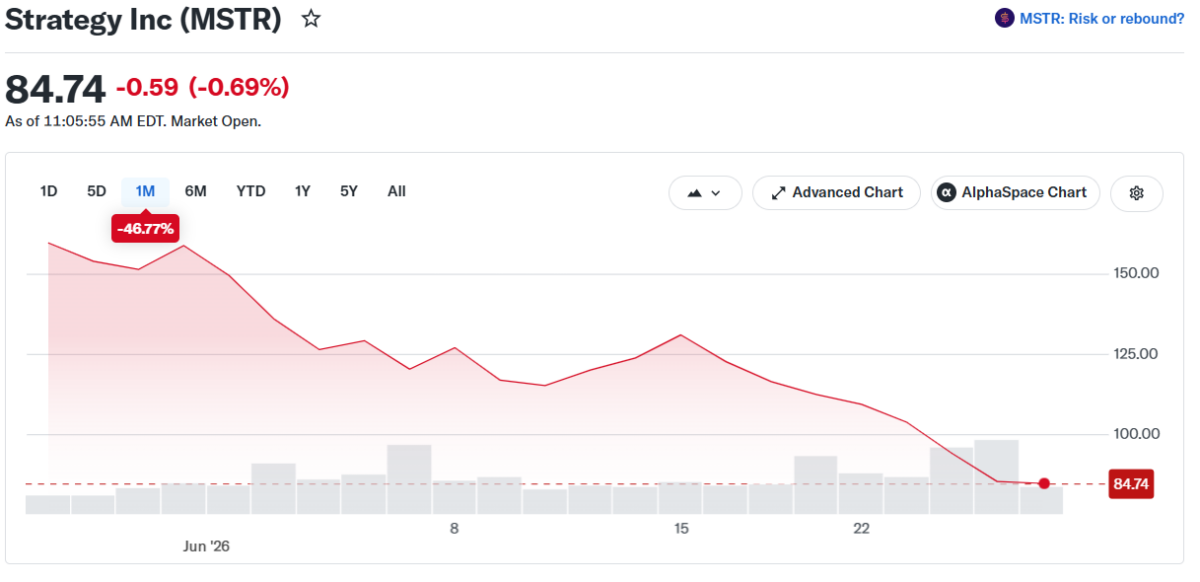
Strategy’s chart for June resembled a steep decline rather than a gradual correction. After opening the month with moderate volatility, the stock came under increasing pressure as Bitcoin weakened throughout June. The sharpest losses occurred during the final week of the month.
Compounding the damage, the company’s STRC preferred stock, a key instrument used to fund ongoing Bitcoin purchases, crashed to an all-time low of approximately $74, well below its $100 par value. Annual dividend obligations on its preferred instruments have surged from roughly $300 million at the start of 2026 to approximately $1.2 billion, while cash reserves fell 38% over the same period.
On-chain analytics firm CryptoQuant urged the company to pause Bitcoin purchases and rebuild its cash reserves, warning that dividend coverage has collapsed from over seven years to approximately 14 months. In a symbolic break from its long-held “never sell” philosophy, Strategy disclosed the sale of a small amount of Bitcoin to fund preferred stock distributions, further rattling investor confidence.
By June 26, MSTR had fallen 46.77% for the month to around $84.74, making it the worst-performing stock in this group. The company holds approximately 847,363 BTC, now sitting on an estimated $13–14 billion in unrealized losses.
Circle Internet Group (CRCL): Stablecoin headwinds
Circle, the issuer of the USDC stablecoin, faced a different set of challenges. Although stablecoins are designed to maintain a stable value, investors evaluate companies like Circle based on capital efficiency, reserve income, transaction volume, and long-term growth prospects.
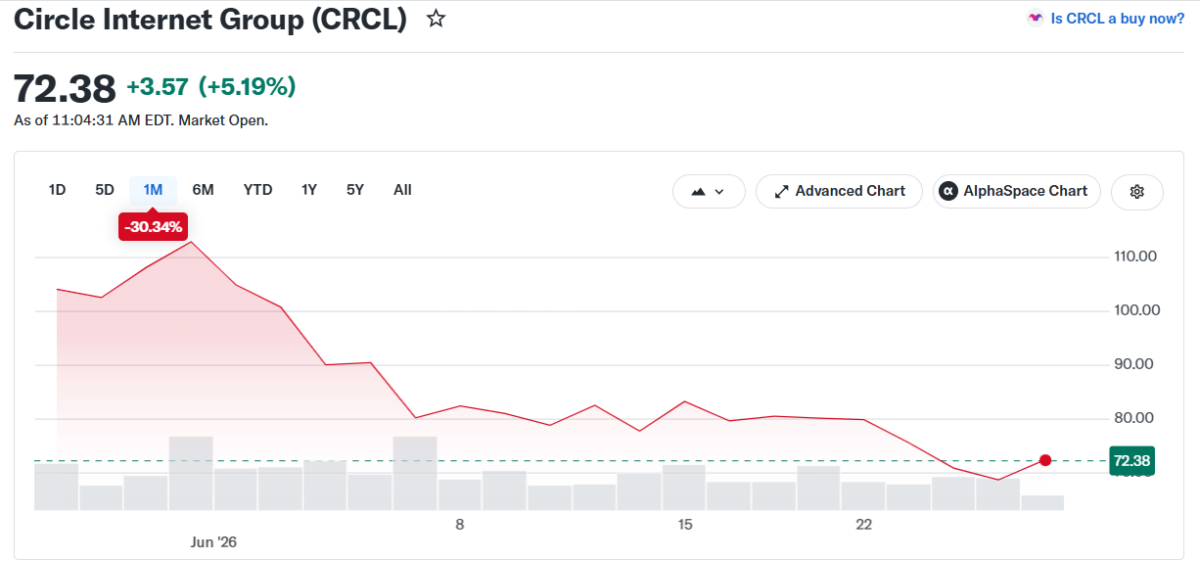
Circle entered June amid declining activity across the broader crypto ecosystem as capital shifted toward traditional financial assets such as government bonds. Reduced activity across DeFi also lowered stablecoin transaction volumes. Investors subsequently revised their growth projections for the company, sending CRCL down 30.34% during the month to $72.38.
The infrastructure squeeze: IREN, BMNR, and ABTC
Bitcoin miners and infrastructure providers face a unique challenge because they operate capital-intensive businesses with high fixed costs, including electricity, specialized mining hardware, and facility maintenance. When Bitcoin prices decline while operating costs remain relatively unchanged, profit margins become increasingly compressed.
IREN Limited (IREN)
IREN has sought to diversify beyond Bitcoin mining by expanding into AI-focused high-performance computing infrastructure. However, that strategy provided only limited protection from broader market weakness.
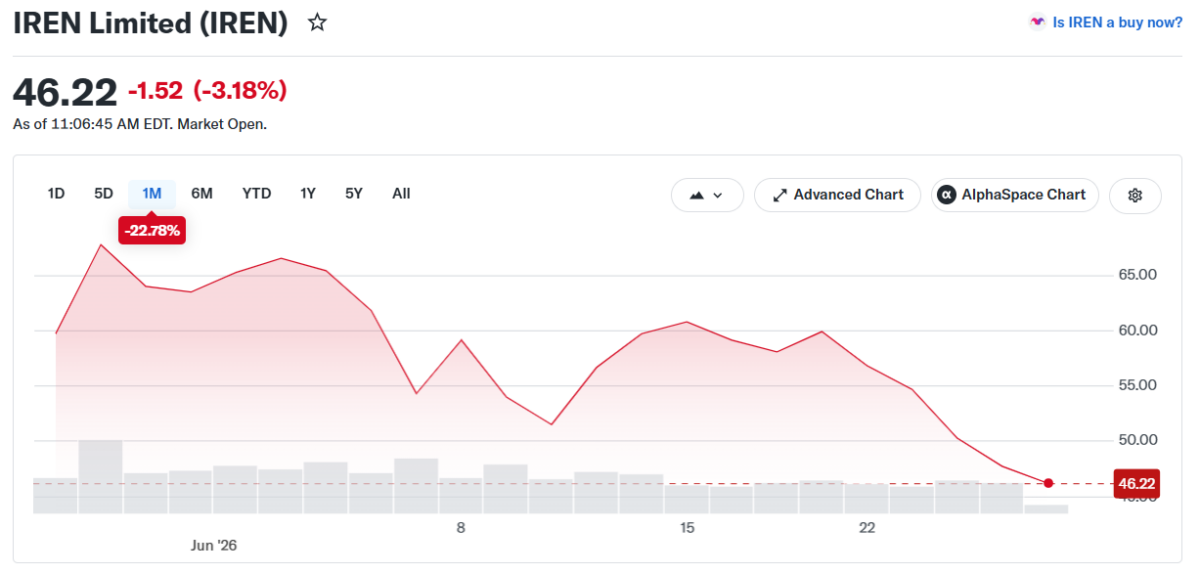
The stock reached an early-month high before broader market pressures took hold. Although IREN recovered somewhat during the middle of June, the late-month sell-off pushed the shares down 22.78%, leaving them near $46.22.
Bitmine Immersion Technologies (BMNR)
Smaller infrastructure companies, such as Ethereum-focused treasury firm Bitmine, faced even greater pressure because they generally have fewer financial resources to withstand prolonged market weakness.
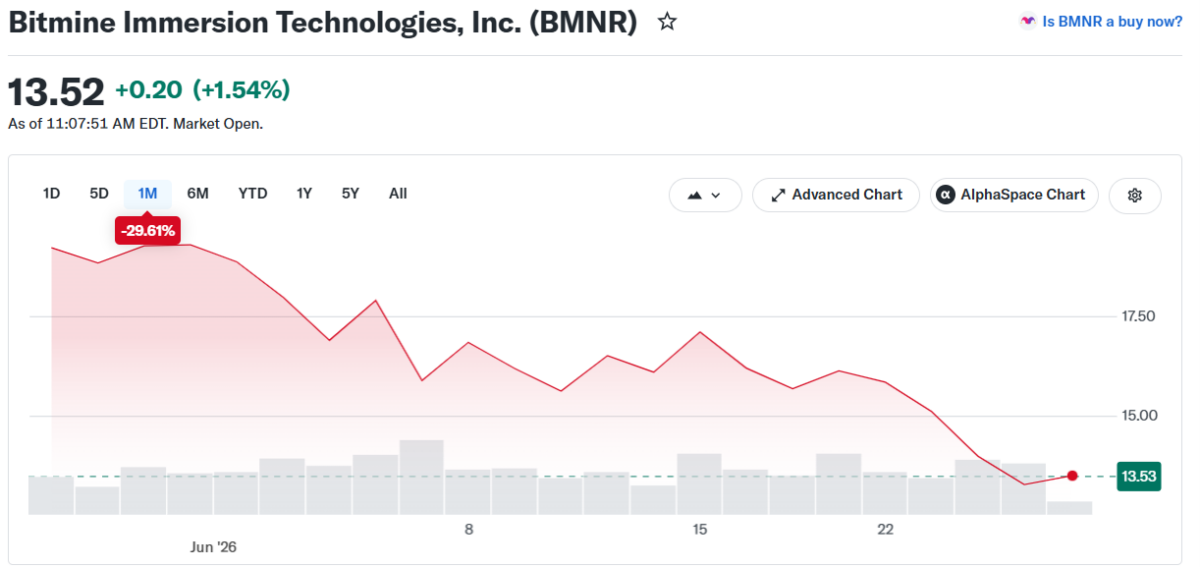
Bitmine attempted to strengthen its balance sheet early in the month by pricing an upsized preferred stock offering. While the move raised additional capital, it also increased concerns about shareholder dilution. Against a backdrop of declining Ethereum prices, BMNR fell steadily throughout June, ending the month down 29.61% at approximately $13.52.
American Bitcoin Corp (ABTC)
American Bitcoin Corp. also came under significant pressure as mining-sector sentiment deteriorated. Compounding investor concerns, shareholders approved a 1-for-15 reverse stock split late in the month to maintain listing requirements.
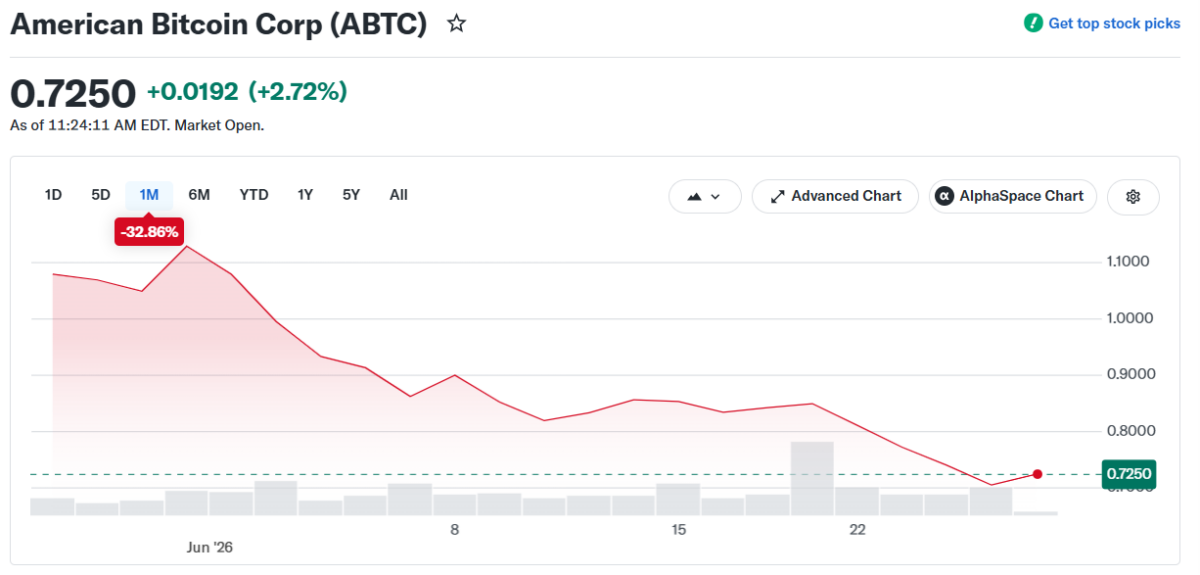
ABTC declined throughout June, falling to approximately $0.72 by June 26. The stock finished the month down 32.86%.
Relative resilience: CleanSpark and MARA Holdings
While smaller mining companies and highly leveraged firms experienced steep declines, two larger miners showed comparatively stronger performance.
CleanSpark Inc. (CLSK)
CleanSpark managed to absorb the market shock relatively well compared to its infrastructure peers. By leaning on efficient mining facilities and proactive energy contracts, the company avoided the 20%+ drawdowns that plagued the rest of the industry.
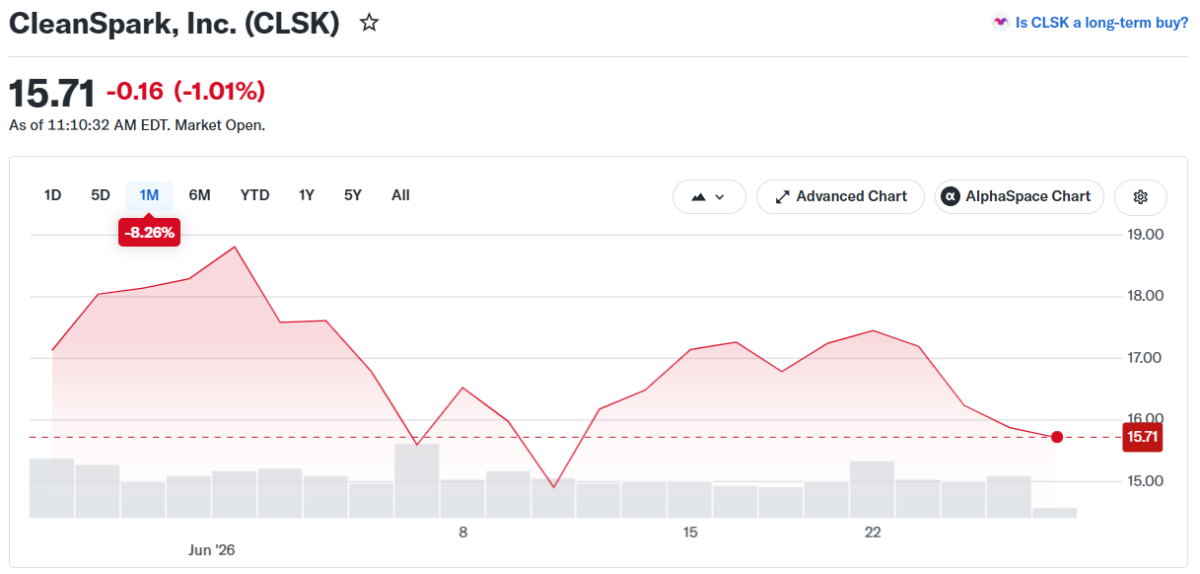
CLSK did take a hit as the market turned red, but its drop was contained to a single-digit 8.26%. Currently trading at $15.71, CleanSpark highlighted that operational efficiency acts as an important buffer during a broader market storm.
MARA Holdings Inc. (MARA)
As one of the largest publicly traded Bitcoin mining companies, MARA showed greater resilience than many competitors.
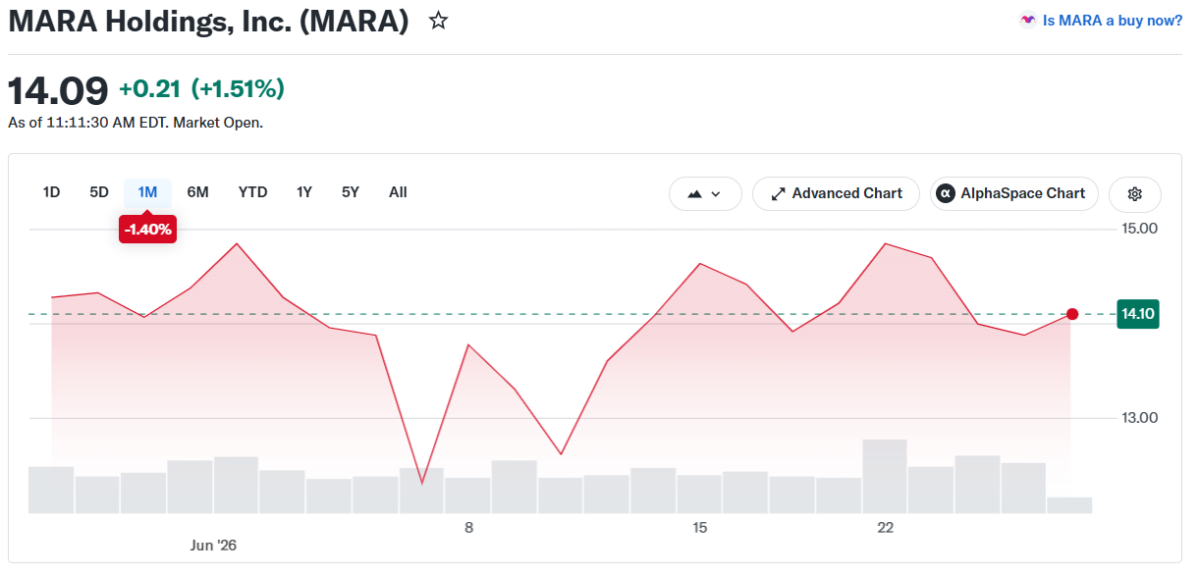
While other stocks were shedding up to nearly half their value, MARA remained virtually unchanged, closing down a mere 1.40% at $14.09. The company’s deep liquidity and substantial holdings of mined Bitcoin gave institutional investors the confidence to hold their ground, avoiding the panic selling seen elsewhere.
Performance summary
The data across the board highlights just how tightly connected these equity valuations are to the general health of the digital asset market:
| Stock Ticker | Late-June Trading Price | Verified June Decline | Primary Market Trigger |
|---|---|---|---|
| Strategy (MSTR) | $84.74 | -46.77% | Direct exposure to Bitcoin, balance sheet losses, STRC stock crisis |
| American Bitcoin (ABTC) | $0.72 | -32.86% | Dilution fears, weak mining yields, reverse split vote |
| Circle (CRCL) | $72.38 | -30.34% | Compressed stablecoin volume and DeFi slowdown |
| Bitmine (BMNR) | $13.52 | -29.61% | Liquidity pressures and sector-wide risk aversion |
| IREN (IREN) | $46.22 | -22.78% | Margin compression on hardware and energy overhead |
| Coinbase (COIN) | $146.22 | -18.77% | Sharp decline in retail and institutional trading fees |
| CleanSpark (CLSK) | $15.71 | -8.26% | General industry downturn balanced by fleet efficiency |
| MARA Holdings (MARA) | $14.09 | -1.40% | Large-scale liquidity cushion and corporate stability |
What does this mean for the summer?
June’s sell-off highlights how closely crypto-related equities remain tied to the broader digital asset market. For these companies to recover meaningfully during the third quarter, Bitcoin would likely need to regain support above $60,000, ETF flows would need to stabilize, and macroeconomic uncertainty surrounding interest rates would have to ease.
Until then, crypto-related equities are likely to remain highly sensitive to movements in the broader digital asset market. Whether June proves to be a short-lived correction or the beginning of a longer crypto-equity bear phase will likely depend on Bitcoin’s ability to recover, renewed ETF demand, and a clearer outlook for U.S. monetary policy.
Also Read: STRC Drops 19% Below Par: Was Peter Schiff Right About Saylor Deceiving Investors?
Disclaimer:
Some elements of this content may have been enhanced with the help of our artificial intelligence (AI) assistants for purposes such as basic refinement, review, image generation, and translation to deliver high-quality news in a shorter time frame. However, all AI-assisted content is reviewed and approved by our team to ensure accuracy, fairness, and editorial integrity.